
Tea Knowledge
Should You Rinse Tea Leaves? A Gentle Guide to the First Infusion

Keeping the first cup can be a simple beginning. Give the leaves, the vessel and the moment a little attention, and the next choice becomes quite simple.
You do not need to rinse tea leaves every time. A very brief rinse can warm a vessel, begin opening tightly rolled leaves or change the character of a first cup; it is not a dependable way to remove pesticide residues or sterilise tea. Tea bags and straightforward pot brewing can usually begin with the first infusion. When tea comes from a source you trust, its package is intact, and the dry leaves look and smell normal, keep or discard that cup for brewing preference. If leaves are damp, mouldy, musty, oddly scented or in damaged packaging, stop using them and ask the seller; extra hot water or extra rinsing is not a remedy.
“Throw away the first infusion” can sound like a rule handed down with the kettle. It is kinder to ask what the action is meant to do. Are you warming a cup, helping a compact oolong unfurl, or simply deciding what you enjoy in the first pour? Our basic brewing guide covers the wider setup; this guide keeps the first-infusion decision calm and clear.
Why rinse tea leaves? Separate the purposes first
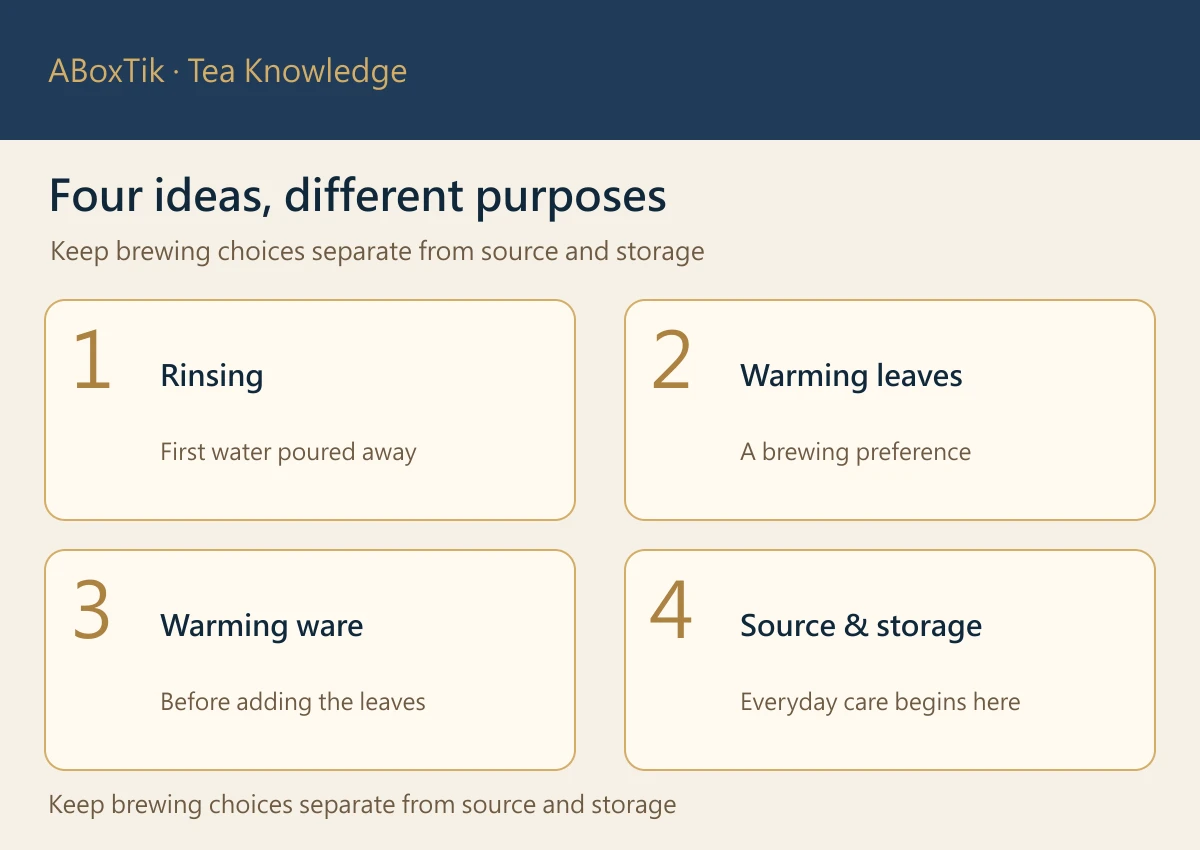
The word “rinse” gathers several different actions under one name. Taiwan’s Ministry of Agriculture explained in a 2015 FAQ that an overflow or warming infusion can be used in tea presentation or evaluation to bring out character sooner and remove surface foam. It also noted that tea bags and large-pot brewing do not require this as a standard step. That is a brewing context, not a compulsory opening move for every tea.
| Purpose | A practical choice | What it cannot establish |
|---|---|---|
| Brief leaf rinse | Give tightly rolled leaves a very short contact with water, then begin the planned brew. | This does not establish: That the tea has been made safe. |
| Warming a vessel | Warm the pot or cups only within their heat limits and maker guidance, then pour that water away. | This does not establish: A hygiene verdict about the dry leaves. |
| Adjusting the first cup | Keep or discard it according to the tea, the instructions and your preference. | This does not establish: That a first infusion is automatically inferior. |
| Source and storage | Choose identifiable sources, intact packs and dry storage. | This does not establish: That a suspicious tea can be fixed at home. |
If timing is the uncertainty, begin with our Taiwan tea steeping-time guide. The gaiwan and teapot comparison and pot-brewing guide can help keep warming, pouring and leaf contact in their proper places. A tea table does not need more ceremony than the cup asks for.
A first rinse is not a pesticide or hygiene control
Discarding the first infusion should not be presented as a reliable pesticide-removal method. The same 2015 Ministry FAQ says that the way residues extract into liquor and distribute across successive infusions is complex, with no settled conclusion that they concentrate in the first infusion. Its pesticide discussion is historical, so it is not a current list of permitted products or a policy guide. The useful present-day conclusion is modest: first-cup preference is not a safety guarantee.
Hygiene begins long before a kettle is filled. The Tea and Beverage Research Station’s factory-hygiene guidance covers the condition of the site, workers, equipment cleaning, production records and keeping finished tea dry. At home, the corresponding useful habits are to notice the tea’s source, keep packs sealed and dry, and respect product instructions. Our tea storage guide and introduction to Taiwanese tea craft offer helpful context.
Damp leaves, visible mould, a musty or unfamiliar unpleasant odour, and damaged packaging belong in a different decision path. Set the tea aside, retain the pack and batch details, and contact the seller about handling or traceability. Do not try to make the tea acceptable by increasing the temperature, time or number of rinses.
Four everyday situations: keep, rinse briefly, or stop
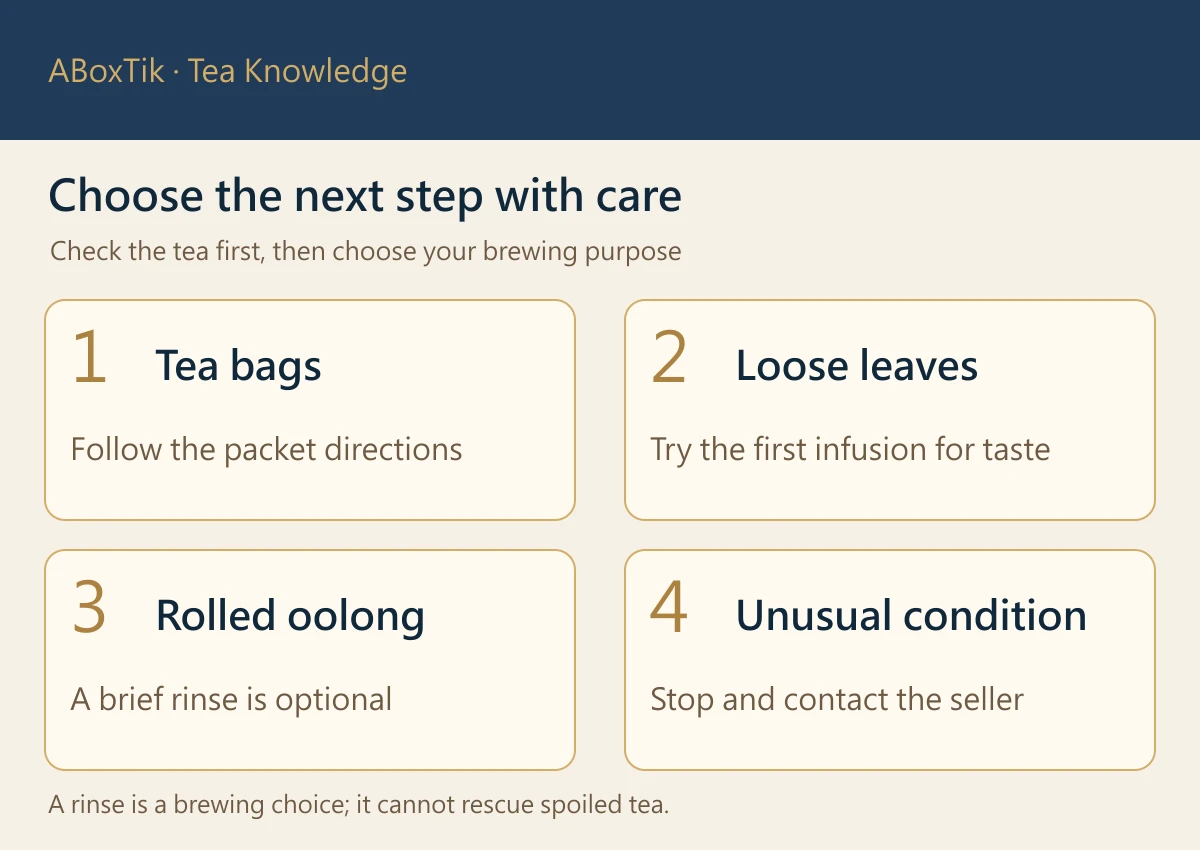
These flavour choices assume tea with a normal condition from a source you trust. A first-infusion preference does not replace attention to source, packaging or storage.
Tea bags: use the water amount and contact time on the packet, then end leaf contact by removing the bag. A separate “wash” is unnecessary. The whole-leaf tea-bag guide and pyramid tea-bag introduction explain formats without turning them into one universal recipe.
Everyday loose leaf: begin with the packet’s method and taste the first cup. If it is stronger than welcome, make the next fresh brew with the same batch and change only time or leaf quantity. Explore oolong water temperature only after the timing has a stable starting point.
Tightly rolled oolong: a short leaf-warming rinse can be a pleasant choice if you want the leaves to begin opening before the planned infusion. Direct brewing is equally reasonable; observe the opening leaves and cup instead of assuming a correct ritual. Our rolling and leaf-unfurling guide gives that observation some context.
An abnormal-looking or -smelling tea: this is not a “rinse longer” situation. Do not drink it. Keep relevant package information and ask the seller about the batch.
Compare a rinse with fresh leaves from the same batch
A quiet comparison can show whether a brief rinse actually suits a particular tea. Prepare two equal, fresh portions from the same batch. Keep leaf weight, water volume and source, temperature and vessel the same. Brew the first portion directly. Give the second the short rinse you would normally choose, then make its planned brew. Write down aroma, strength and the feeling of the first cup.
Do not compare a second infusion of already-brewed leaves with a fresh first brew. The leaves have already changed, so that comparison cannot isolate the rinse. This small method is not a laboratory test; it is a fairer household way to choose the flavour direction you prefer.
- Record the starting point: tea, leaf amount, water, vessel and time.
- Change one thing: the brief rinse, not the water temperature and time together.
- Describe rather than score: a note such as “more open aroma; softer first cup” is enough.
- Choose the next step: use the comfortable recipe, then add vocabulary through our tea-aroma observation guide or organise a relaxed session with the Taiwan tea-table guide.
Questions about foam, oolong and the first infusion
Does foam mean I should discard the first cup?
No. Foam alone does not give a safety answer. Decide whether to keep the cup according to your brewing purpose and preference, and keep storage/source questions separate.
Does every oolong need a rinse?
No. Tightly rolled leaves can make a very short rinse appealing, but direct brewing is also valid. Start with the package and the cup in front of you.
May I still discard the first infusion because I like the ritual?
Yes. Describe it as a flavour or table preference. It does not need to become a claim about pesticide removal, disinfection or guaranteed quality.
Share a cup with ABoxTik
Let the first infusion be a comfortable choice
The practical answer is to give flavour and hygiene different responsibilities. Choose the first cup by leaf form, vessel and preference; treat source, storage and unusual condition as separate concerns. ABoxTik’s Classic Taiwanese Tea four-box set offers several packet-guided cups for practising that calm start. Continue with the ABoxTik story when you would like to know the people and ideas behind the table.
Sources
Editorial sources accessed 8 October 2026.