
Tea, Tea Knowledge
Taiwan Tea Regions: From Northern Hills to the Central Mountains
A mountain gives tea more than elevation: it gives mist time to linger, soil a rhythm of its own, and makers a season they must learn to read.
Taiwan tea regions should never be judged by elevation alone. The northern hills are known for Pouchong, green tea, and Oriental Beauty; central Taiwan produces high mountain oolong, Dong Ding oolong, and Sun Moon Lake black tea; Greater Alishan anchors the south; and the eastern valleys are associated with honey-scented teas and Red Oolong. To understand a tea, read its origin together with its cultivar, harvest, processing, and producer information.
If this is your first introduction to the island’s teas, begin with seven qualities that make Taiwanese tea distinctive. This guide takes the next step: what can a place name genuinely tell us, and what should we never assume from the name of a famous mountain?
Why elevation alone cannot explain Taiwanese tea
Origin is a useful starting point, not a certificate of quality. Temperature, rainfall, mist, slope, and soil influence how a tea plant grows. Cultivar gives the fresh leaf its underlying character. Withering, tossing, oxidation, rolling, and roasting then transform that leaf into the tea in your cup. Two teas from the same mountain can therefore differ because they came from different villages, seasons, gardens, or makers.
This is why “higher is always better” is an unreliable buying rule. Wenshan Pouchong, Sanxia Biluochun, Oriental Beauty, Dong Ding oolong, and Sun Moon Lake black tea became important in very different landscapes. For a focused explanation of altitude and terminology, see our guide to Taiwan high mountain tea.
Reading an origin label is not a search for the most prestigious mountain. It is a way to find the cultivar, season, and craft behind a tea.
Taiwan tea regions at a glance
| Area | Representative places | Common specialty teas | What to check next |
|---|---|---|---|
| North | Wenshan, Sanxia, Shiding, Taoyuan, Hsinchu, Miaoli | Wenshan Pouchong, Biluochun, Tieguanyin, Oriental Beauty | Cultivar, leaf shape, and degree of oxidation |
| Central | Lishan, Ren’ai, Zhushan, Lugu, Mingjian, Yuchi | High mountain oolong, Shanlinxi tea, Dong Ding oolong, Sun Moon Lake black tea | Roast, season, producer, and actual origin—not elevation alone |
| South | Meishan, Zhuqi, Fanlu, Alishan | Alishan high mountain tea | Township or village, cultivar, harvest, and maker |
| East | Ruisui in Hualien, Luye in Taitung, and nearby areas | Honey-scented tea and Red Oolong | Tea category, leafhopper conditions, and processing description |
This table is a map, not a flavor guarantee. Taiwan’s Tea and Beverage Research Station explains that the island’s specialty teas developed through the combined influence of climate and land, cultivated varieties, and processing methods. A region can be strongly associated with a tea style without being its only possible home.
Northern hills: distinctive teas without the highest elevations
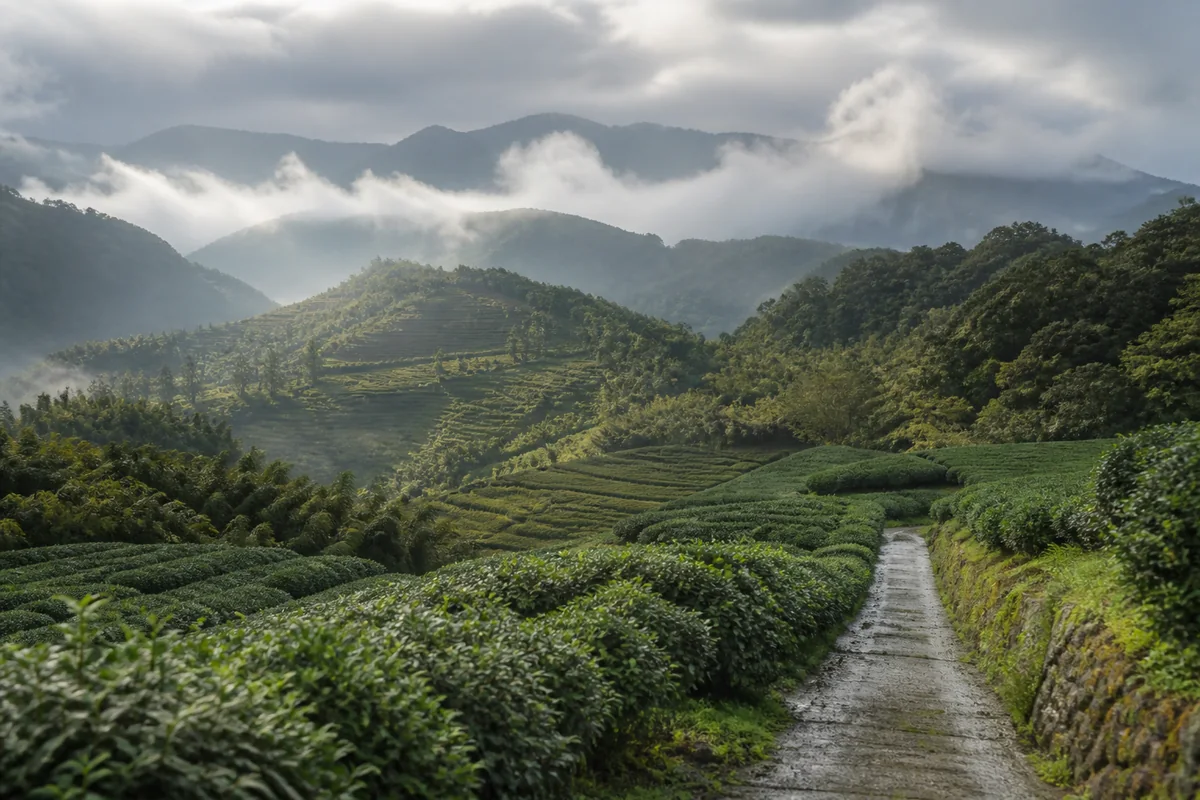
Northern production stretches from the Wenshan and Sanxia districts around New Taipei City to Shiding, Taoyuan, Hsinchu, and Miaoli. Wenshan’s humid, temperate hills support the fragrant, twisted-leaf style of Pouchong. Sanxia is especially associated with pan-fired green tea. Readers who want to understand the light, floral side of northern Taiwanese tea can continue with our introduction to Wenshan Pouchong.
The Taoyuan–Hsinchu–Miaoli hills are also central to the story of Oriental Beauty. Origin is only one part of its identity: suitable cultivars, summer harvesting, tea green leafhopper activity, and relatively high oxidation all matter. A label that merely says “honey aroma” does not prove that a tea is Oriental Beauty. Our Oriental Beauty guide explains the tea’s form, production, and characteristic profile in more detail.
Central mountains: more than high mountain oolong
Lishan in Taichung and the mountain districts of Ren’ai and Zhushan in Nantou are major sources of high mountain oolong. Cooler conditions can slow growth, but cultivar, picking date, and processing decisions still shape the finished tea. Compare the origin and brewing characteristics of Lishan tea with our broader high mountain tea selection guide rather than treating altitude as a score.
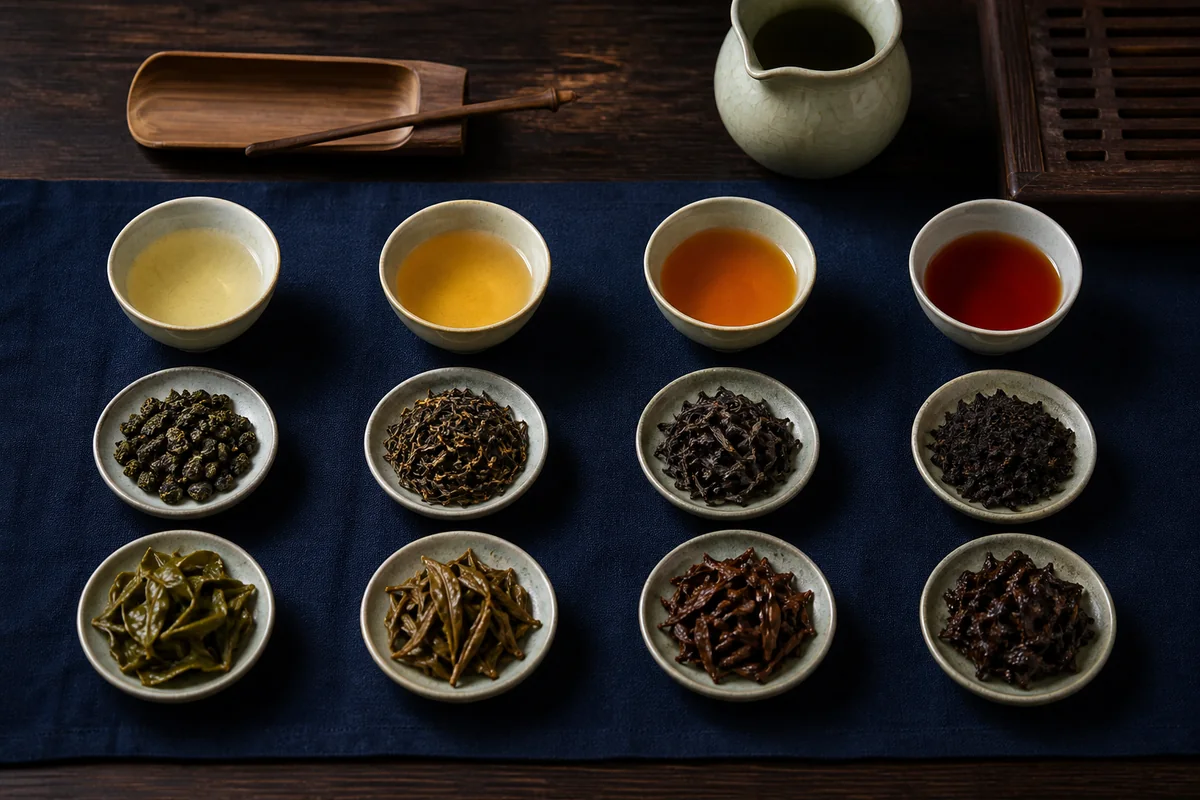
Central Taiwan is not limited to pale, lightly oxidized mountain oolong. Lugu’s Dong Ding oolong is known for a tradition of more pronounced oxidation and roasting. Yuchi and Puli are important to Sun Moon Lake black tea, where cultivars such as Taiwan Tea No. 8, No. 18, and No. 21 are used. These examples reveal the more useful question behind Taiwan tea regions: not only “How high is the garden?” but also “What kind of tea has this community learned to make well?” Our article on Taiwan’s competition teas offers another view of local craft and evaluation.
Greater Alishan: one name, several tea communities
Greater Alishan is not a single peak or garden. The official regional description includes Meishan, Zhuqi, Fanlu, and Alishan townships in Chiayi County. Chin-shin oolong and Taiwan Tea No. 12 are among the commonly planted cultivars, often made as tightly rolled, partially oxidized tea. When a package says “Alishan high mountain tea,” the village, cultivar, season, and producer provide a far more precise picture than the regional name alone.
That distinction also keeps this guide separate from our existing high mountain articles. We are not arranging tea districts into a prestige ladder. We are showing readers how to verify an origin claim and use it as one part of a buying decision. For a broad overview, see our guide to ten representative Taiwanese teas. To understand rarity and value without relying on a famous place name, read the five indicators of a rare tea.
Eastern valleys: how honey aroma and Red Oolong became local signatures
Ruisui in Hualien and Luye in Taitung are often associated with honey-scented tea and Red Oolong. Red Oolong is an oolong processing style with relatively high oxidation and roasting; it is not a simple mixture of black tea and oolong. A genuine honey-aroma description should likewise be connected to leafhopper activity, garden management, and processing—not applied to every tea that reminds a drinker of honey.
ABoxTik’s Classic Taiwanese Tea collection guide presents Ying Xiang oolong, Tsui Yu oolong, winter Four Seasons Spring, Jin Xuan oolong, honey-scented Red Oolong, and Dong Ding oolong in one practical tasting context. All are Taiwanese teas, yet their cultivars and processing choices create several different expressions of “Taiwan flavor.”
How to read a Taiwan tea origin label
- Look at the level of detail. Does the package say only “Taiwan,” or does it identify a county, township, tea district, garden, or producer? More detail improves traceability, although a precise name is not a quality grade.
- Find the cultivar. Chin-shin oolong, Taiwan Tea No. 12, and Taiwan Tea No. 18 tell you more about the raw material than a broad phrase such as “mountain tea.”
- Identify the tea and process. Twisted or rolled, green or oolong, lightly fragrant or roasted—these choices directly influence the result in the cup.
- Check harvest and production information. Season, lot, maker, and packer make it easier to compare teas from the same region.
- Verify traceability marks. Geographic origin certifications, traceability systems, and other official identifiers can help, but their scope should be checked in the issuing authority’s system.
Taiwan’s official tea-origin certifications include Lugu Dong Ding Oolong, Alishan High Mountain Tea, Wenshan Pouchong, Shanlinxi Tea, Sun Moon Lake Black Tea, Taitung Red Oolong, and Lishan Tea, among others. These marks protect and clarify origin claims. They do not mean that every certified batch tastes identical, and they never replace sensory evaluation.
Choose by flavor direction, not by the highest mountain
| If you enjoy | Start with | Compare next |
|---|---|---|
| Fresh floral aromas and a lighter body | Wenshan Pouchong or lightly processed high mountain oolong | Cultivar, season, and withering style |
| Roasted aromas and a fuller liquor | Dong Ding oolong or Tieguanyin | Roast level and storage condition |
| Honey, ripe fruit, and sweet-aroma associations | Oriental Beauty, honey-scented black tea, or honey-scented Red Oolong | Tea category, origin, and leafhopper conditions |
| Black tea aroma for unblended drinking | Sun Moon Lake black tea | Taiwan Tea No. 8, No. 18, No. 21, and production lot |
ABoxTik treats “100% Taiwan tea” as a traceable starting point, then asks whether a tea clearly communicates its cultivar, style, and drinking occasion. We do not use high elevation as the only definition of premium tea. To compare several Taiwanese oolongs, build a selection in the Classic Taiwanese Tea gift box. For flexible gifting, consider the two-box tea bag gift set or the four-box premium Taiwan tea set. Current availability and combinations should always be confirmed on the product page.
Frequently asked questions about Taiwan tea origins
Is tea from a higher elevation always better?
No. Elevation changes growing conditions, but quality also depends on cultivar, garden management, picking maturity, processing, and storage. Pouchong, Oriental Beauty, Dong Ding oolong, and Sun Moon Lake black tea are reminders that representative Taiwanese teas do not come only from the highest gardens.
Is Alishan tea a tea-plant cultivar?
No. Alishan is an origin name. Farmers there may grow Chin-shin oolong, Taiwan Tea No. 12, and other cultivars, then use particular processes to make high mountain oolong. Region, cultivar, and processing should be read separately.
Is a package labeled “Taiwan tea” enough?
It tells you the country of origin, but a careful buyer can look further for the region, producer, cultivar, lot, and traceability information. Detailed, verifiable information is more useful than luxurious adjectives.
Which region should a beginner try first?
Begin with flavor rather than fame. Select one fresh floral tea, one roasted oolong, one honey-scented tea, and one black tea. That comparison builds a personal taste map more effectively than memorizing every mountain name.

Follow ABoxTik
Begin with a place, then discover a box of Taiwan
A tea mountain is never merely a name. It connects rain, cultivar, and the maker’s judgment with the way a piece of Taiwan is shared. Learning about Taiwan tea regions is not an invitation to chase the most expensive address. It is a way to ask better questions and find a tea that suits you—and that you can give with confidence.
ABoxTik presents Taiwan’s quality through understandable knowledge, careful selection, and thoughtful packaging. Continue with the origin and selection philosophy of ABoxTik, or explore how limited-edition tea boxes bring Taiwanese tea and craft together.
Sources
- Taiwan Tea and Beverage Research Station: Characteristics of Central and Southern Tea Regions (accessed 2026-08-20)
- Taiwan Tea and Beverage Research Station: Classification and Processing of Taiwanese Specialty Teas (accessed 2026-08-20)
- Taiwan Tea and Beverage Research Station: Tea Origin Certification Marks (accessed 2026-08-20)