
Tea Knowledge
Why Is Oolong Tea Tossing Important? Floral Aroma and Red Leaf Edges
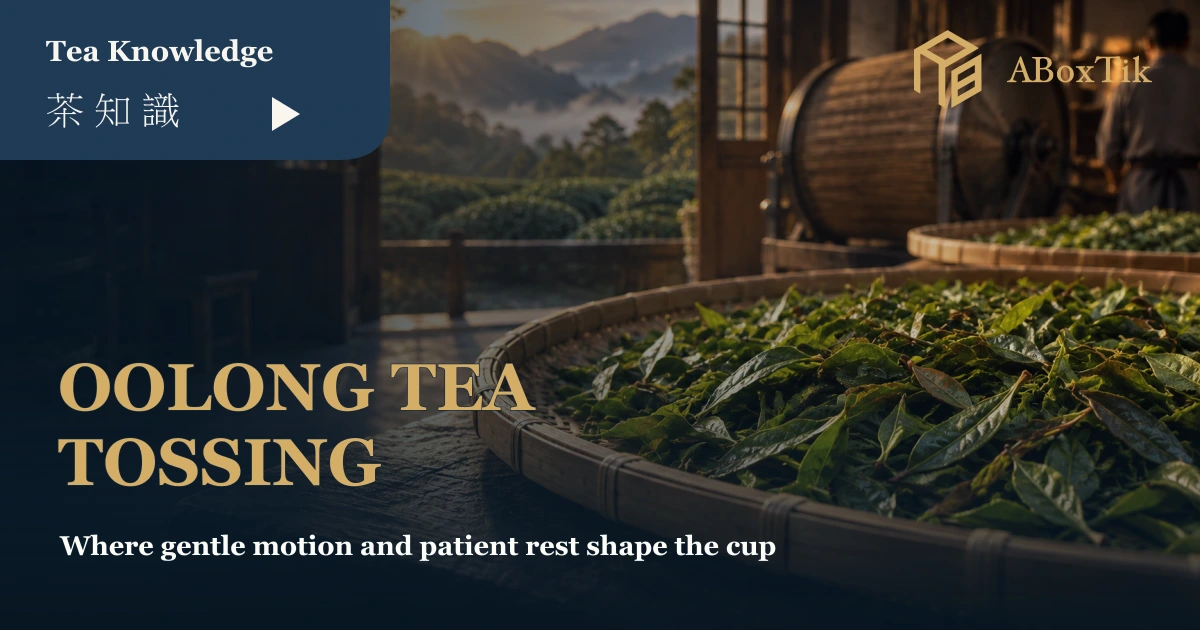
Tossing gently wakes the leaves, then lets them rest. Its value is not a number of turns, but the response of the leaf between them.
Oolong tea tossing is a controlled movement of leaves during indoor withering. It helps redistribute moisture and, through measured edge friction and air contact, supports conditions for enzymatic oxidation. It is not oxidation itself, nor is it the sole cause of floral aroma or red leaf edges; leaf quality, weather, resting, fixation and later processing all matter.
Tossing is more than moving leaves
For partially oxidised tea, leaves are withered in sun or warm air and then rested indoors. Tossing—also called shaking or stirring—may be used between rests. Taiwan Ministry of Agriculture material explains that early turning redistributes water; later measured friction affects leaf-edge cells and helps establish reactions involving polyphenol oxidase and catechins.
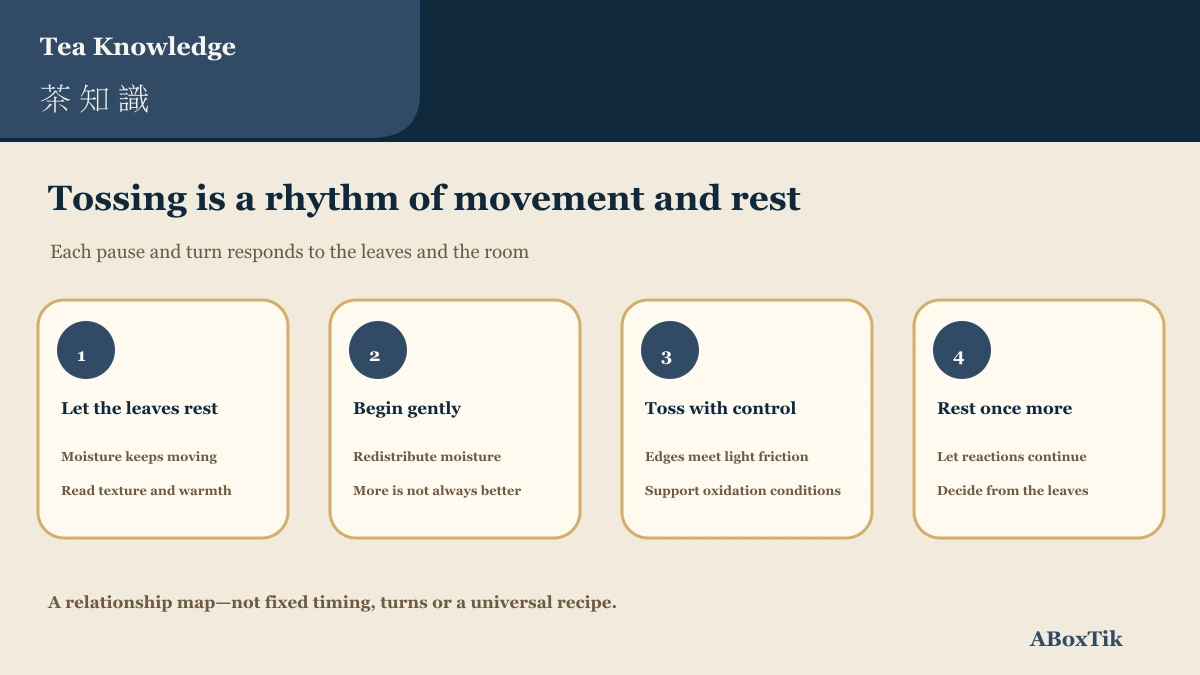
This is why tossing is neither “oxidation” nor a case of more being better. It is a maker’s way of balancing motion and rest. After movement, leaves need time for water movement, cooling and reactions. Whether to intervene again depends on leaf texture, aroma, humidity, temperature and what has already happened. No universal seconds, turns or room condition can faithfully replace that reading.
Floral aroma and red edges: related, not guaranteed
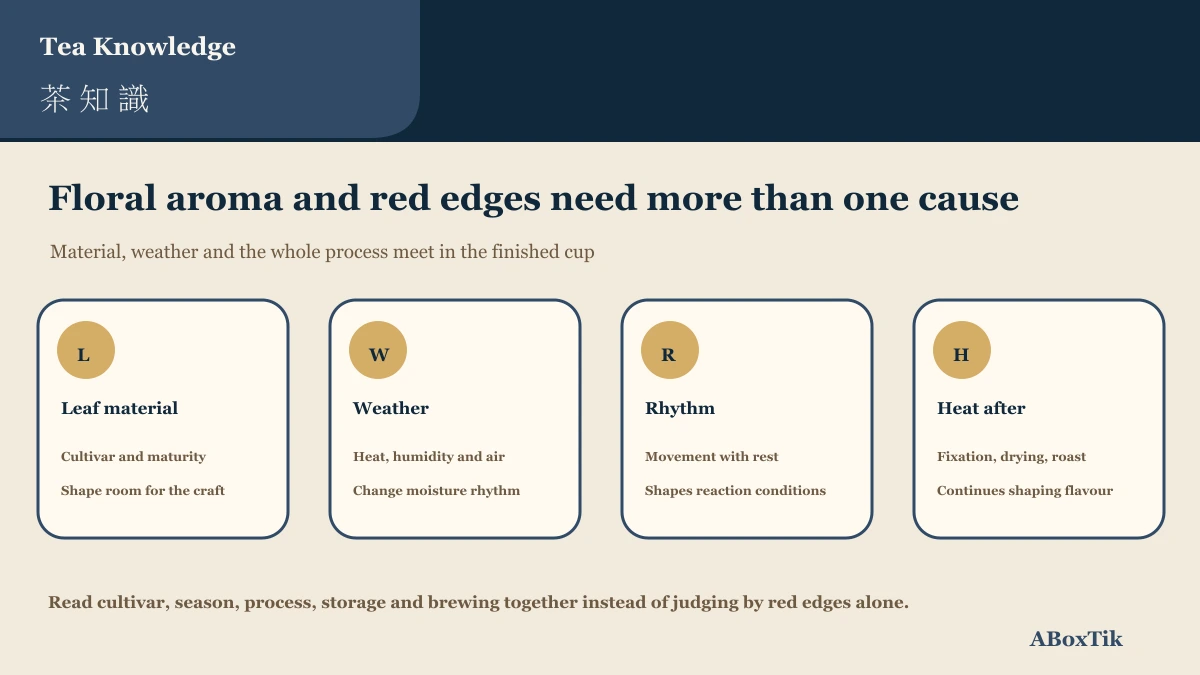
Controlled movement can increase air contact at the edge and make edge oxidation more visible, often described as green leaves with red edges. Withering and oxidation also participate in aroma development. Yet “tossing creates floral aroma” is too blunt: cultivar, maturity, weather, leaf water, resting, fixation, drying, roast, storage and brewing all shape the cup.
A red edge is an observation, not a quality certificate. A floral description is also a tasting impression, not a promise that every lot will name the same flower.
Craft is a rhythm, not a recipe
Warm, humid weather calls for a different rhythm from a dry day; firm leaves do not ask for the same handling as softened leaves. The Taiwanese saying “make tea by watching the weather and the leaves” is practical attention, not mystery. Read tea withering and water movement for moisture management, and oolong oxidation and processing for the larger sequence.
How to read the craft in a cup
A cup cannot reveal how many times leaves were tossed. Instead, notice aroma separately from taste: floral, fruit, sweet, roast or vegetal; then freshness, body and astringency; then whether the aroma stays clean as the cup cools. The tea aroma guide offers a repeatable home framework. One careful observation is more useful than an invented process claim.
Why tossing and resting belong together
Tossing alone is only half the rhythm. After leaves are moved, they rest: moisture continues to redistribute and leave, leaf temperature can settle, and the reactions encouraged by the previous movement can develop. The next intervention is not intended to make the tea “stronger.” It is a response to the leaf’s texture, warmth, aroma and the surrounding air.
This is why a fixed schedule cannot travel unchanged from one garden or day to another. Tenderness, leaf water, time after picking and weather change what the leaves need. Good craft makes room for those conditions instead of forcing every batch into one numerical recipe.
Hand tossing and machine tossing
Hand shaking and mechanical tossing share the same broad purpose: controlled, reasonably even movement during indoor withering. They differ in capacity, repeatability and how adjustments are made on site. The research-station equipment information places tossing machinery in the indoor-withering stage and frames it around regular movement, moisture management and oxidation rhythm. It does not establish that either hand or machine work is automatically more fragrant, more authentic or more premium.
Hand work can keep the maker close to changes in leaf softness, scent and warmth. Machinery can help maintain a stable rhythm across repeated movement. In either case, the material and the maker’s judgment remain central. “Handmade” is useful process information, then—not a shortcut to a quality verdict.
Reading process clues in a finished-tea description
A product page may not list a tossing method or number of turns, and that is normal. Begin with cultivar and origin; then read terms such as fresh floral, ripe fruit, roast, sweetness or body; then check harvest, storage and brewing guidance. These details can suggest a style, but they cannot reconstruct an entire factory process.
A lifted floral note may sit alongside a lighter oxidation direction, yet cultivar and place still matter. A fuller liquor or ripe-fruit note cannot be assigned to heavier tossing alone. The most helpful description is one that clearly states what is known about the tea rather than presenting one hidden step as the whole secret.
A quiet two-cup comparison
Choose two clearly labelled oolongs and use the same vessel, water and package guidance. In the first infusion, note the aroma family and texture. In the second, notice whether aroma becomes clearer, sweeter, more mature or more roast-led. When the cups are warm rather than hot, check whether the aroma remains clean. The result describes only those two teas; it is not evidence for all oolong tossing.
There is no need to force a flower name. “Bright floral but brief” or “a clean sweet aroma remains as it cools” is already useful language for the next thoughtful choice.
Common questions
Is tossing the same as shaking?
They often refer to controlled leaf movement during indoor withering in Taiwanese oolong contexts, though local terms and machinery differ.
Does more tossing mean more floral aroma?
No. Excess or poorly timed movement can upset balance; many conditions shape aroma.
Do red edges prove quality?
No. They are a process clue, not an independent quality grade.
Can a home brewer reproduce tossing?
No. Tossing belongs to fresh-leaf manufacture, before tea reaches the cup. At home, the useful equivalent is careful observation: follow the package guidance, change one brewing variable at a time, and record the result without pretending to recreate the factory.
Tea with ABoxTik
Learning about tossing adds one quiet layer to selecting oolong: cultivar, place and craft belong together. Compare Green Jade, Jinxuan and Dong Ding at an unhurried pace; current specifications, flavour notes and availability belong to the live product pages.
If aroma is the next thread you would like to follow, the guide to floral aromas in tea helps put impressions into calm, usable language. The light-versus-roasted Taiwanese tea guide separates oxidation from roast, while the Taiwan tea regions guide adds place without turning origin into a flavour promise.
There is no need to memorise the factory before enjoying the cup. Begin with why Taiwanese tea is distinctive, use the six tea types overview when a category needs clarification, and browse the ABoxTik tea collection only when it feels helpful to compare current teas. A little context at a time is enough; careful tasting can remain warm, personal and entirely free of a test.
Sources
- Ministry of Agriculture: Taiwan specialty tea processing (checked 2026-09-26)
- Tea and Beverage Research Station: tea-making equipment (checked 2026-09-26)
- Tea and Beverage Research Station: tea-making machinery (checked 2026-09-26)