
Tea Knowledge
Tea Drying and Moisture: A Gentle Guide to Aroma Stability
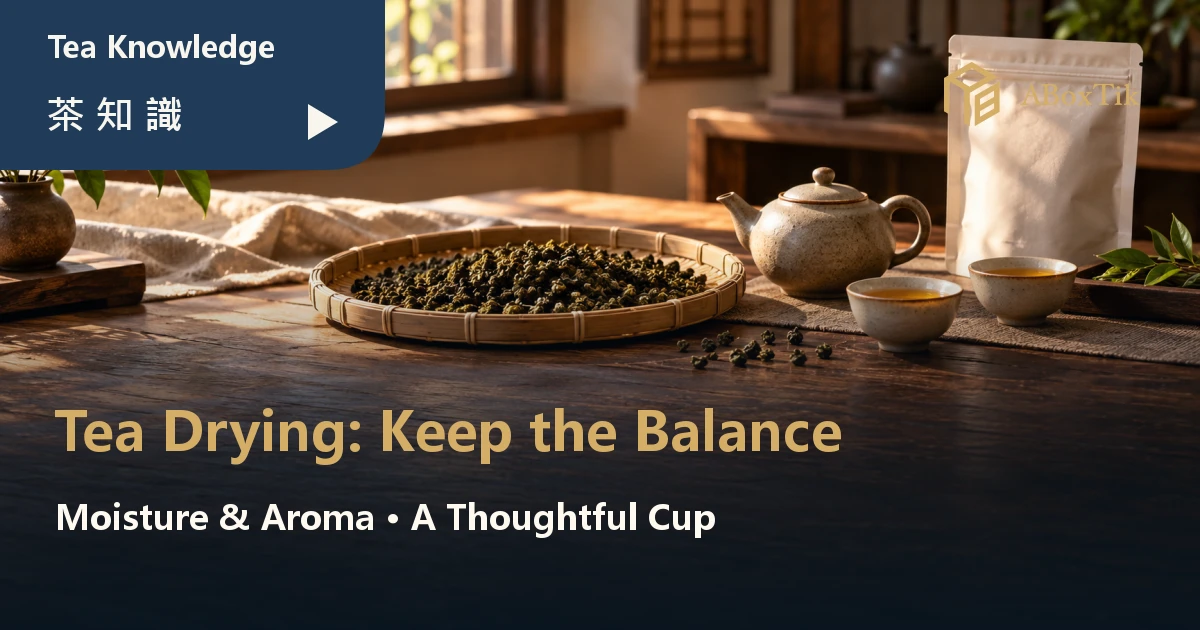
The maker brings water down; a well-closed packet carries the work forward. Leave room for the aroma, and a little time for the cup.
Tea drying reduces moisture towards a suitable finished-tea condition. Moisture matters for keeping quality, but a lower number does not automatically mean better aroma. Taiwan’s tea research station describes 3–5% as a common moisture-control range. Read it as production and packaging guidance, rather than a measured value for every packet or a setting for your kitchen oven.
If a newly opened tea smells lovely, it is tempting to ask whether extra drying could keep that fragrance forever. There is no need to enter the leaves in a dehydration contest. The useful question is how the maker balances water removal with the flavour the tea is meant to express.
Where tea drying belongs in the process
Green tea is generally fixed early, then rolled and dried. Oolong goes through its developing stages, fixation and rolling or shaping before drying. Black tea is dried after withering, rolling and oxidation; its drying heat also stops the preceding enzyme activity. These are simplified routes, with details varying by tea and equipment.
A dry-looking leaf surface does not tell us whether the whole batch has reached its intended finished condition. The agriculture ministry’s processing introduction notes that moisture remains inside leaves after fixation. Follow the tea withering guide, the tea fixation guide and the tea rolling guide if you would like to trace the earlier steps; here we focus on the handover into finished tea.
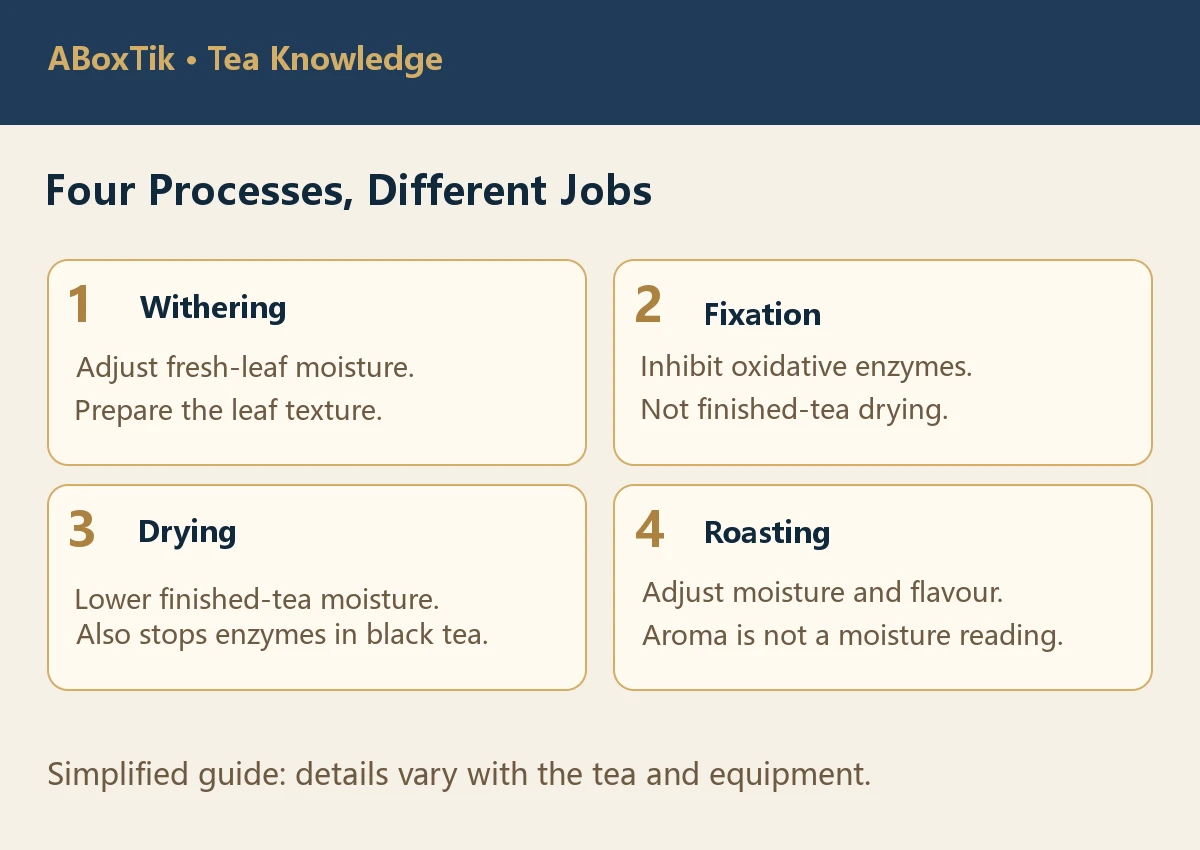
Four terms, four jobs
- Withering: adjusts fresh-leaf moisture and texture for subsequent work.
- Fixation: uses heat to inhibit oxidative enzymes, with some water loss.
- Drying: lowers moisture towards a more stable finished condition; in black tea it also stops preceding enzyme activity.
- Roasting: adjusts moisture and flavour later in production. Its aroma cannot provide an exact moisture reading.
How to read a 3–5% moisture figure
Think of moisture content as the proportion of water in a sample. To compare figures, ask about the sample, method and measurement date. A number in a general tea description and a result for the packet’s batch are different kinds of information. That extra question makes the figure useful rather than merely impressive.
The range is not an aroma score or a universal ranking of tea styles. Agricultural knowledge material notes that reducing moisture further may require stronger or longer heat treatment and affect quality. “Four beats five” is therefore a poor buying rule. Clear origin, processing information and packaging deserve a place alongside any available measurement.
When a seller mentions moisture, a friendly question is enough: “Is that a result for this batch, or background information about the tea?” Record what is known and leave the rest blank. Your notebook does not need a decorative decimal point, and the cup will not be offended by an unanswered question.
Drying and aroma require a balance
Heat treatment helps bring tea to its intended condition, but it also changes flavour. Temperature and time need to be considered together with the leaves and equipment. A single machine setting, detached from those conditions, is not a useful recipe for every tea or for home reprocessing.
One maker may want a clear floral direction; another may be working towards a warm roasted style. Both teas can be appropriately dried and still taste different. Cultivar, raw material and earlier processing also contribute. Start with the light and roasted tea guide to choose a direction, then use the roasted tea aroma guide to describe grain, nut or caramel-like associations.
That distinction is helpful when reading a product story. “High-temperature drying” needs context before it can tell us much. Ask what was heated, how the process was controlled and whether the explanation concerns the offered batch. There is more to learn from those details than from awarding the hottest number first place.
Why dry tea still needs careful handling
Finished tea can take up moisture and surrounding odours. Oxygen, light, temperature and time also affect its keeping quality. Drying is a starting point; suitable packaging and handling carry the work forward. The leaves have not received a lifetime membership of the “never damp again” club.
A small practical adjustment is to separate taking out dry tea from preparing hot water. Use a dry tool, close the original packet after taking what you need, and return it to a dry, shaded place away from strong smells. Keep wet spoons and kettle steam near the brewing area, rather than beside the tea awaiting storage.
Follow a product’s refrigeration instructions where relevant. Keep a chilled packet sealed while it returns towards room temperature before opening, to reduce condensation. Use your product’s own handling and date information for everyday organisation. Being dry does not make tea an indefinitely unchanged food.
Can a cup tell you the moisture content?
Aroma and leaf feel can be observations, but they cannot provide a precise percentage. Shape, rolling and breakage affect texture too. A floral impression is not a moisture meter, and there is no need to crush good leaves to complete your notes. They have already finished the shaping stage; let them wait quietly for the water.
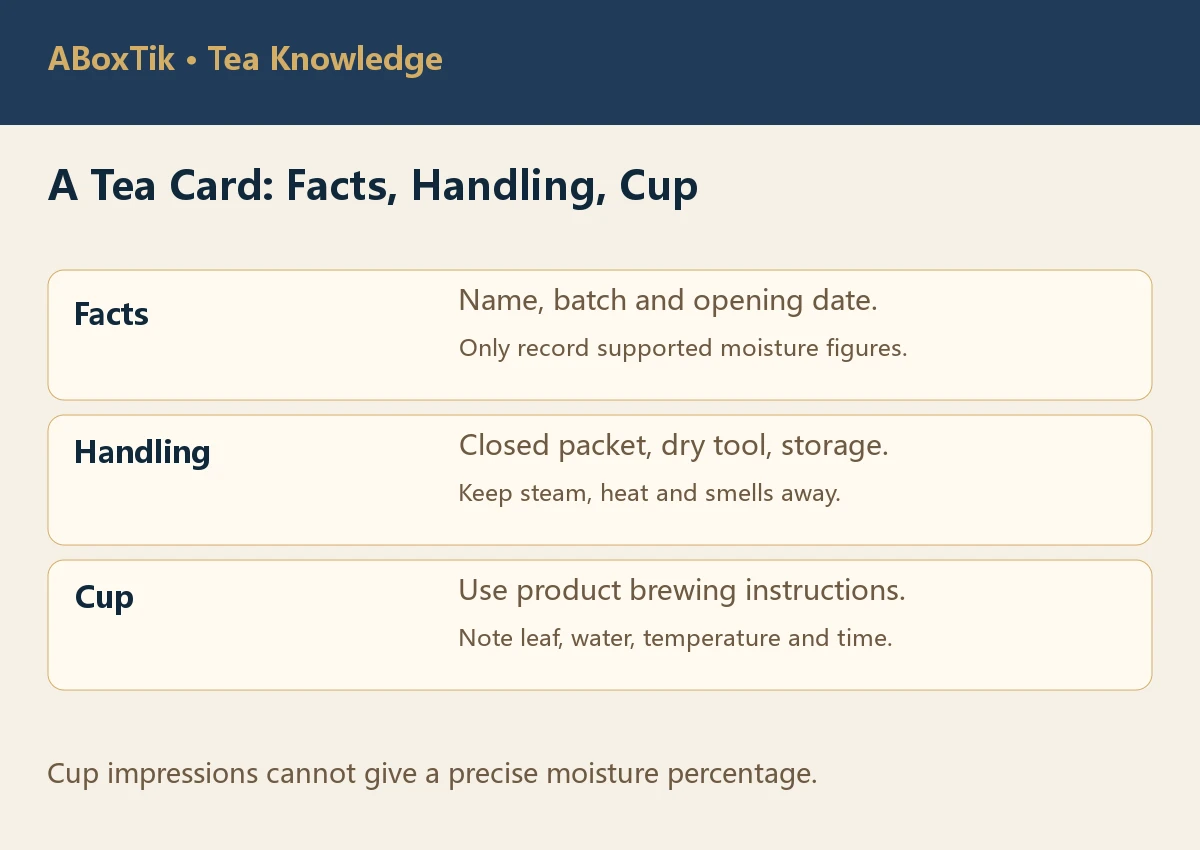
A three-column card for the next cup
- Information: note the name, batch or packaging date and opening date. Enter a moisture result only when corresponding information is available.
- Handling: note whether the packet was closed, the tool was dry and the storage position was away from heat or strong smells.
- The cup: begin with product brewing instructions, record aroma and strength, and retain the leaf quantity, water quantity, temperature and time for a later comparison.
A note might read: “Closed the bag after use; the warm cup had a light floral impression, with a softer sweet aroma as it cooled.” Adapt those words to what is present in your own cup. If a cup differs from your memory, first check brewing and handling, then ask the supplier about the batch. One sip need not become a diagnosis of the drying machine. the tea aroma guide offers a repeatable smelling sequence.
A three-question tea-table quiz
Does fixation mean tea is ready to pack? It is not the same as finished-tea drying. Does stronger roast aroma mean a lower moisture percentage? Aroma cannot give that measurement. Does well-dried tea need its packet closed after opening? Yes: the later handling still matters. No answer sheet required; separating two previously confused steps is already useful progress.
For a flavour comparison, begin with teas you already own and whose information is clear. Brew each according to its instructions. Do not deliberately expose leaves to humidity for an experiment. Different products also differ in more than drying, so compare what you enjoy without attributing every contrast to that one step.
ABoxTik: bring the details back to everyday tea
The helpful takeaway is modest: water is reduced during making, then managed through packing and use. Aroma travels through that whole sequence. Remembering “appropriate drying, thoughtful handling” is enough for today. Give the next cup a little attention without making its moisture figure the centre of the occasion.
Explore the current styles in the four-box Taiwanese pure tea gift, or read the guide to Taiwanese tea for the wider story of place and craft. Choose by flavour and occasion, then follow each tea’s storage guidance. Open what you need at a pace that fits your day; a thoughtful tea routine should be easy to live with.
Related recommendations
- the tea fixation guide: distinguish drying from earlier heat treatment.
- the roasted tea aroma guide: find words for the roasted notes in your cup.
- the four-box Taiwanese pure tea gift: choose the next cup by your preferred style.
Sources
- Taiwan Tea and Beverage Research Station: tea packaging and storage
- Agricultural Knowledge Portal: stored tea, moisture and heat treatment
- Ministry of Agriculture food education platform: learning about tea
Sources checked: 11 October 2026. Observation card and quiz: editorial learning activities.