
Tea Knowledge
Corporate Lunar New Year Tea Gifts: A Procurement Guide
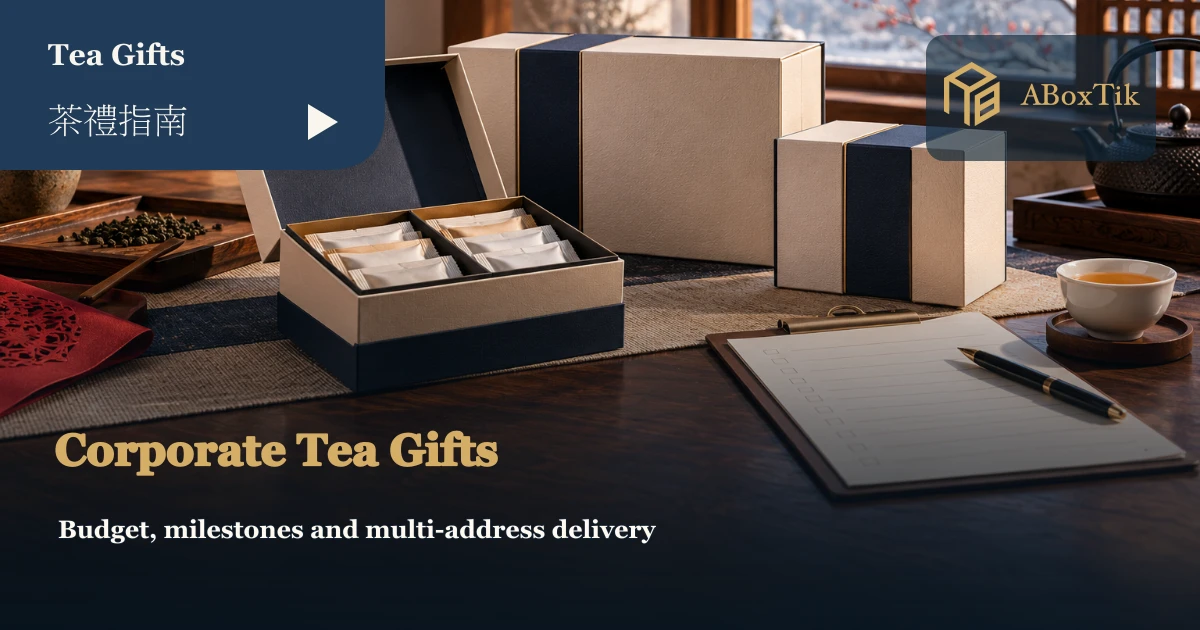
Let the seasonal gesture be warm and the procurement steps clear. Give each tea gift a recipient, a confirmed version and a thoughtful route to the door.
For corporate Lunar New Year tea gifts, start procurement with the recipients, total budget, desired arrival date and delivery locations. Work backwards through supplier confirmation, samples, artwork approval, final recipient data and dispatch. Include packing and delivery in the budget, and distinguish production completion from handover to a carrier and actual arrival.
If the recipient list and the latest management suggestion keep arriving in different messages, begin with one task card. A named decision-maker and a dated version can do more than another spreadsheet. This guide provides a procurement and multi-address delivery framework; actual products, prices and lead times need confirmation for the project.
Corporate Lunar New Year tea gifts: who approves?
Clients, partners, employees and overseas contacts may require different arrangements. Group the recipients before choosing formats. This article concerns execution: who approves, what is final and how the information reaches the supplier. For an initial quantity estimate, use the corporate gift quantity guide rather than making one table solve every question.
For each group, record an owner, an approver, an estimated quantity and the intended delivery window. Confirm whether the recipient can accept a parcel and whether an office closes early. Your own holiday calendar cannot answer for the whole mailing list. Respect a recipient’s preference or organisational restriction about accepting gifts.
Mark quantities as estimated, awaiting confirmation or confirmed. Compare a mixed tea-bag format with a multi-tea gift box in terms of intended use, not just the presentation photograph. The decision should remain understandable to the next person handling the project.
Separate the total budget into usable fields
List the gift itself, confirmed customisation charges, bags or other packing, cards and delivery. Identify any project allowance separately. Different locations may have different delivery costs. Ask the supplier to clarify tax treatment, quote validity and the price basis for additional quantities in the same written proposal.
For example, a total ceiling of NT$60,000 for 100 gifts, with NT$8,000 reserved for confirmed other costs, leaves NT$52,000 for gifts: NT$520 each. These are example inputs to demonstrate arithmetic, not ABoxTik prices, a market range or a recommended corporate spending level. Replace them with the actual project figures before comparing options.
| Budget field | What to confirm | Keep a record of |
|---|---|---|
| Gifts | Tea, contents and unit count | Chosen version and quote |
| Packing | Scope of any custom work | Approved sample and charge |
| Delivery | Locations and arrangements | Confirmed cost by destination |
| Changes | Rules and cut-off points | Written confirmation |
Inspect the two-tea bag set and other formats using current specifications. A large box does not automatically answer the portion or recipient question. Keep the useful format ahead of the desire to make a budget sheet look more impressive.
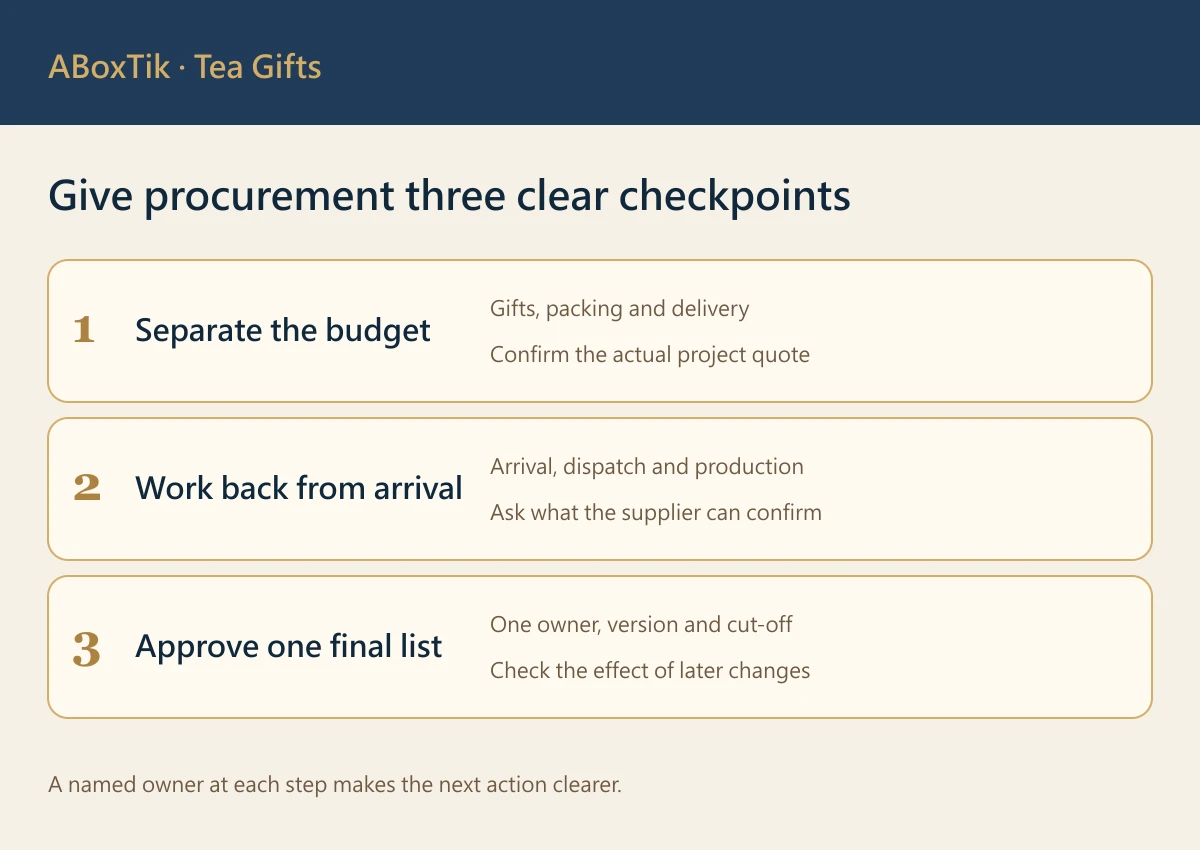
Work backwards from arrival, with distinct milestones
Choose the desired arrival date and ask the supplier and carrier about feasible arrangements. Then list dispatch checks, packing, printing or custom work, sample approval, ordering and selection. Add the required input and approver to each milestone. This is a task sequence, not a claim about any supplier’s fixed number of production days.
“Ready to dispatch” and “guaranteed to arrive” are different promises. Raise collection, split shipments, remote destinations and overseas delivery before obtaining confirmation. Do not infer a bulk-order lead time from a general product page, or announce an arrival date to recipients while it remains unconfirmed.
Set separate cut-offs for artwork and recipient data. Agree how extra quantities, address changes and substitutions will be handled afterwards. Confirm their effect on price and timing before accepting a change. The delivery van should not be expected to transport everyone’s last-minute imagination as well as the tea.
Make a multi-address list that another person can use
Depending on the delivery arrangement, a row may need the recipient or organisation, contact details, complete address, quantity, gift version and a receiving condition. Distinguish headquarters from branches and people with the same name. Keep enough detail for the actual operation rather than relying on the organiser’s memory.
Use one formally dated version and name a single contact for corrections. Share only the information needed by the people carrying out delivery. Avoid putting the full recipient list in an open group or publicly accessible link. Check duplicates and outdated contacts while the information is still being finalised.
Try a small desk review with different situations: one gift to headquarters, two to a branch and several people at one address. Check row count, address count and gift count separately; those numbers may legitimately differ. Have another colleague reconcile the quantities and versions before the supplier receives the final file.
Approve the sample, tea choice and card separately
A sample review should cover tea names, company names, artwork version, wording, language and actual dimensions. Ask which elements are illustrative and which are confirmed deliverables. A product photograph does not establish that every printing, packing or customisation option has been included in the quote.
For tea selection, explore light and roasted styles, Jinxuan or Green Jade, then return to the contents of the chosen product. If a recipient has only a mug and hot water, suitable packaging and a clear brewing instruction may be more thoughtful than expecting specialist equipment.
Check organisation and recipient names in each language on a bilingual card. Avoid shrinking a long translated sentence simply to keep it on one line. A short seasonal message can be enough. The Taiwanese tea story can provide context without turning a gift into a letter that seems to require a reply.
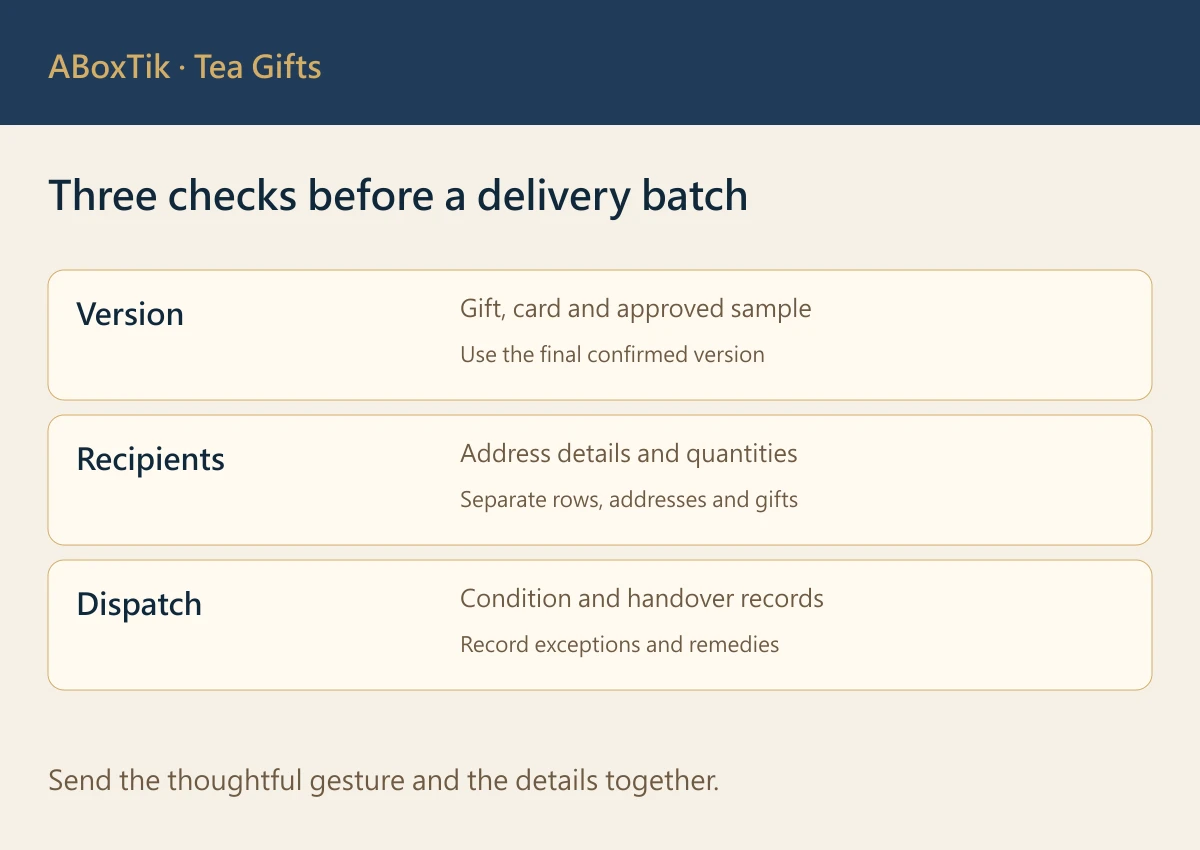
Reconcile incoming stock before dispatch
On arrival, check quantity, version, packaging condition, product information and dates. Record discrepancies separately and contact the supplier about the actual remedy. Taiwan’s Tea and Beverage Research Station explains that tea readily absorbs moisture and surrounding odours. Follow the product’s storage instructions and keep it away from heat, damp and strongly scented materials.
Organise the temporary storage area by confirmed delivery batches rather than treating any spare office corner as suitable. Before dispatch, reconcile version, quantity and recipient information again. Keep the handover or shipment record. A doubtful address or damaged package should be isolated for checking instead of making the entire confirmed project start over.
The tea storage guide adds practical background. If a replacement or second shipment is needed, confirm the supplier’s actual terms. Record what happened rather than treating one successful delivery as proof that every future arrangement will be trouble-free.
Close the project with a useful procurement card
Keep the chosen tea, final quantity, actual expenditure, approval dates, dispatch and arrival records on one page, alongside the relevant internal and supplier contacts. At the next project, recheck stock, prices and delivery conditions. Last year’s timetable is a reference, not this year’s commitment.
For a small personal gesture, a sharing gift format may be all that is needed. For a full corporate project, make each change traceable and each milestone answerable. Good procurement is not one person remembering everything; it is a clear next step that somebody else can confidently follow.
A brief retrospective can ask three concrete questions: which information arrived late, which approval caused rework and which delivery condition should have been asked earlier? Keep the answers factual and useful. The purpose is to make the next round calmer, not to award a trophy for surviving the busiest inbox.
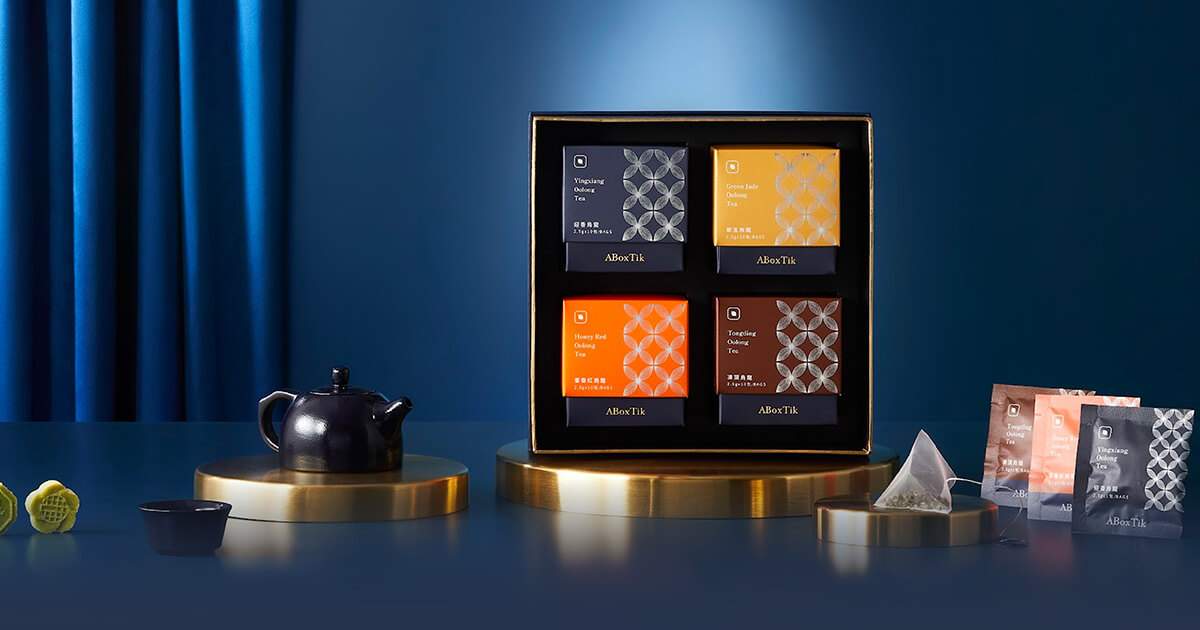
Follow ABoxTik: send the thoughtfulness and the details together.
Prepare a warm seasonal gesture with clear steps
A corporate tea gift need not explain everything through elaborate packing. Suitable tea, a readable card and attention to how a recipient accepts the parcel can make the gesture easier to enjoy.
Explore a multi-tea gift format, then confirm the budget, lead time and delivery arrangement item by item. ABoxTik invites careful preparation, so the final tick on the task card can feel as comfortable as the first cup.
Related reading
Sources
Sources checked 18 October 2026.