
Tea Knowledge
How to Brew Tea in a Thermos: Leaves, Temperature and Separation Time
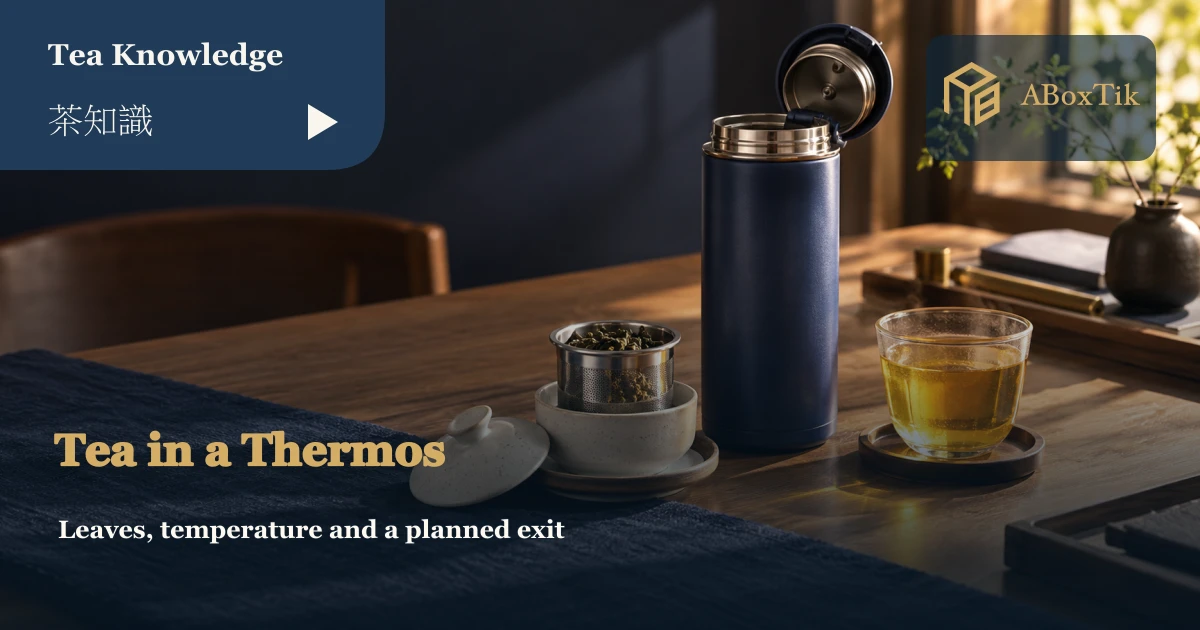
The useful part of brewing tea in a thermos is giving the leaves a moment to leave the water.
Tea in a thermos can become more bitter or astringent because a warm, enclosed vessel keeps leaf and water together. Rather than looking for one permanent formula, treat leaf amount, starting water temperature and leaf-water separation time as three adjustable controls.
Begin with the package guidance for the tea in hand. Then use a tea bag, infuser, removable basket, or a brew-then-pour method to create a planned separation point. A clear finishing point makes the morning routine easier to repeat.
Why a thermos can keep building strength
In a regular brew, leaves and water can be separated at a chosen moment. In a thermos, continued contact allows the liquor to keep changing. Water temperature and time both affect sensory expression, so insulation is an active condition rather than background scenery.
Aim to keep the strength you enjoy, rather than promise a cup will never taste bitter or astringent. Observing bitterness, astringency and strength helps identify what you actually want to adjust.
When a cup is too forceful, do not reduce leaf amount, lower temperature and shorten time at once. Change one control in the next brew so the result can teach you something.
Start with package guidance and a modest leaf amount
A thermos does not make every tea behave the same way. Tea type, processing, leaf shape and the product itself differ, so the package is the best first reference. For a travel brew, a more conservative leaf amount can leave helpful room for later adjustment.
Whole-leaf tea bags offer an easy separation method. With loose leaf, use an infuser or removable basket, or brew in another vessel before pouring. The important feature is a repeatable moment when leaves stop contacting water.
Not every morning needs to be a precision experiment. A repeatable starting point is already a generous bit of help for tomorrow.
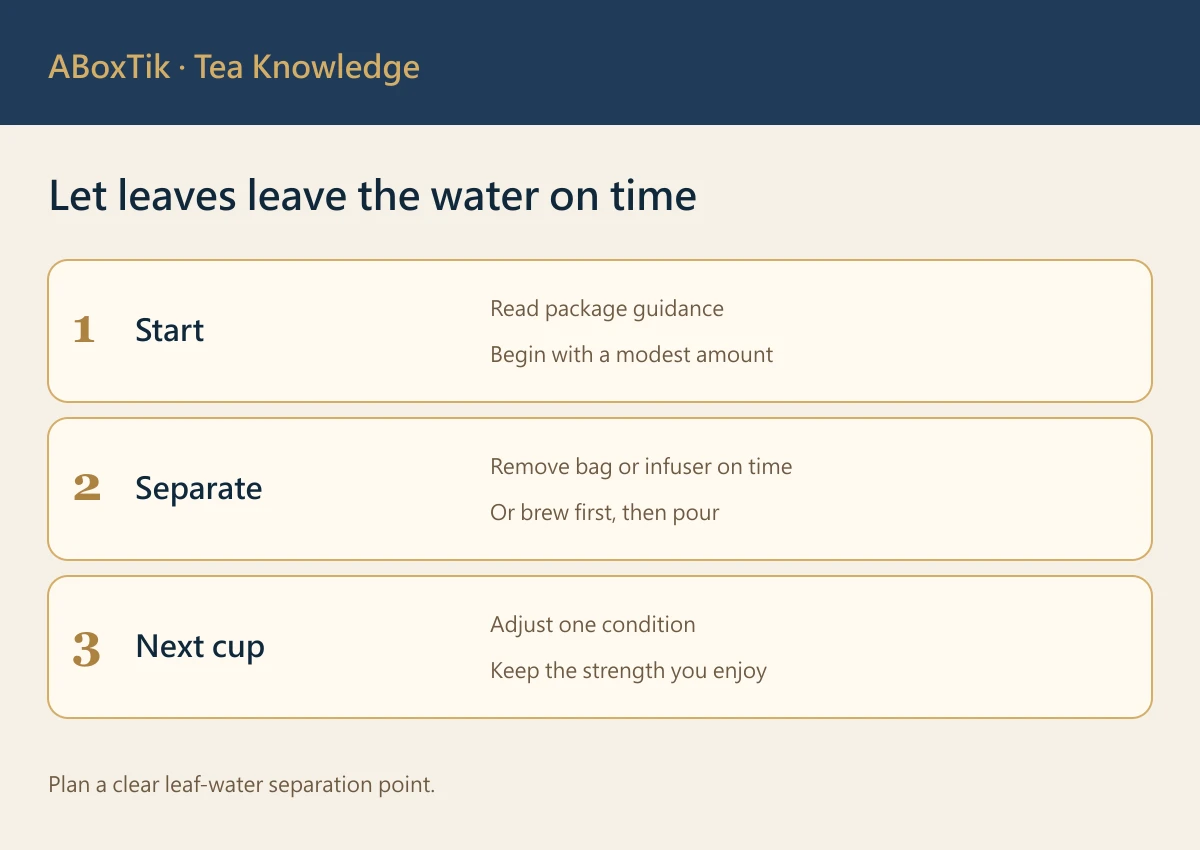
Starting water temperature gives flavour a direction
Water temperature changes tea expression; the Tea and Beverage Research Station notes its effect on sensory qualities and extraction. Follow product guidance first. If a gentler result is desired, adjust starting temperature alone in a later round and observe what changes in aroma and strength.
Oolong water-temperature guidance offers context for oolong, while the six tea categories gives broader background. Neither is a universal-number table that replaces the package.
A note reading “same tea, same thermos, temperature adjusted” is usually more useful than a borrowed number from the internet.
Separation time is the control worth practising first
In a thermos, separation time is easy to overlook and easy to repeat once planned. Set a reminder, then remove the tea bag, lift the infuser, or pour the liquor into another vessel. You are controlling contact time, not judging the leaves.
When leaves cannot be removed, brewing first and then pouring is more controllable than leaving loose leaf in the thermos all day. Steeping-time adjustment shows how to keep a one-variable note.
Tea leaves finishing work on time are often more reliable than memorising a heroic string of ratios.
A repeatable thermos workflow
| Step | Action | What to note next time |
|---|---|---|
| Start | Read package guidance; choose a modest leaf amount | Tea and leaf amount |
| Pour | Choose a starting water temperature | Aroma and entry strength |
| Separate | Remove bag/infuser or brew then pour | Difference before and after separation |
| Next round | Adjust one condition only | Which change moved toward preference? |
For a working-day extension, read Brewing and leaf-water separation. For pyramid bags, a pyramid tea bag guide offers another separation tool.
The purpose of the workflow is not identical cups; it is a clear route back from a cup you did not enjoy.
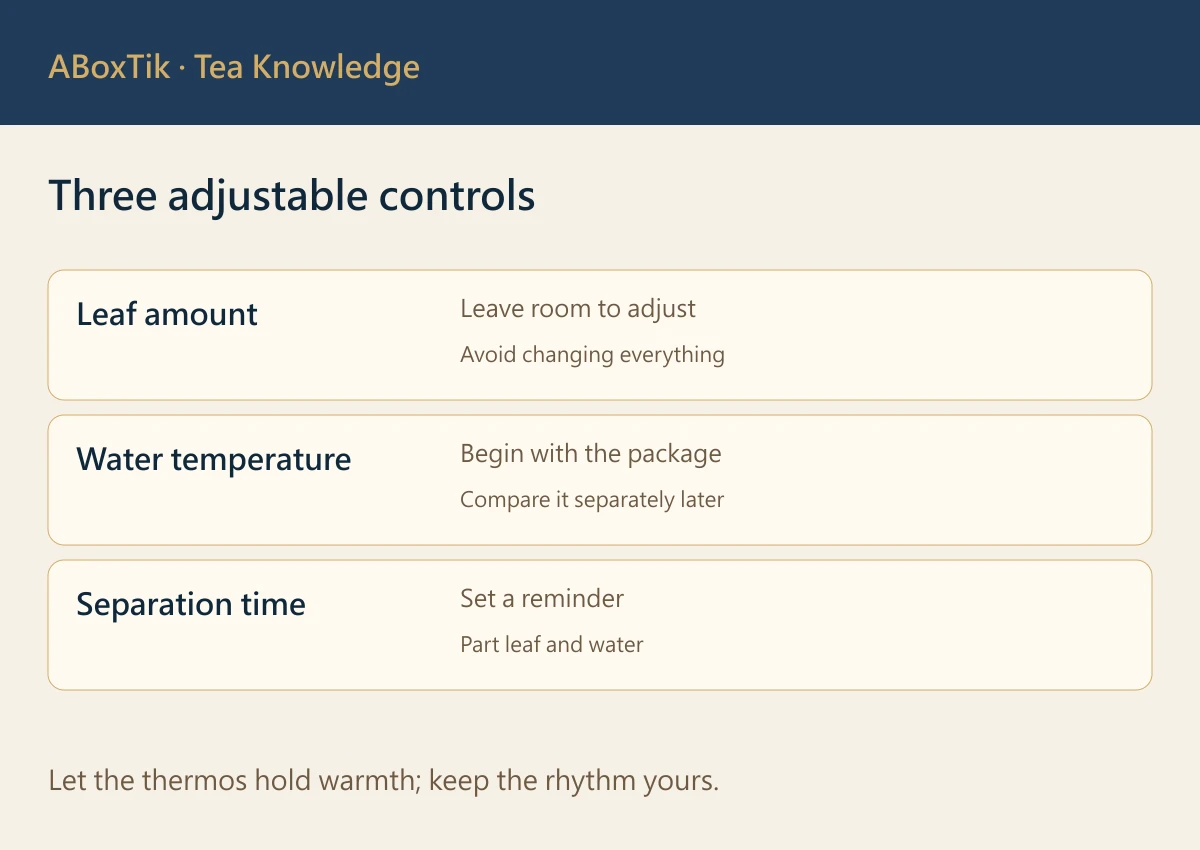
When the cup tastes too bitter or astringent
First say what happened: was it concentrated on entry, bitter after swallowing, or noticeably astringent in the mouth? Then consider whether leaf amount, starting temperature or separation time is the most likely control to revisit. The sensory diagnosis guide turns a flat “not right” into an actionable next brew.
For a lighter direction, choose either a modest leaf amount or lower starting temperature as the single first adjustment. To retain more shape, keep two controls steady and alter separation time only. Keep package instructions as the base.
A thermos is there to accompany the day. Let it hold warmth while you decide when leaf and water part ways.
Rehearse the morning routine once
Check the thermos manufacturer’s instructions for suitable drinks and use, then choose a brewing tool that can actually be removed through the opening. If a narrow neck makes lifting a basket awkward, brew in another vessel and pour the separated liquor into the thermos. An easy action repeated calmly is more helpful than an ingenious arrangement that becomes difficult whenever the morning is busy.
Record the time water meets the leaves and the time contact ends as separate points. A bag lifted only halfway out of the liquor is still in contact with water. Place the removed bag or basket on a small dish so dripping does not become an extra task. Put hot vessels on a stable surface and take the time needed for comfortable handling; a reminder is an invitation to check, not a demand to rush.
Treat a refill as another round. Note whether the same leaves are used and how much water is added. A later, lighter refill cannot by itself tell you whether the first leaf amount was right. Keeping the two rounds separate makes the flavour record more useful and helps identify which part of the day actually needs a change.
Before leaving, write one sentence for tomorrow: “Keep the leaf amount; remove the bag earlier.” A note with one action is easier to use than a long list of competing fixes. If the result is already comfortable, repeat it before changing anything. Consistency can be a perfectly good discovery.
For a shared workplace, put the removal dish and timer beside the brewing area rather than across the room. Ask who will remove the bag when preparing a pot for someone else. That small handover prevents an otherwise clear method from depending on an assumption. The thermos can look after warmth while the routine looks after timing.

Tea, one box at a time
Keep thermos tea in a rhythm you enjoy
At ABoxTik, we believe travel tea need not depend on guesswork. Begin with package guidance, plan a separation time, then change one condition at a time; a thermos can become a calm part of a tea routine.
Continue with steeping-time adjustment, or build an easy carry-along routine with whole-leaf tea bags.
Related reading
- Build repeatable notes with steeping time
- Separate bitterness, astringency and strength
- Brewing and leaf-water separation
One bottle, two jobs: carrying brewed tea or doing the brewing
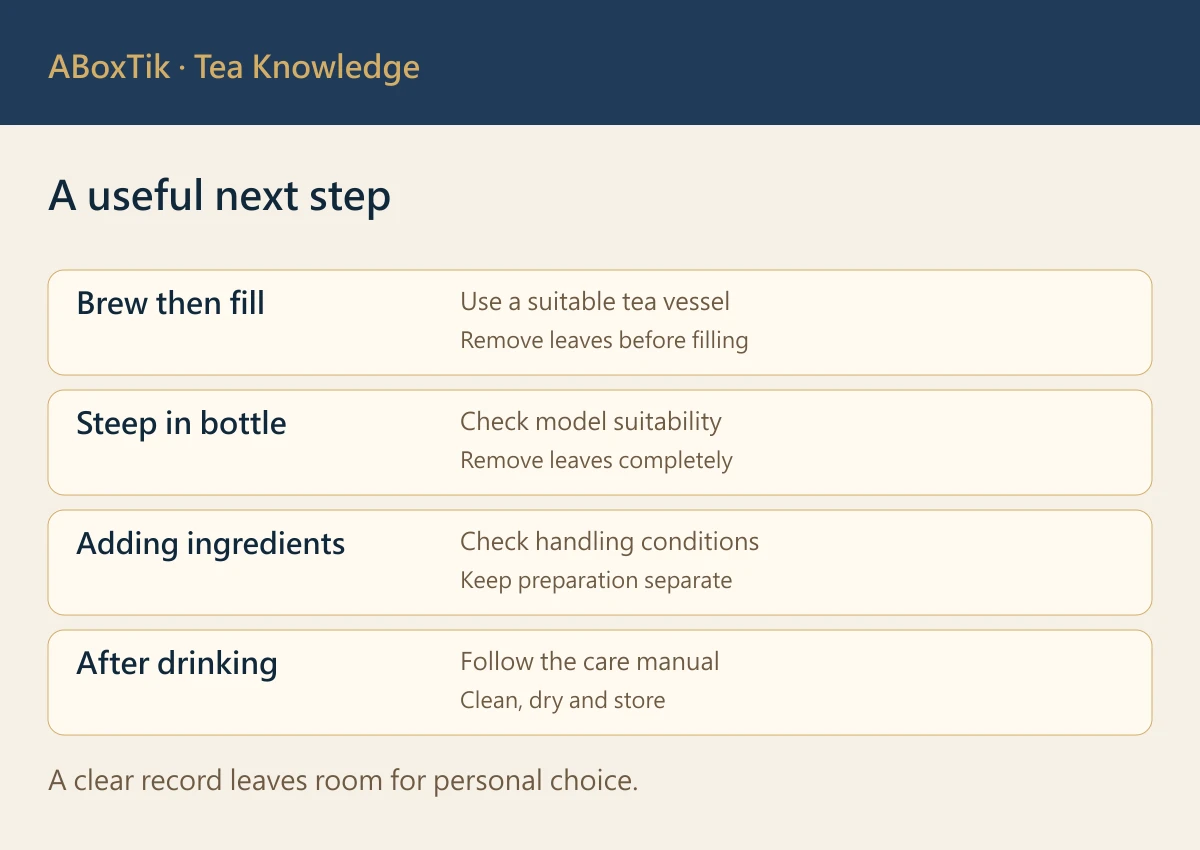
When tea is brewed elsewhere first, the bottle receives an infusion already separated from its leaves. Brewing inside the bottle adds another job: arranging when and how the leaves leave the water. Choose one workflow before starting. A bottle may be versatile without requiring a busy morning to run three departments at once.
| Step | Brew elsewhere, then fill | Brew inside the bottle |
|---|---|---|
| Preparation | Provide a suitable brewing vessel and receiving position | Confirm the manufacturer permits the use and the filter can be removed safely |
| Brewing | Follow the tea directions in the separate vessel | Time the infusion in the bottle |
| Leaf separation | Complete it before filling | Remove the bag or basket completely at the chosen time |
| Carrying | Follow this bottle’s filling and closure instructions | Finish separation, then follow the closure instructions |
| Cleaning | Clean both sets of equipment | Care for bottle, lid and basket according to their instructions |
Check that the model is suitable for hot drinks, infusion and any accessories being used. Identical-looking steel bodies do not establish identical lid, gasket or filter limitations. Do not improvise a filter basket or trap a tea-bag string in a closure when that use is not supported. If removing the leaves is awkward, brewing separately gives the contact time a clearer endpoint.
Put the bottle on a stable surface before filling. Follow its stated fill level, temperature precautions and closure method. If preheating is recommended, use the method for that model rather than borrowing a temperature or waiting time from another product. Keep the pouring route visible and away from electronics; secure the closure as directed before moving.
For brewing inside, prepare a suitable place for the removed basket or bag first. A basket lifted only partway, with leaves still in the infusion, has not ended contact. If removal feels likely to spill or burn, use a separate brewing vessel instead of racing the timer. A reminder is meant to help the operation, not hurry hands into an awkward position.
For the next morning, keep a short note: “Today’s method: ____. Leaves removed at: ____. Next time I will change only ____.” This distinguishes a brewing adjustment from a change in how the drink is carried. It also helps identify which tools actually make the routine easier.
Temperature retention and food safety are separate questions. A bottle still feeling hot does not establish a safe holding period. The drink’s ingredients, actual temperatures, handling and product directions matter. If milk or another perishable ingredient is added, follow the appropriate ingredient-storage requirements rather than treating the plain-tea workflow as a universal rule.
At the end of the day, include the lid and removable parts in the cleaning plan. Follow the maker’s instructions for disassembly and care, then let suitable parts dry before storage. A simple reset makes tomorrow’s choice easier: the right bottle, a clear leaf-removal point and no forgotten basket waiting at the bottom.
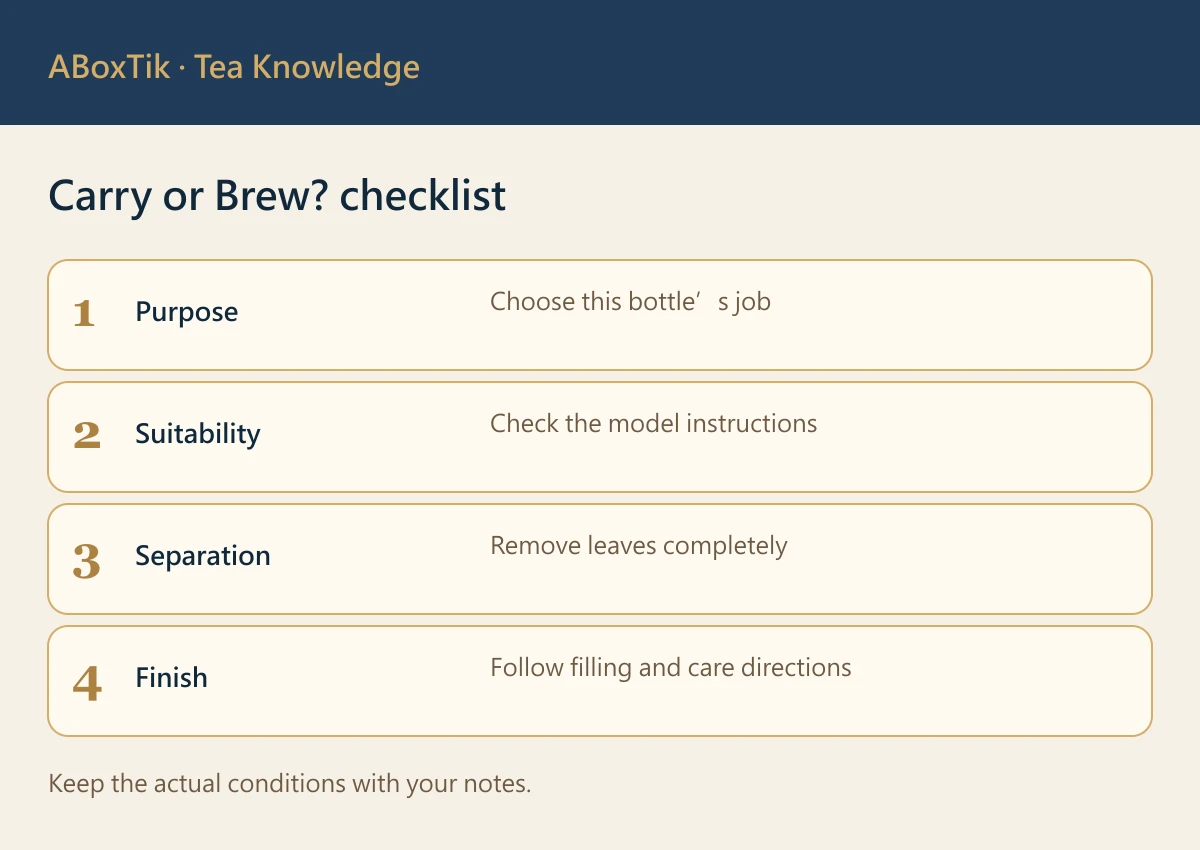
Sources for this addition
Sources
- Tea and Beverage Research Station: Effects of water quality and water temperature on tea liquor
- Tea and Beverage Research Station: Steeping and extraction patterns across tea types
Sources checked 19 October 2026.