
Tea Knowledge
New Tea, Same Pot: Reset the First Infusion

Record the first cup clearly, and give the next one an easier start.
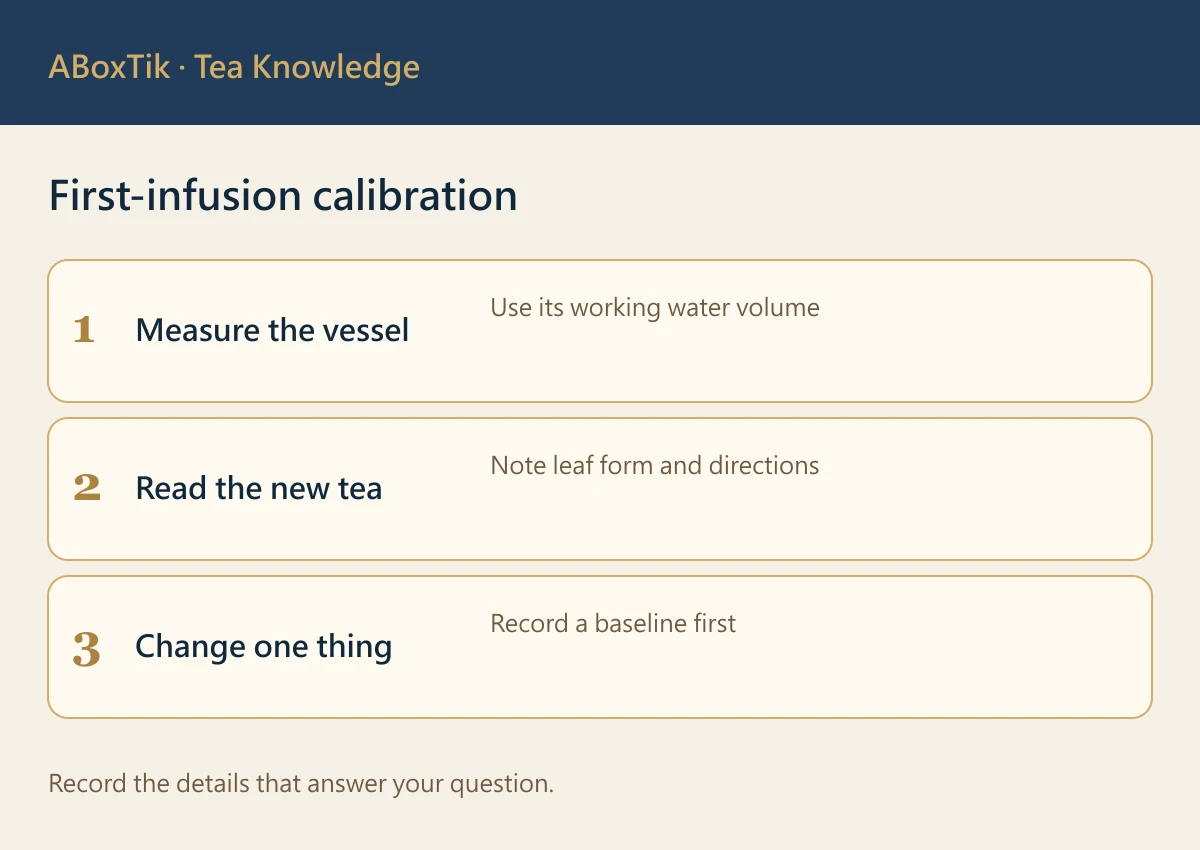
When you put a new tea in a familiar pot, start with the new product’s directions, measure working water volume and dry leaf weight, define the timer, and change one condition after tasting. Keeping the pot does not keep the whole recipe constant. Rolled oolong, open twisted leaves and broken material occupy space differently. “The usual layer across the bottom” can quietly become a different dose.
The first infusion does not have to prove your tea expertise. Think of it as meeting a new neighbour: learn the name and check the address before planning a decade of visits. This guide concerns resetting a first infusion when the ingredient changes. The steeping-time guide covers broader timing questions; here the task is to make the new starting point repeatable.
Measure the water you actually use
A pot’s advertised capacity need not equal its working fill. Do you pour to the same point each time? How much liquor remains after decanting? On a stable surface, practise a normal fill and pour with cool water, measuring a comfortable working volume. Filling to the rim is unnecessary. Keep that fill point for subsequent comparisons so a change in tea is not accompanied by an unnoticed change in water.
Measure dry tea by weight rather than transferring the old tea’s visual fill level. Compact balls and loose strips can look equally deep while weighing differently. Equal weights can also need different room to open. If a scoop is your available tool, record a consistent scoop method for that particular tea. A scoop is not automatically a common unit across all leaf forms.
Turn the package directions into a starting card
Identify the supplied format first. Loose leaf, tea bags and material prepared for specific equipment should not share a timetable merely because they contain tea. Record the suggested dose, water, temperature, steep and separation method. When information is missing, ask the retailer for a starting setup for that actual product. A tea name offers context; it does not fill in every blank operating field.
| Starting-card field | Record | Why keep it? |
|---|---|---|
| Tea identity | Product, form, lot and opening date | Compare the same material later |
| Pot and water | Vessel, working volume, source and fill point | A familiar pot can hide a different fill |
| Dose and heat | Dry weight, actual temperature and preheating | Reproduce the starting conditions |
| Timing | Timer start, beginning of pour and pour duration | The same minute can contain different contact times |
| Impression and next step | Aroma, strength, bitterness, drying and preference | Separate the question before adjusting |
This is a household record, not a professional assessment standard. If package directions supply your first round, follow that coherent set. There is no need to combine it with a timetable for another tea. One traceable starting point is easier to understand than five conflicting recipes all trying to run the kettle.
Agree on cleaning, preheating and the timer
Check for old leaves, noticeable residual aromas and deposits, then clean and rinse according to the maker’s directions. If a vessel tends to retain aroma, note that limitation. A new tea is not an invitation to grind the interior, invent a cleaning mixture or perform a heat experiment. The teaware materials guide provides context, while the instructions for the individual piece remain relevant.
Keep preheating consistent. Empty the preheating water, then add tea and water in the chosen order. If you do not preheat, record that too. Start timing at the beginning of filling, or use the product’s specified definition, but keep the definition stable. A slow pour continues the contact between leaves and water. Record pouring duration rather than allowing that part of the infusion to disappear from the notebook.
Describe the first cup before choosing an adjustment
After decanting, wait until sipping is comfortable. Separate overall strength from bitterness and the drying sensation of astringency. A quiet aroma does not necessarily mean weak extraction. “Clear aroma but fuller than I wanted” gives a different direction from “pleasant strength, drying finish.” Breaking down “I did not like it” produces a question you can actually work on.
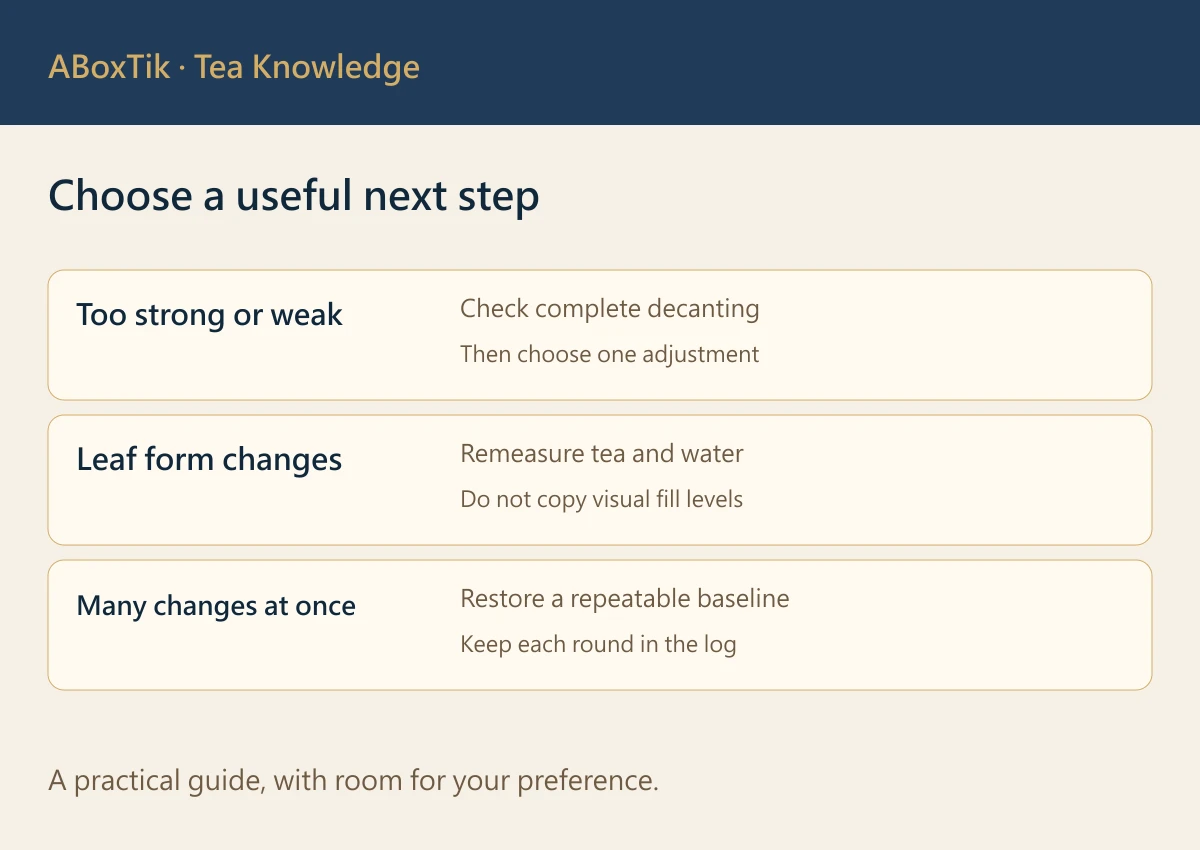
For an overly strong cup, one possible next comparison is a shorter first steep with everything else retained. For a weak cup, first check whether water reached the leaves and whether you followed the starting directions fully. These are adjustment examples, not universal prescriptions. Incomplete decanting or an unwanted vessel aroma needs an operational solution; adding more tea does not answer that question.
A second infusion is not another first infusion
This distinction matters. Leaves in a second round are already wet and have already undergone extraction. They cannot directly show what a shorter first infusion with fresh dry tea would do. Continue drinking subsequent rounds with suitable adjustments, of course. To compare first-infusion settings, use another fresh portion from the same lot, retaining the other conditions and changing the selected variable.
Suppose the first day’s cup was too strong. On the next attempt, use fresh dry tea from that lot, the same pot, water volume and thermal setup, but shorten the first steep. “Lighter than before, still distinct, more appealing for another cup” is a useful note. If you also change water, dose and temperature, you can describe a preferred overall arrangement, but cannot isolate which change caused the difference.
Check what changes with leaf form
For leaves that expand substantially, consider whether the strainer constrains them or the outlet becomes obstructed. Use an appropriate vessel rather than trying to compensate for a blocked flow with a longer steep. With finer material, check filtration and convenient separation. Sediment and leaf size are observations, not automatic quality verdicts. The whole-leaf and broken-tea comparison explores the formats.
Moving between bags and loose leaf requires a fresh look at their respective directions. One bag and one scoop are not interchangeable measurements. A mug can still support a useful log of volume, time and removal. Whether a small pot adds value depends on how you drink. Calibrating tea should make an existing routine easier, without requiring an extension to the teaware cupboard before the first cup is ready.
Leave room for the cup you want
A light tea for a meal and a weekend session following successive rounds may call for different preferences. Record the occasion so the adjustment has a purpose. Your chosen setting need not become everyone else’s rule. If the first attempt already suits you, keep it. Calibration does not require finding a fault; it can simply preserve the address of a cup you would like to visit again.
For today’s small task, take one newly opened tea and fill in three fields before brewing: dose, water volume and timer definition. Taste, then choose either one adjustment or none. To explore familiar tea formats, check the current contents and preparation information for the Classic Taiwanese Tea gift set. A repeatable cup is more useful than memorising a collection of supposedly universal seconds.

Related reading and tea choices
Sources
Sources checked: 25 October 2026.