
Tea Knowledge
How Formosa Tea Reached New York: Taiwan’s 19th-Century Tea Export Story
A tea leaf left the northern hills of Taiwan by river, workshop, and port before it reached another shore. What travelled with it was more than merchandise: it was an island beginning a conversation with the world.
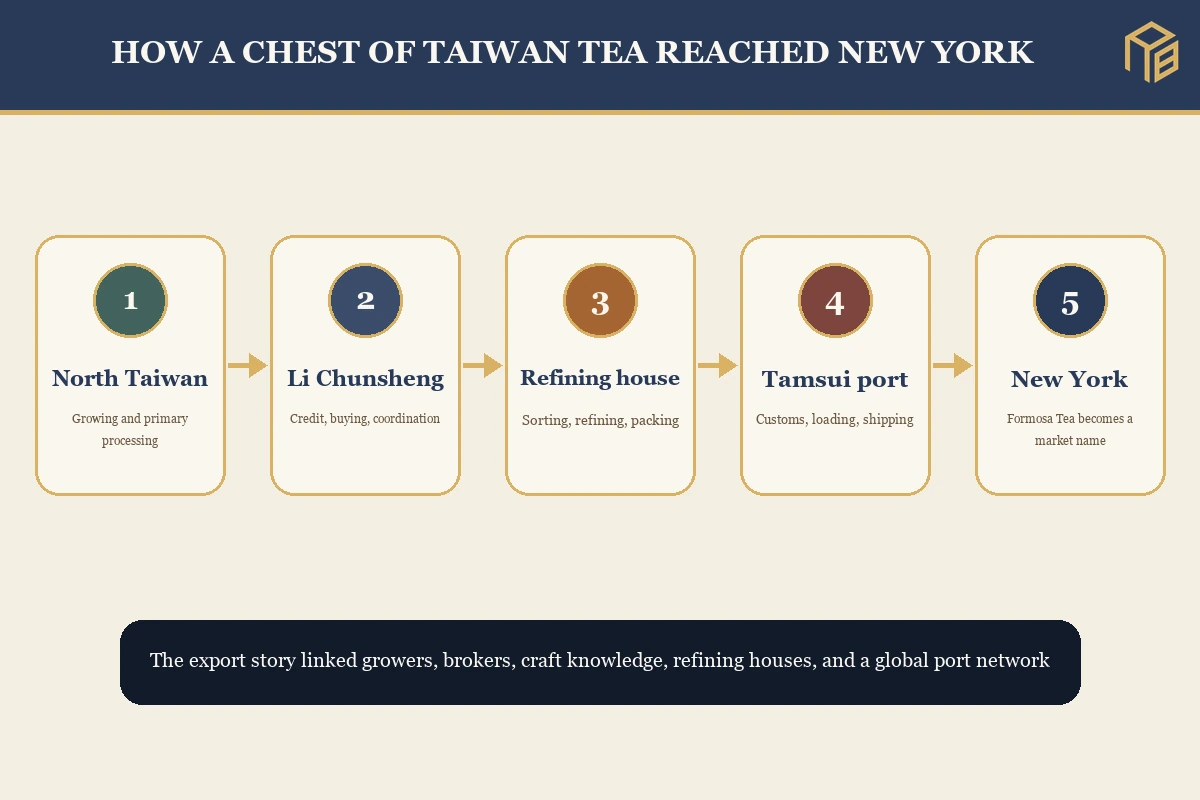
Taiwan tea export history is often told through one memorable moment: in 1869, Taiwanese oolong reached New York under the name Formosa Tea. That journey was not the work of one ship or one merchant. Growers, local commercial networks including Li Chunsheng, refining workshops in Mengjia, and the port of Tamsui made a route to the international market possible. This ABoxTik editorial guide follows the official record from 1865 to 1869 and explains why origin still matters when we introduce Taiwanese tea abroad.
How did Formosa Tea reach New York? Through a connected trade route
By the mid-nineteenth century, northern Taiwan already grew tea and made rough tea, but much of it still needed to travel to Xiamen or Fuzhou for further processing or sale. After Tamsui became a treaty port, its river-and-sea connection created a practical gateway to overseas trade. Our Taiwan tea regions guide explains the geography behind those northern growing areas. John Dodd recognized the commercial potential of northern tea; official accounts describe Li Chunsheng as the local comprador who helped connect commercial work and tea cultivation.
This is best understood as a network, not a hero story: capital, seedlings, growers, buying, refining, packing, and port logistics had to work together. For a broader introduction to tea styles, see our guide to Taiwanese tea and why Taiwanese tea is special.
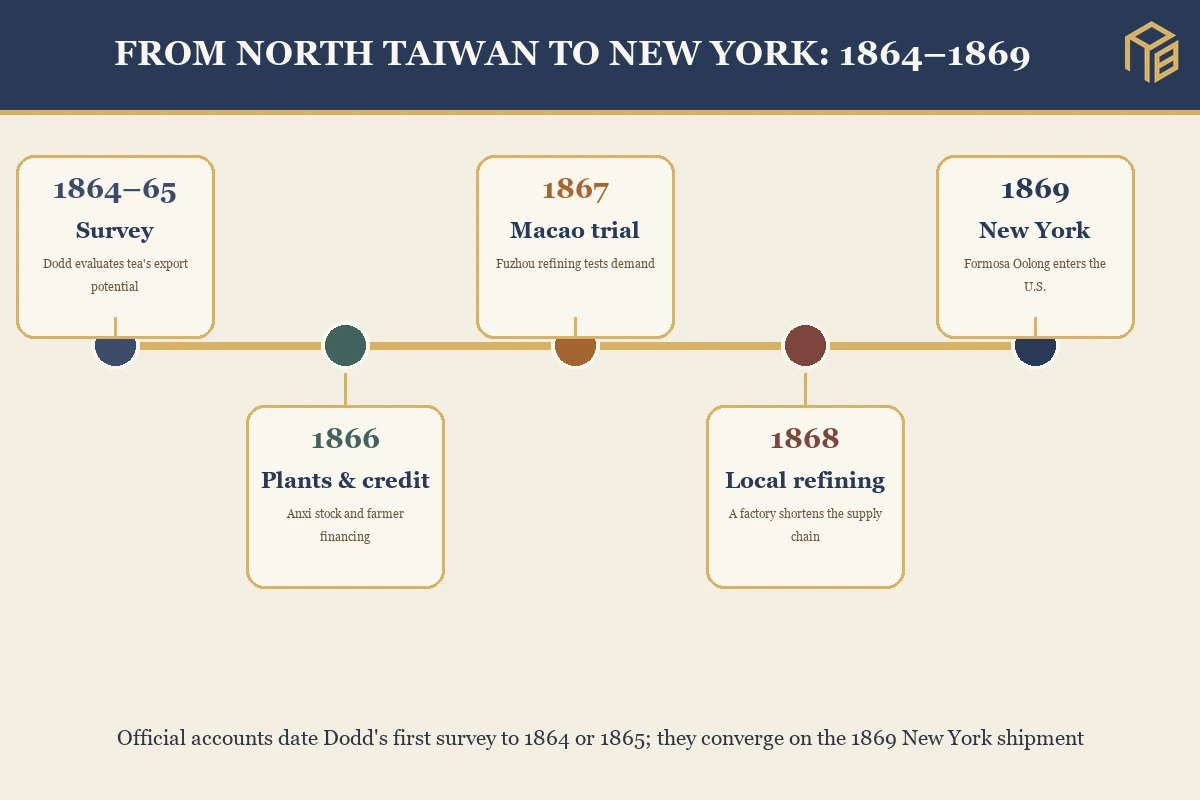
Four turning points, 1865–1869
| Year | What changed | Why it mattered |
|---|---|---|
| 1865 | A Tamsui customs record documented 82,022 kg of tea exports. | It provides an important early record of Taiwan tea leaving the island. |
| 1866 | Seed and seedlings from Anxi, together with credit for growers, expanded organized cultivation. | Supply could grow beyond scattered small-scale production. |
| 1867–1868 | A Macau sales trial was followed by a refining factory in Mengjia. | More processing and packing could be completed in Taiwan. |
| 1869 | Taiwanese oolong was sold directly to New York as Formosan or Formosa Tea. | The island gained a clearer identity in the American market. |
One dating nuance is worth keeping: one Ministry of Agriculture account dates Dodd’s arrival or investigation to 1864, while the Tea and Beverage Research Station dates his camphor inspection and tea-development turn to 1865. Rather than present either as an uncontested single date, this article uses “the mid-1860s” for the beginning of that work.
A port let the river meet the sea; a workshop made leaves into tea that could be recognized. Formosa was not only a label, but the beginning of a cross-ocean introduction.
From Mengjia and Dadaocheng to Tamsui
Official sources identify the 1868 refining factory in Mengjia as a decisive step. Tea came in from the surrounding hills to be sorted, refined, packed, and traded; related tea activity later concentrated in Dadaocheng. The port at Tamsui then connected that commercial system to the sea.
Accounts commonly describe two sailing vessels carrying oolong directly to New York in 1869. Exact shipment weight and vessel terminology vary among historical summaries, so we do not build the story around a disputed figure. The durable fact is that Taiwanese oolong was presented to New York under the Formosa name rather than only passing through established transshipment routes.
What did the 1869 New York shipment change in Taiwan tea export history?
The shipment did not invent Taiwanese tea overnight. It changed the scale and visibility of a trade that had already depended on northern growers, river transport, brokers, refiners, packers, and customs officials. Tea and Beverage Research Station material describes the years after 1869 as a period in which foreign firms entered and purchased oolong at higher prices. That demand helped make tea one of late-Qing Taiwan’s defining export products, while Dadaocheng grew into a commercial center shaped by tea.
It also changed how origin was communicated. A tea sold simply as oolong named a style; Formosa Oolong connected style to an island. The name could not guarantee every lot’s quality, but it gave buyers a geographic reference they could remember. That distinction still matters: modern origin language should help a reader understand where a tea was grown and made, not turn history into an unsupported quality claim.
The people behind the route should not disappear behind the two best-known names. Dodd and Li Chunsheng matter because surviving accounts record their roles, yet the product depended on many unnamed growers, tea makers, port laborers, and trading staff. Treating the route as a network produces a more useful history than repeating a single-founder legend.
Why oolong, and why Formosa?
MOA material identifies oolong as the representative early tea sold abroad as Formosa Tea. “Formosa” was an international-era name for Taiwan; used on tea, it gave overseas buyers both a tea type and a place of origin. Aroma and refinement mattered, but a recognizable origin also helped build trust.
That lesson remains useful today. When we introduce Wenshan Baozhong, Dong Ding Oolong, or high-mountain oolong, we can say where it was grown, which cultivar it uses, how it was made, and how to brew it. Our guides to oolong oxidation and smelling dry, hot, and cooled tea show how process and sensory language can make that explanation more concrete. Explore the cultural setting in our tea ceremony guide.
A present-day way to share Taiwanese tea overseas
Nineteenth-century export is not a blueprint for modern tea buying. Today, Taiwan tea is often appreciated through smaller lots, growing areas, cultivars, and distinct flavor profiles. The story of TTES No. 8 Assam black tea also shows how Taiwan’s tea economy kept adapting after the oolong-export era. A tea gift does not need to claim it contains all of that history; it can state origin and brewing guidance clearly, then let the first cup start a genuine conversation. For recipients without teaware, whole-leaf pyramid tea bags offer one modern bridge between leaf quality and convenience.
At ABoxTik, we believe refined packaging should make a tea’s story easier to understand, never conceal the tea itself. Discover the selection behind ABoxTik’s classic Taiwanese teas, or compare the teas in the Classic Taiwan Tea Set.
Four details worth translating for an overseas tea drinker
- Origin: name Taiwan and the verified growing area rather than relying on “high mountain” alone.
- Cultivar: include a TTES number or cultivar only when the product information confirms it.
- Process and flavor: explain oxidation, roasting, and observable aroma instead of attaching vague wellness promises.
- Brewing: give vessel, water temperature, infusion time, and re-steeping guidance so the first cup has a fair chance to succeed.
Those four details turn Taiwan tea export history into useful present-day communication: not a claim that every modern tea reenacts 1869, but a clear invitation to understand one tea on its own terms.

Follow ABoxTik
Share Taiwan through a tea with a clear story
From northern Taiwan’s tea hills to New York, the Formosa Tea story shows how far tea can travel while remaining rooted in people, place, and craft. Whether you brew for yourself or choose a gift for someone far away, a Taiwanese tea with clear information can be a graceful first introduction to the island; read more about that selection approach on the ABoxTik story.
Sources
- Taiwan Historica, Academia Historica: A Brief History of Taiwan Tea Exports (accessed 2026-08-31)
- Tea and Beverage Research Station: Talking about Taiwan’s Old Tea (I) (accessed 2026-08-31)
- Ministry of Agriculture Food and Agriculture Education Platform: Getting to Know Tea Together (accessed 2026-08-31)