
Tea Knowledge
Tea Fixation: How Heat and Timing Shape Tea Aroma

A leaf needs time to develop, and a well-judged moment of warmth to turn a corner. Understanding that moment brings a little more of the maker’s care into your cup.
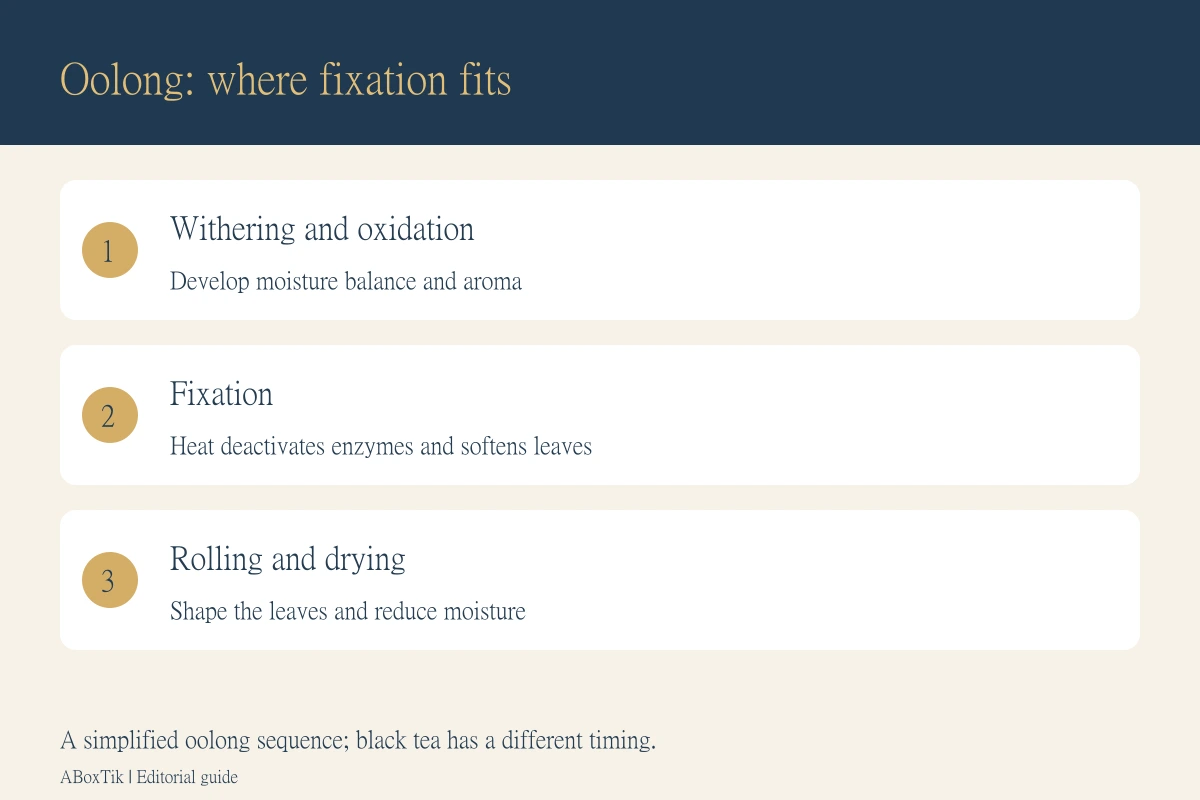
Tea fixation uses heat to deactivate oxidation enzymes in tea leaves, stopping enzyme-driven oxidation at the intended stage. It also removes some moisture and softens the leaves for subsequent rolling. Temperature and duration need to be considered alongside the leaf material, equipment and heating conditions; there is no single setting for every tea.
If this is a new term, take your time. You may also see it called “kill-green,” a translation of a tea-making term rather than a brewing instruction. This guide takes a closer look at that one stage. For the broader journey, begin with oolong oxidation and making tea, then return here to explore the role of heat.
Tea fixation: stopping enzyme activity and preparing the leaf
In ordinary oolong and black tea production, what the trade often calls “fermentation” mainly refers to oxidation involving the leaf’s enzymes. Heating changes the conditions that allow those reactions to continue. Taiwan’s Tea and Beverage Research Station also describes fixation as helping remove some grassy character, lose moisture and soften the leaf. It is more than simply making a leaf hot.
Think of it as a handover between stages. Withering and moisture movement prepare the leaf, while tossing in oolong production helps establish conditions for oxidation. Fixation brings that earlier development to its intended endpoint. It does not make the finished aroma permanent: later processing, packaging and storage still matter.
Green, oolong and black tea: different moments for heat
Heat controls enzyme activity at different points in different processes. The comparison below is a simplified reading guide. Individual regions and tea styles may use more detailed sequences; it is not a production checklist.
| Tea style | Where heating fits | What to understand |
|---|---|---|
| Green tea | Early fixation, followed by rolling and drying | Early suppression of enzymatic oxidation helps retain a greener appearance |
| Oolong tea | Fixation after withering, resting and tossing stages | The desired development comes first, then heat stops earlier enzymatic oxidation |
| Black tea | High-temperature drying after withering, rolling and oxidation | Do not apply oolong’s pre-rolling fixation sequence to black tea |
The Research Station distinguishes steaming or pan heating for green tea from the sequences used for oolong and black tea. A guide to the major tea types can help with names. When reading a process description, also ask when heat is applied. Two stages using heat need not have the same purpose.
Why temperature and time belong in the same conversation
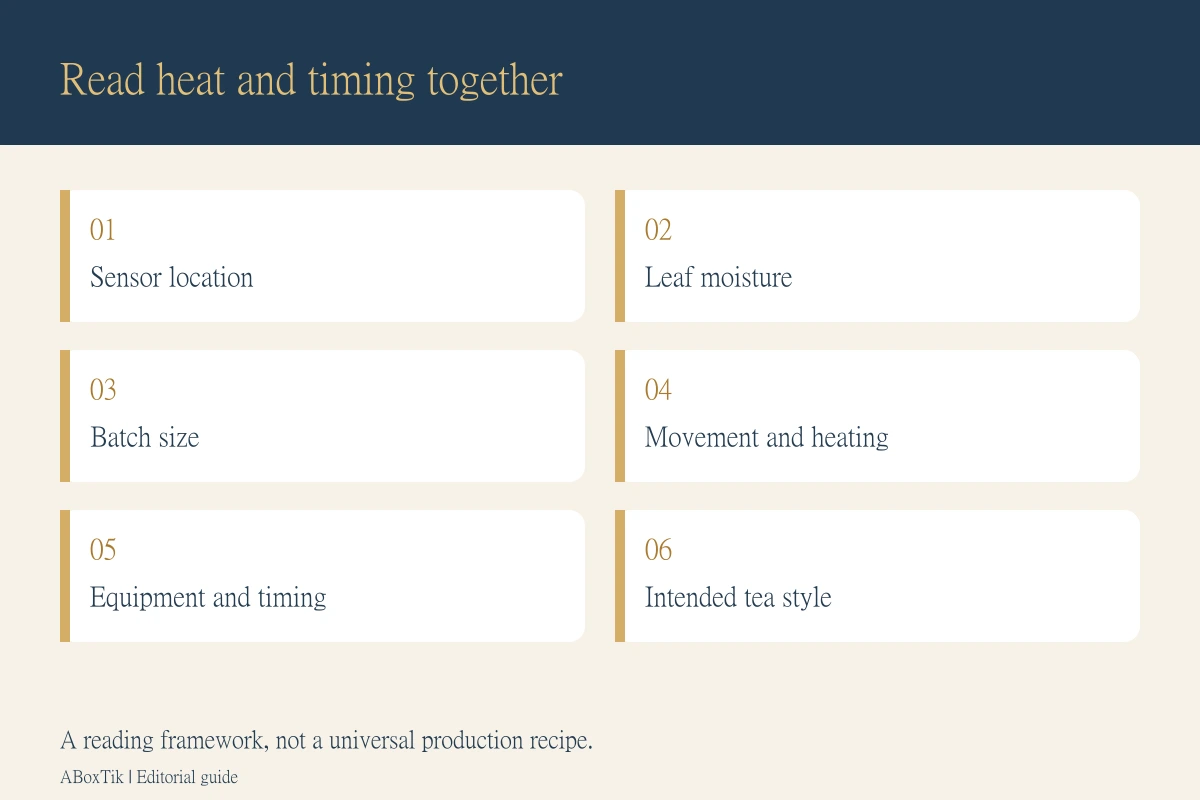
“High heat” is only a starting description. The leaves must receive suitable heating, with duration and distribution considered together. A 2015 Research Station paper on a drum fixation machine discusses scorching when heating is too intense or prolonged, and inadequate removal of grassy character and moisture when heating is insufficient. More heat or more time is not automatically better.
First ask what the temperature measures
That study measured both the drum wall and the air at different positions, finding an uneven distribution. A reading in a factory video might therefore describe a surface, air inside the machine, or a measurement of the leaves. Those readings cannot simply be substituted for one another. Data from a particular machine are also not a recipe for every producer.
This distinction gives you a useful question without requiring you to judge a factory from afar: “Where was that temperature measured?” The answer provides context. If the location is unknown, leave it unknown rather than treating the displayed number as the temperature experienced by every leaf.
Then put the batch and equipment back into the picture
Leaf moisture, batch size, movement and equipment influence actual heating conditions. A single photograph of a setting cannot show the whole operation. The earlier leaf preparation and intended tea style also matter. For background on raw material, see machine harvesting and tea quality; for growing context, explore Taiwan’s tea regions.
Fixation affects aroma, but aroma cannot identify the whole process
Alongside the change in enzyme activity, fixation involves moisture loss, softening and changes caused by heat. It needs to work with the aroma developed earlier and the shaping and drying that follow. “Preserving aroma” is a helpful shorthand, not a promise that every aromatic component remains unchanged.
A strong grassy note, burnt smell or unpleasant off-note is worth noticing. Yet one smell cannot establish that fixation was insufficient or excessive. Cultivar, earlier handling, later roasting, storage and brewing can all contribute to what you perceive. Describe the sensation first; ask about the batch second. Leave the cause open when the evidence is incomplete.
For a relaxed way to practise, read our tea aroma guide. The comparison of lighter and roasted styles can help separate floral, fruity and roasted impressions. Aroma vocabulary should make a cup more approachable, rather than turn it into an examination.
Fixation, drying and roasting each have a job
| Stage | Main role | Keep this distinction |
|---|---|---|
| Fixation | Deactivate oxidation enzymes, remove some moisture and soften leaves | Fixation alone does not mean the tea is dry enough for storage |
| Drying | Reduce moisture and help stabilize the finished tea | In black tea, high-temperature drying also stops enzyme activity |
| Roasting | Adjust moisture and flavour later, depending on the tea | A deep roast does not reveal oxidation level or fixation temperature |
The Research Station lists fixation, rolling and drying machines separately. That separation is a useful reminder to read each stage in context. You do not need to memorize machinery names. Distinguishing the purposes makes a package description or a maker’s story easier to follow.
Three gentle questions for choosing and tasting tea
- What style is this tea aiming for? Read its cultivar, origin, oxidation and roasting description. Do not rank quality by one temperature.
- Is this information about the batch, or the general style? Without batch records, treat process descriptions as background. Avoid supplying missing factory settings yourself.
- What do I actually notice in the cup? Start with the package’s brewing advice, record aroma, sweetness and bitterness or astringency, then change one brewing variable at a time.
You could explore the current descriptions of Dong Ding Oolong and Honey Red Oolong, or browse our tea collection. These are starting points for tasting, not experimental samples that differ only in fixation. Their materials and other processing conditions may differ too.
Use the same cups and water source, follow each tea’s suggested preparation, and record dry-leaf aroma, warm liquor and the cup after slight cooling. These are personal notes rather than official judging or a way to reconstruct factory operations. For another perspective on selecting tea, see our guide to premium tea price and value.
Bring a little of the maker’s judgement into your cup

Explore tea with ABoxTik
The thoughtful part of tea fixation is knowing when the leaf needs to turn a corner. Earlier air and waiting meet heat, then hand over to rolling, drying and possible roasting. If you are new to this, a slow read and a quiet cup are enough. Understanding the separate jobs already brings you closer to the craft.
Explore Taiwanese tea’s landscape and craftsmanship and ABoxTik’s story. We hope that clear, welcoming explanations make a Taiwanese flavour easier to enjoy and share.
Related reading
- Oolong oxidation and making tea: put fixation back into the larger sequence.
- Tea aroma guide: keep a tasting notebook in your own words.
Sources
- Taiwan Tea and Beverage Research Station: Taiwanese tea classification and processing (Chinese).
- Research Station: tea-processing machinery (Chinese).
- Tea Research Newsletter, issue 93, September 2015: improving temperature distribution in a drum fixation machine, pp. 7–8 (Chinese). The equipment observations are not universal operating specifications.
Sources checked: 2026-10-04. Diagrams are editorial summaries. Tasting suggestions are observation frameworks; no factory visit, production trial or controlled experiment is claimed.