Tea Knowledge
Tea Gifts for Teachers: Thoughtful Choices and School Rules
Tea Gifts for Teachers: Start with Permission
Tea gifts for teachers work best when the school’s policy comes before the shopping list. Check whether the teacher may accept a physical gift, then consider familiar flavours, brewing equipment and a suitable amount. If gifts are not allowed, a specific, thoughtful card can express the whole thank you. Tea is one possible way to show appreciation, not something a teacher should have to explain or quietly return.
It is natural to want to acknowledge a patient explanation, a well-timed word of encouragement or the person who helped a child ask questions again. Keep that feeling, and take a moment to choose the form. Appreciation does not need to be measured by the size of a box. A useful gesture gives the recipient room to accept, decline or simply read the card without another task attached.
This guide considers teacher appreciation in Taiwan throughout the year, including Teacher’s Day and graduation. Readers elsewhere should check their own school’s rules. Our general thank-you guide covers card messages and tea pairings; here, the teacher’s role and boundaries shape the decision before any flavour is chosen.
Thank-you tea gifts and card messages · The tea-gift selection guide
Check the School’s Rules Before Choosing Tea
Taiwan’s Civil Service Integrity Ethics Directions do not automatically apply to every public-school teacher. Employment status, administrative responsibilities, the school’s rules and the circumstances all matter. The Ministry of Education’s ethics rules expressly cover teachers without administrative duties at its subordinate public schools; local authorities can have separate rules. Private schools and tutoring providers can also have gift policies. The label “private” is not an invitation to skip the question, and rules from Taiwan should not be carried over to another country as if they were universal.
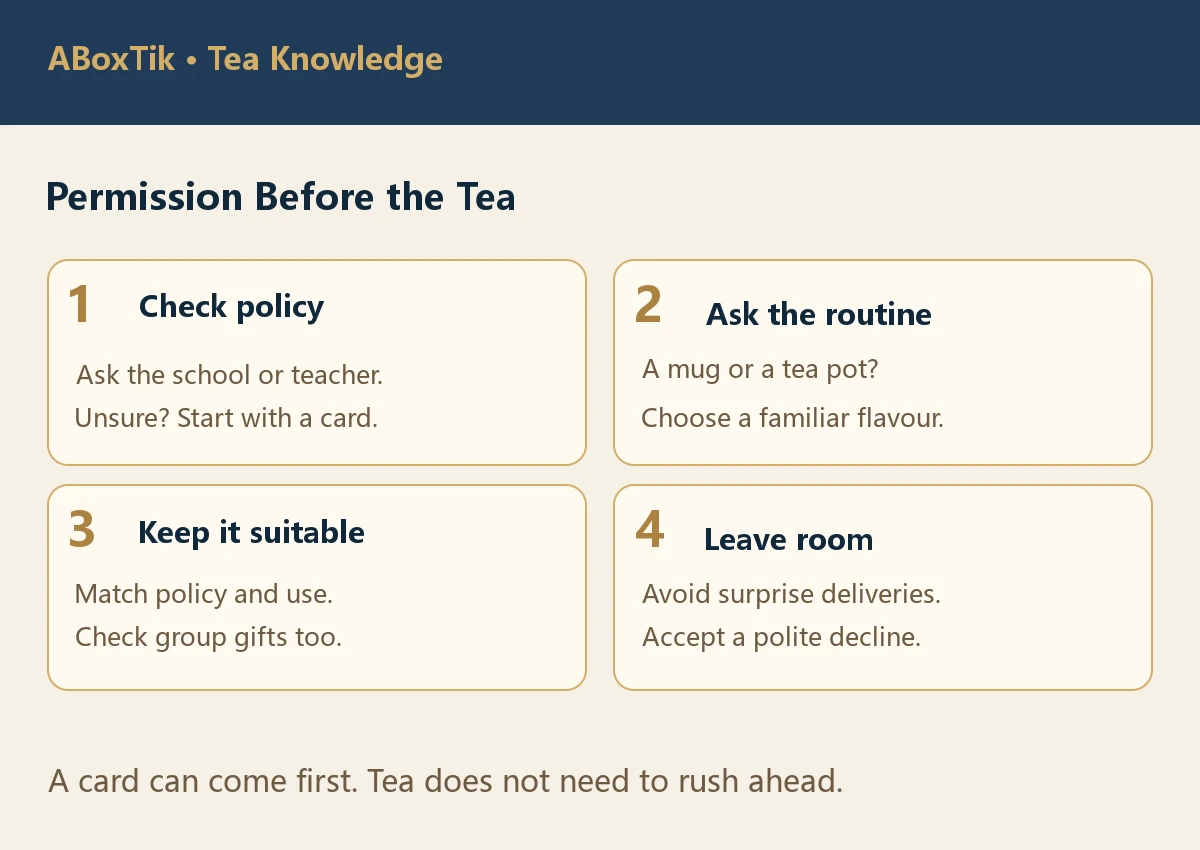
Ask the school whether staff may receive gifts from students or parents, and whether individual and class gifts are treated differently. If the answer is unclear, seek guidance from the relevant school office. Starting with policy is kinder than asking a teacher to invent a graceful excuse after a parcel arrives. Until the position is clear, choose a card rather than a physical gift.
A low price, a holiday, a group contribution or graduation does not by itself establish permission. Never attach a gift to a request concerning grades, recommendations, applications or another pending decision. Discuss learning needs through the usual school channels. If the teacher declines, accept that answer without trying a smaller box, a different delivery address or a child acting as an unofficial courier.
Everyday Thanks, Teacher’s Day and Graduation
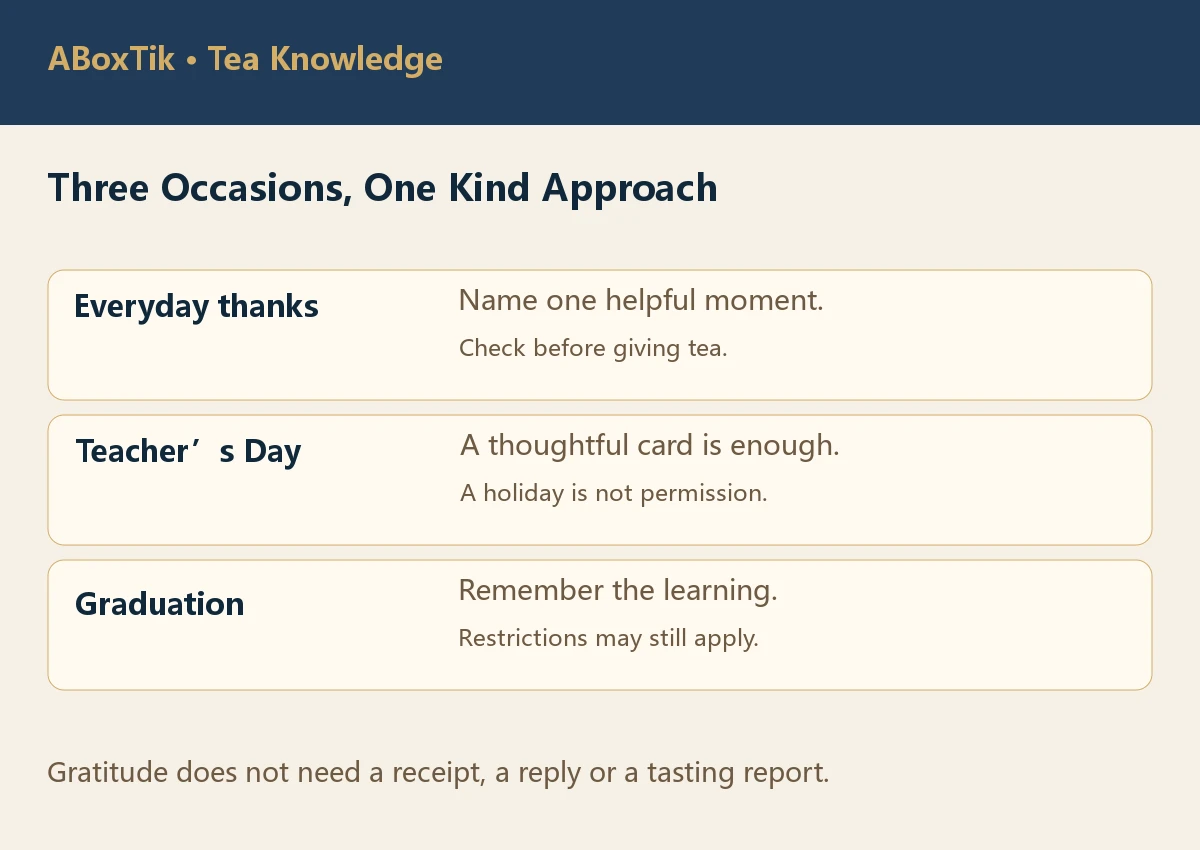
For everyday appreciation, one remembered moment is often the strongest starting point. Describe the explanation that made something click or the encouragement that helped a student try again. A teacher can recognise the meaning without being presented with an expensive object. Where physical gifts are restricted, let the card do the work on its own.
Teacher’s Day can prompt a family or class to collect those memories, but the occasion does not override gift rules. For a shared card, invite each student to write a sentence in their own voice. Participation should remain voluntary. If a class proposes a tea gift, check permission first; dividing the cost between families does not remove the question of whether the teacher may receive it.
Graduation offers a chance to look back on learning rather than settle a relationship with a present. Restrictions may still matter, especially if a recommendation or other process remains open. A short learning reflection or a collection of messages can be complete without tea. Try choosing one starting line: “Thank you for that moment,” “Wishing you a happy Teacher’s Day,” or “Thank you for this part of the journey.” The choice makes a card sound like a person, rather than an awards speech downloaded at midnight.
Match the Tea to the Teacher’s Brewing Routine
Once permission is confirmed, ask how the teacher actually makes tea. Someone using a mug between tasks may appreciate measured tea bags; an established pot or gaiwan user may prefer loose leaf. These formats describe how tea is used, not a quality ranking. There is little benefit in sending an elaborate brewing kit to a desk that already has everything it needs.
Flavour questions can stay simple: floral and fresh, or toasted and rounded? There is no need to test the teacher’s knowledge of mountain names. If the answer is that they do not drink tea, respect it rather than searching for a tea that might convert them. A gift should fit an existing routine, not require the recipient to enrol in a new hobby.
Consider who will use it, the package size, ingredients, best-before information and brewing instructions. A gift intended for staff sharing still needs permission; “for everyone” is not a policy exemption. Where ingredients matter to the recipient, check each product label. Names suggesting relaxation or wellness are not substitutes for that check, and a gift card should describe flavour rather than promise a health result.
Pyramid tea bags and brewing · Whole leaf and broken tea
Use Familiar Flavours Instead of Guessing by Age
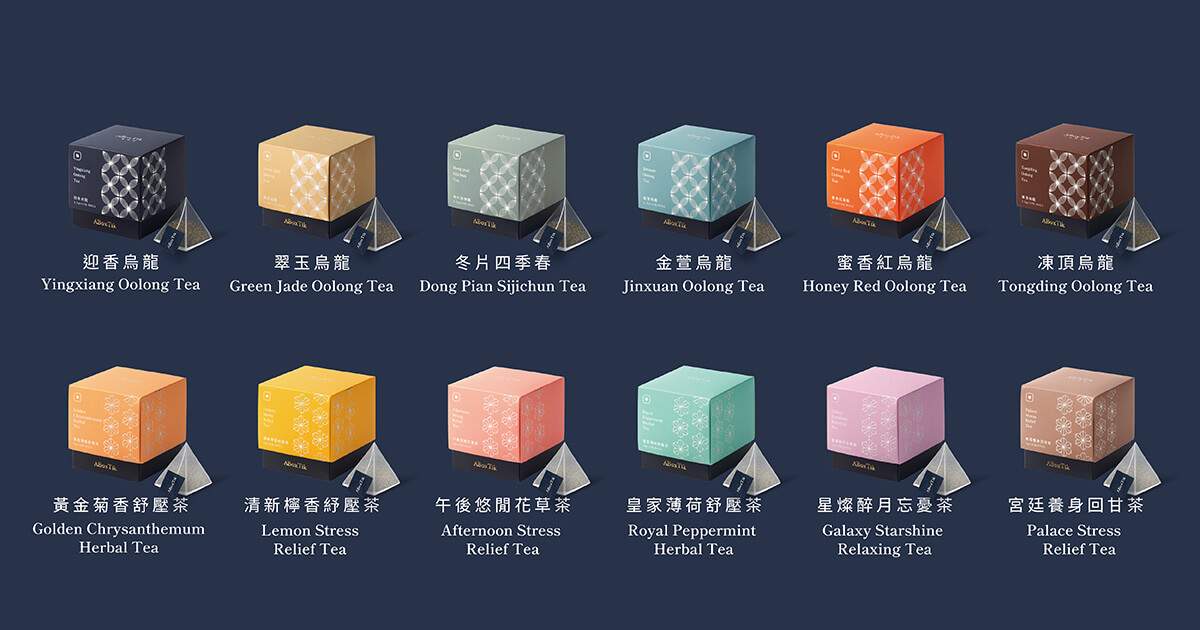
For a floral preference, compare the descriptions of Yingxiang or Green Jade oolong. For a toasted profile, explore Dong Ding or another clearly described roasted tea. Teaching subject, age and classroom style do not reveal drinking preferences. A mathematics teacher is quite entitled to a cup that does not taste like a formula.
If the teacher already enjoys one style, stay near it. If they enjoy comparison, two distinct choices may offer more useful variety than several similar names. Aroma descriptions are selection clues; the experience still depends on the tea and how it is brewed. Avoid writing that a particular tea is guaranteed to be their favourite.
Product details deserve the same attention as the flavour name. ABoxTik’s current Jin Xuan oolong description emphasises roasted sugar and cane-sweet notes, so its cultivar name should not be taken as a promise of an intense milky aroma. The two-selection tea-bag gift set currently contains two boxes of ten bags, twenty bags in total. “Two selections” does not mean two individual tea bags, and fewer selections do not establish a low price or permission to give the set. Check quantity, price and policy separately.
A guide to smelling tea · Light and roasted Taiwan oolong · Tea-box selections and quantities · This Jin Xuan oolong’s flavour profile · Yingxiang oolong flavours · Understanding roasted tea aromas
Ask Gently, Deliver Only by Agreement
A clear opening might be: “We would like to thank you for this term. Does the school allow a tea gift? If not, we will write a card.” Including the alternative makes a direct answer easier. After permission, agree on a convenient handover. Avoid interrupting a lesson, arranging an unexpected school delivery or sending something to a private address without consent.
A card can say: “Thank you for your help with ____. It helped me / our child learn ____. We have remembered that moment.” If tea is permitted, add a simple invitation to enjoy it whenever convenient. There is no need to mention its cost, ask for a photograph or request a report on which flavour was opened first. Gratitude is allowed to have a quiet ending.
Before buying, ask three final questions: Is giving this gift permitted? Does the tea suit the recipient’s tools and preferences? Is the message free of any expectation in return? If the first answer is missing, pause the purchase. A card can go ahead. If the gift is declined, keep the tea for your own household and leave the thanks intact; a delivery receipt is not proof that appreciation mattered.
Follow ABoxTik: Leave Room for a Comfortable Thank You
The most thoughtful tea gifts for teachers begin with respect, then become a flavour decision. Check the rules, listen to the teacher’s answer and choose something that fits their daily cup. A card alone can be a complete expression of gratitude, especially when it records one real moment of learning.
Where a tea gift is confirmed as permissible and useful, explore ABoxTik’s tea information at an unhurried pace. Familiar pure tea, clear ingredients and an easy first cup matter more than a larger box. Use the tea-gift guide to compare options, and let the final choice keep the same spirit as the card: warm, specific and free of pressure.
Everyday tea brewing · About ABoxTik