
Tea Knowledge
Sanxia Biluochun: Northern Taiwan Green Tea and Aroma
A northern Taiwanese green tea can introduce a place one quiet cup at a time. Read its origin first, then let a personal aroma note add the detail that belongs to today.
Sanxia biluochun is a green tea associated with Sanxia in northern Taiwan. Its tightly curled dry leaves, fine hairs and fresh, delicate tasting direction offer useful starting points. A seaweed-like aroma is a possible sensory association in some batches, rather than a guaranteed feature or proof of origin.
Begin with product information and a repeatable brew. If the first impression is simply fresh, that is already a useful note. The cup has no attendance sheet for aromas, and there is no penalty for failing to find seaweed. This guide separates place, season and tasting so that each can make sense.
Put the place name and tea name in context
Biluochun has different production backgrounds in different places. Read the actual growing origin rather than assuming the name describes one uniform tea. This guide concerns Sanxia green tea in New Taipei City, without transferring the history of Dongting in China onto northern Taiwan.
The Ministry of Agriculture’s food-education platform, drawing on New Taipei City information, describes Sanxia biluochun through its tightly curled form, fine hairs and fresh, delicate character. Treat this as an introduction to a local tea, then retain the actual product’s cultivar, origin and production details for a more specific understanding.
The Taiwan tea regions guide explains the geographic map, while tea categories explains processing directions. One answers where a tea comes from and the other helps explain how it was made. Keeping those questions separate makes a small product label much easier to read.
Use the harvest season as context
Official information lists the general spring season as March to April and the winter season as October to November. Actual harvest details still depend on weather and the batch. A calendar is helpful background, rather than an appointment every garden must keep.
Ask a supplier which season the tea was made in and when it was packed. Keep the answer with the tea name. A later conversation can then begin with a specific batch instead of the charming but difficult clue that the previous one seemed more fragrant.
When comparing seasons, use broadly similar equipment and preparation, and consider opening and storage differences too. Tea storage matters after production. A harvest date does not remove the effects of making, packing and the conditions in the kitchen cupboard.
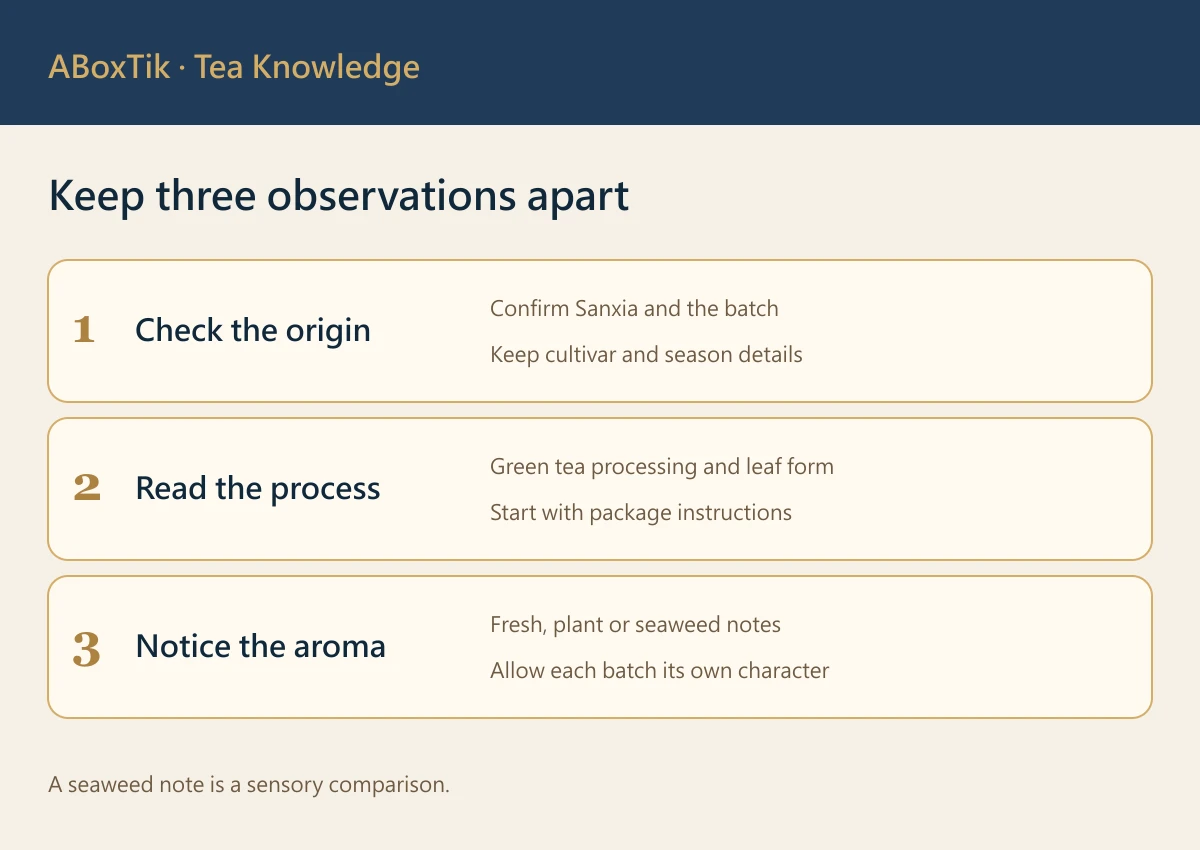
Read a seaweed note as a sensory comparison
A seaweed-like note borrows a familiar smell to communicate an impression. It does not mean seaweed was added, and it cannot identify a growing origin on its own. Someone else may first notice fresh leaves, plant notes or sweetness. Start with the association that actually arrives.
Follow the dry, hot and cooling aroma sequence. Smell the dry leaf, then the brewed cup, and taste when comfortable. If an association appears only as the liquor cools, add that timing. It is more useful than naming the entire tea after one food.
With a friend, write the first word independently before comparing notes. Seaweed and fresh leaves need not compete for the title of best nose. Ask whether each person was smelling dry leaves, the cup or the aroma after a sip; attention may simply have settled in different places.
Keep appearance, aroma and liquor in separate columns
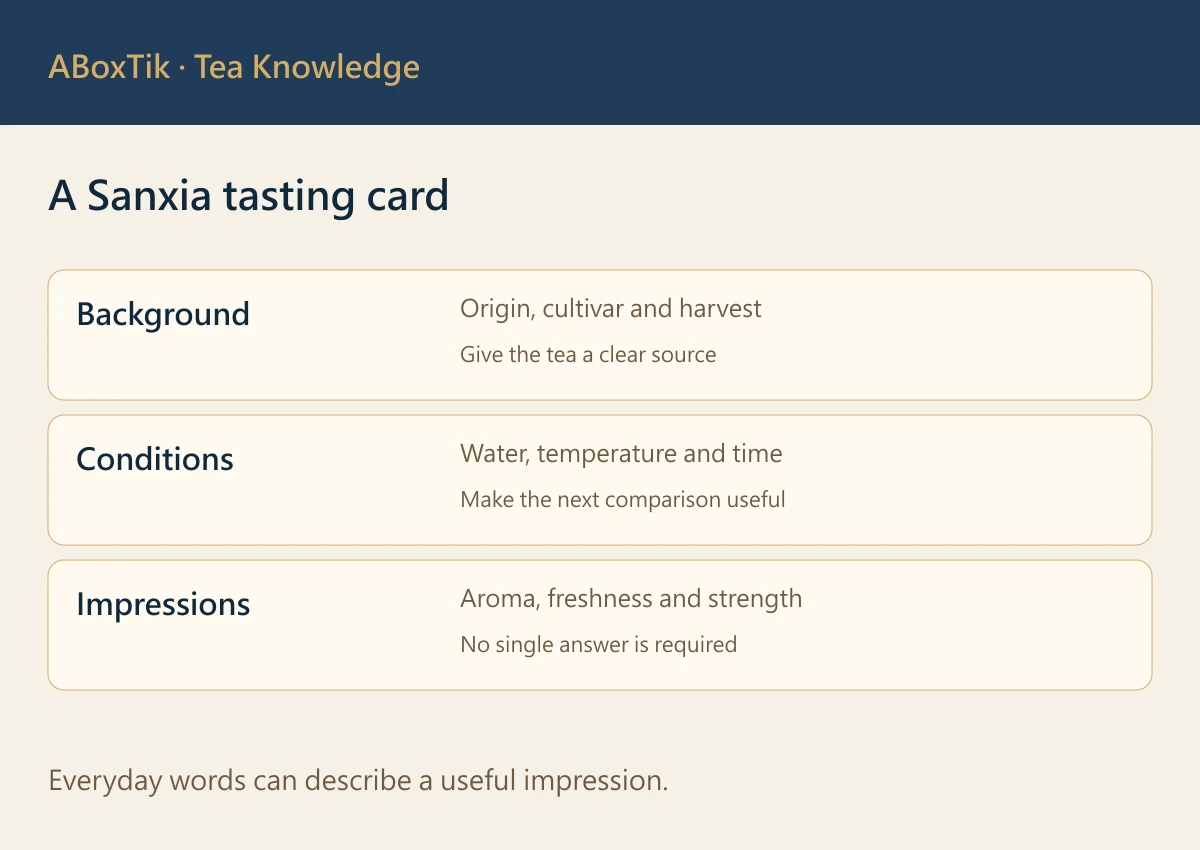
For appearance, note form, fine hairs and the state of the dry tea. For aroma, record type, clarity and change. For the liquor, separate strength, freshness, bitterness, astringency and texture. One attractive aroma word should not do all the work of describing the cup.
| Observation | First question | A useful note |
|---|---|---|
| Dry leaves | How are form and hairs presented? | Describe without ranking by appearance alone |
| Aroma | At which temperature is it clearest? | An everyday word and a time point |
| Sip | What strength and texture stand out? | Separate intensity and preference |
This is an everyday tasting card, not a competition procedure. If comparing it with light or roasted oolong, notice the differences in style rather than treating green tea as merely a weaker oolong. Different processing directions deserve their own vocabulary and a little patience.
Arrange a first brew that can be repeated
Start with the package instructions and a vessel that makes the liquor easy to see and pour out. Record leaf quantity, water, temperature and time. Equipment need not be expensive: clean, odour-free and comfortable to handle is a useful specification in its own right.
If the first infusion is too strong or astringent, change one condition next time, such as time or leaf quantity. If it is too weak, check the water volume before changing everything else. Otherwise, when the cup improves, the notes may not know which change deserves the thanks.
Use the brewing steps to build a routine and the porcelain guide to consider a suitable vessel. The aim is a repeatable starting point, rather than a flawless first attempt. A balance worth another sip leaves a clear reason to return.
For a first comparison, put two cards beside the cups and leave the origin visible. Record the package instructions before tasting so that a later change has a clear starting point. If one cup seems more savoury, repeat that observation without immediately explaining it through soil or weather. A useful note distinguishes what was noticed from what might explain it. On another day, try the preferred preparation again before buying a larger amount. That small repeat tells the drinker more about everyday enjoyment than one unusually memorable sip.
Bring four small questions to the purchase
Ask about actual origin and cultivar, season or batch, tea format, and packing and storage instructions. For a gift, also consider the recipient’s mug, filter or pot. An easy brewing explanation helps the gesture continue beyond the first opening.
| Question | Purpose | Information to keep |
|---|---|---|
| Origin and cultivar | Clarify what the name describes | Package and source details |
| Season and batch | Give comparison a reference | Production or packing date |
| Amount and format | Fit equipment and routine | Weight, portion and instructions |
For examples of convenient sharing formats, review the actual contents of a Taiwanese tea selection or two-box tea gift. Confirm a green tea’s availability from its product information. A guide to a region does not imply that every mixed gift includes that tea.
Bring the place into an ordinary day
Next time, try only three things: confirm the batch, keep one preparation steady, and record one aroma and one texture. If no seaweed association appears, write that honestly. A personal impression need not be edited to satisfy the headline.
For a wider view, explore Taiwanese terroir and craft, then learn about different cultivars through Jin Xuan and Red Jade. Following one interesting question at a time is more comfortable than attempting to drink the entire map.
When sharing, ask first whether the cup appeals, then what part of it is enjoyable. Knowledge provides directions, but a comfortable pace and someone willing to listen often make the occasion memorable. A fresh cup can be a beginning without needing to prove everything about its place.

Follow ABoxTik
Leave a personal note for northern Taiwan’s freshness
At ABoxTik, a clear origin and an individual response both deserve space. Begin with one northern Taiwanese green tea and keep a detail worth returning to, without searching for every possible aroma.
Compare the tea styles and formats in our Taiwanese tea gift boxes and choose instructions that suit the recipient’s equipment.
Related reading
Sources
Sources checked 19 October 2026.