
Tea Knowledge, Tea Set
What Is Stoneware? A Thoughtful Guide to Stoneware Teaware
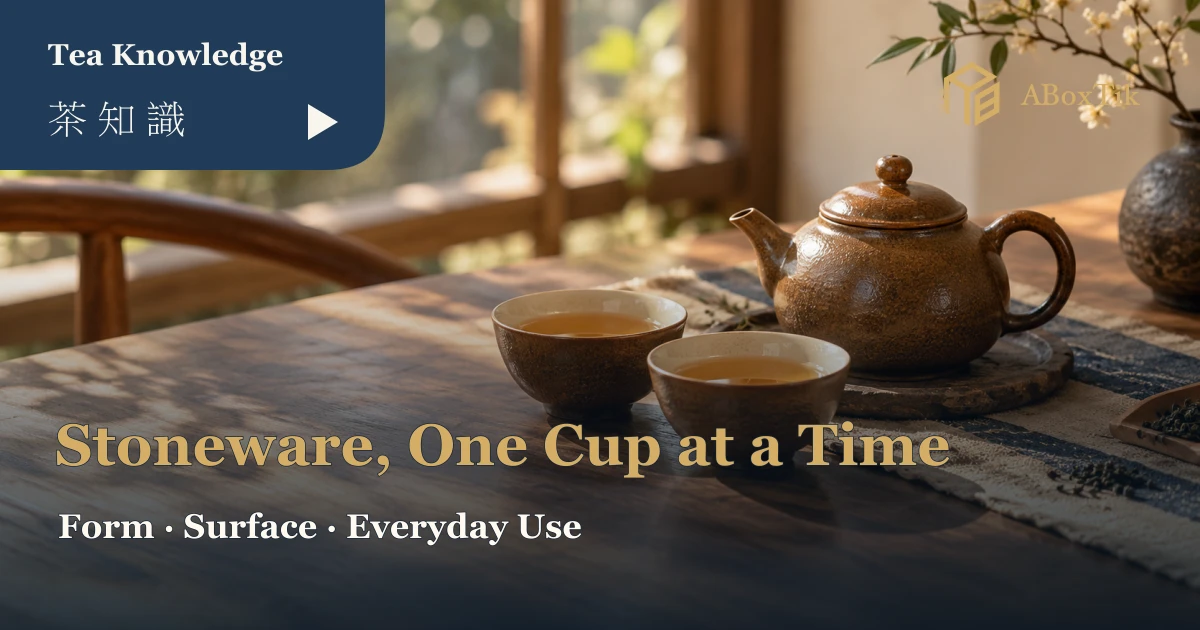
A favourite vessel earns its place one ordinary cup at a time. Begin with a comfortable rim and a steady pour, and let a story of clay and fire become part of tomorrow’s tea.
Stoneware teaware belongs to a family of clay ceramics fired to form a relatively dense body. It is usually opaque and may be glazed or unglazed. The familiar description “between earthenware and porcelain” is a useful introduction to material characteristics, rather than a recipe mixing the two or a middle position on a quality ladder.
A new ceramic name can make shopping feel unexpectedly like homework. Fortunately, the tea is not setting an exam. Begin with four useful questions: what is the body, what covers its surface, how does the shape work, and what is it designed to do? For a wider comparison, start with the teapot materials guide; this guide takes a closer look at stoneware itself.
What is stoneware within the ceramic family?
Ceramics is a broad family. Museums often discuss earthenware, stoneware and porcelain through the clays used and the properties produced by firing. Terminology varies across places and traditions. As a starting point, stoneware generally has a dense, relatively low-absorption, opaque body; the particular clay blend and firing determine the finished result.
The Museum of Oriental Ceramics, Osaka, considers clay, body hardness and density, water absorption and glazing together. That is a helpful reading order: the name opens the conversation, while the material details make it useful. Stoneware is made from clay, rather than a cup carved out of a rock. There is no need to bring a small mountain to the tea table.
| Common name | A material starting point | Ask next for teaware |
|---|---|---|
| Earthenware | Usually a more porous body; glaze changes the contact surface | Glazing, intended use and cleaning |
| Stoneware | Usually dense, low-absorption and opaque | Body, inside and outside surfaces, hot-water instructions |
| Porcelain | Usually dense; thin areas may be translucent, with varied appearances and recipes | Shape, capacity, rim and surface condition |
Everyday names can be broader than technical categories. If a label says “high-fired pottery,” ask the maker to explain the actual material rather than guessing from the phrase. Taiwanese ceramic craft history offers a wider view of the industries, workshops and creative choices that bring ceramics to Taiwanese homes.
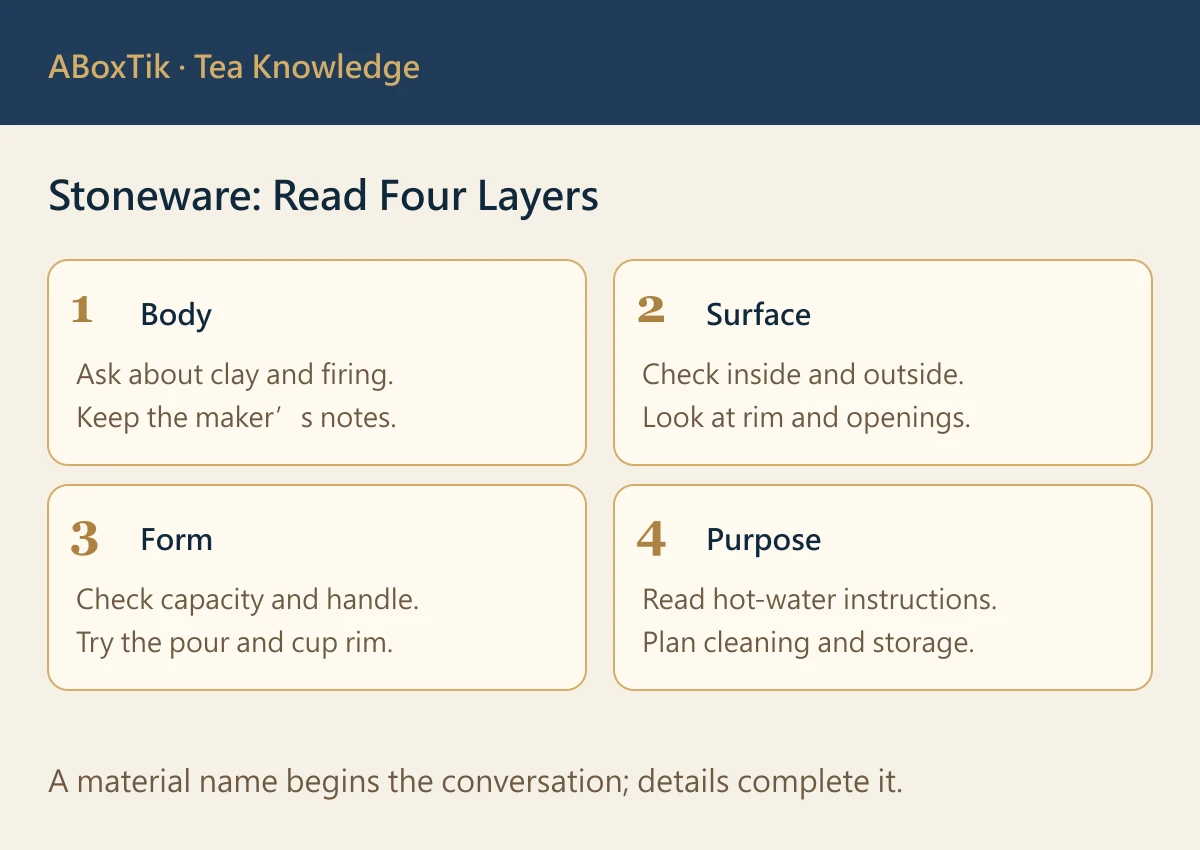
Does a rustic appearance identify stoneware? Read four layers
Grey, brown and earthy surfaces often suggest stoneware, but colour is shaped by clay, glaze and firing. Stoneware can also carry a smooth glaze and a carefully refined form. Colour and weight alone cannot identify the body. The V&A’s studio pottery introduction shows stoneware within both functional objects and individual artistic practices; rustic is one expression among many.
- Body: what material does the maker name, and what clay and firing information is available?
- Surface: are the inside and outside glazed in the same way? Inspect the rim, spout and strainer openings.
- Form: do the opening, handle, rim and capacity fit the way tea is served?
- Purpose: is the piece intended for tea, and what instructions cover hot water, washing and storage?
Wood firing, hand building and a place name each tell a different part of a story. Miaoli pottery and Yingge ceramics explore local contexts. Keep “where it was made,” “what it was made from” and “how it was fired” as separate questions; a conversation with the maker becomes much more revealing that way.
What does stoneware offer at the tea table?
The appeal may lie in glaze, texture, proportions or the way a cup settles into the hand. A comfortable rim and a stable base matter every time the cup is lifted. Begin with one piece that invites regular use; the whole table does not need to come home in one shopping bag.
Temperature behaviour also depends on wall thickness, capacity, opening, lid, preheating and the room. A thick stoneware pot and a thin one can behave differently. The material name alone cannot predict how long either retains heat or which tea will suit it. Follow the tea and vessel instructions, then use brewing guidance and steeping-time guidance to organise the practical details.
For rotating between teas, look for an interior that can be cleaned and an opening that allows leaves to be removed. If observing liquor colour matters, consider the interior colour and lighting. the porcelain brewing guide provides another observation starting point. For an unglazed pot, the clay-pot care guide goes further into cleaning and retained smells. Material choice and care for an individual piece can be considered in separate, manageable steps.
Keep a four-field card when choosing a piece
A simple question such as “We usually drink tea as a pair; how would this pot work for us?” is enough to start. Four notes on a phone can connect an attractive glaze to a real daily routine.
| Field | A useful question | Keep before taking it home |
|---|---|---|
| Material and maker | What are the body, glaze and maker details? | Piece name, maker and material notes |
| Intended use | Is it intended for hot tea? What is the working capacity? | Instructions and a suitable serving arrangement |
| Handling | May I try room-temperature water? | Filled weight, lid behaviour and the end of the pour |
| Daily care | How should it be washed, dried and stored? | Cleaning instructions and uses to avoid |
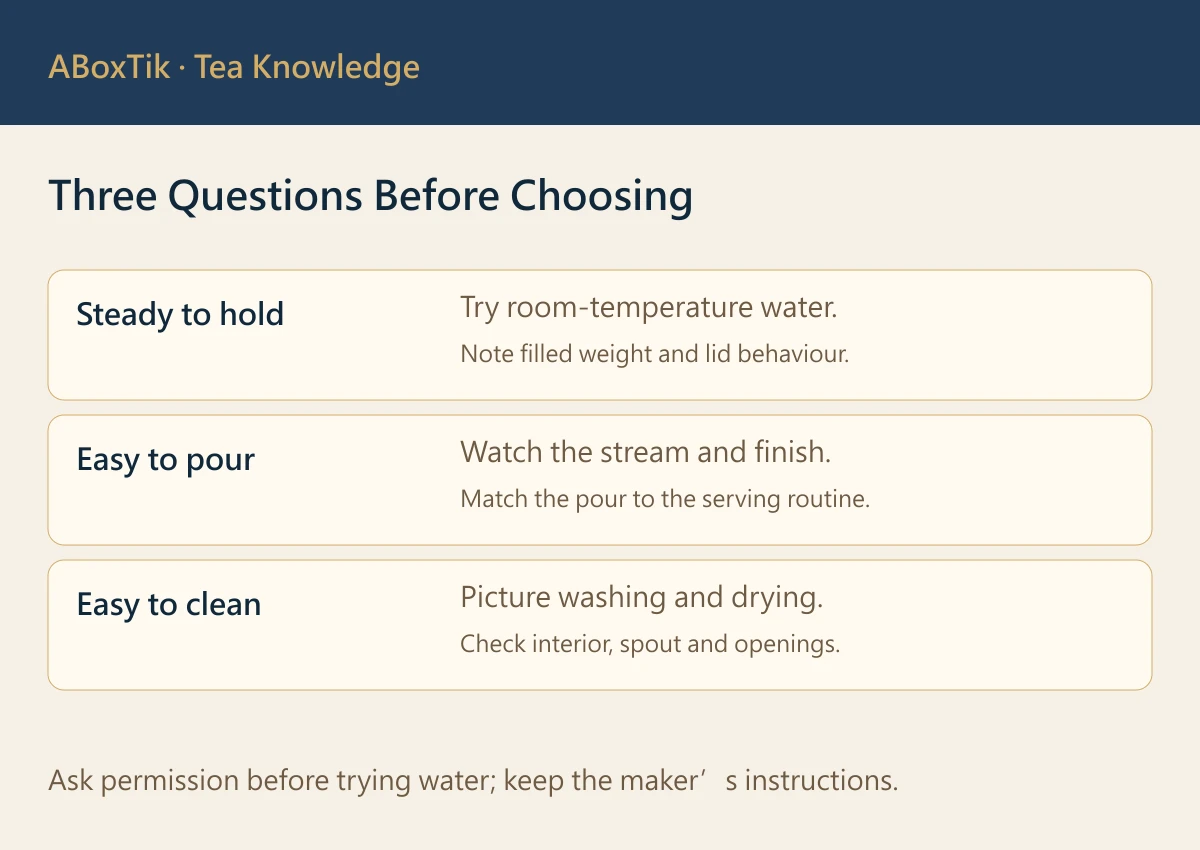
With the shop’s permission, fill to the usual working level with room-temperature water. Check that the piece can be held steadily, then watch the stream, lid and any dripping after the pour ends. For a cup, focus on grip and rim. Finally, picture washing it: can water or a suitable brush reach the interior? Beauty that extends into easy cleaning is more likely to become part of everyday life. the gaiwan and teapot comparison helps compare forms, and the beginner gaiwan guide offers a gradual introduction to handling a gaiwan.
Try familiar tea and leave room for a useful observation
Brew a familiar tea with the usual method and note leaf quantity, water volume, timing and pouring speed. When changing vessels, adjust one condition at a time. Even without a dramatic flavour difference, “easier to hold” is a worthwhile finding. A cup does not owe anyone a revelation every afternoon.
For a floral direction, explore the background of Wenshan Baozhong; for a roasted style, read about Dong Ding oolong. These are tea choices, while the word stoneware does not assign a flavour to every batch. the tea aroma guide helps begin with one familiar smell. Changing tea, water and pot together makes a note rather like a group photograph with nobody labelled.
A small question for today: which matters most—an appealing glaze, a steady grip or easy cleaning? Pick a first priority, then look for a shape that supports it. That answer is easier to carry to the next shop than a long list of ceramic legends.
Common questions about stoneware teaware
Is stoneware always unglazed?
No. It can be glazed or unglazed, and the interior may differ from the exterior. Examine the surface touching the tea and ask for the maker’s use and cleaning instructions.
Can sound, weight or colour identify it?
Those clues are insufficient on their own. Shape, thickness, clay and glaze all influence what is seen and heard. Maker information is more useful than turning the cups into a miniature percussion section.
Can it go in a dishwasher, microwave or over a flame?
Check instructions for the individual piece, including decoration, metal components, construction and intended heating method. A high firing temperature does not replace instructions for the finished vessel.
Does it need a special seasoning routine?
Remove leaves, wash as directed, and let the piece dry thoroughly before storing. A surface that can be inspected is more useful than deliberately keeping tea deposits. Ask the maker how to handle chips, cracks or damaged glaze. The clay-pot care guide above covers maintenance in more detail.
Should a beginner buy a complete set?
One comfortable cup is enough. Use it for a while and note capacity, rim and cleaning before deciding whether a pot or sharing vessel would help. For a present, the tea gift guide can help put the recipient’s routine first.
Tea, one box at a time · A comfortable vessel, a cup enjoyed slowly.
Make room for stoneware in an ordinary, comfortable tea routine
Understanding stoneware can begin with body, surface, form and purpose. To explore pieces, browse Taiwanese teaware and craft selections and read the details for each work. For a familiar tea to accompany a new cup, look at the four-box Taiwanese pure tea gift; ABoxTik’s story shares how ABoxTik brings Taiwanese tea and craft into everyday life. Leave a little time for the feel of a piece, and a little room for the next cup.