
Tea Knowledge
How Tea Roasting Works: First Roast, Re-Roast and Resting
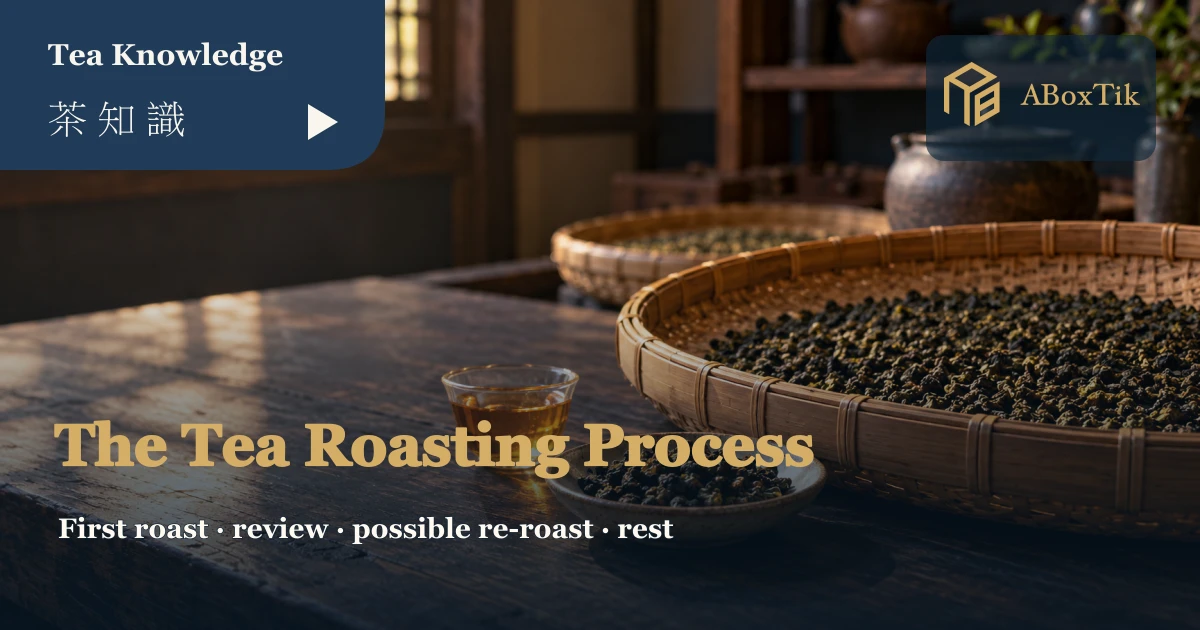
Good heat has a pause in it: let the tea travel one stage, then listen to what it says back.
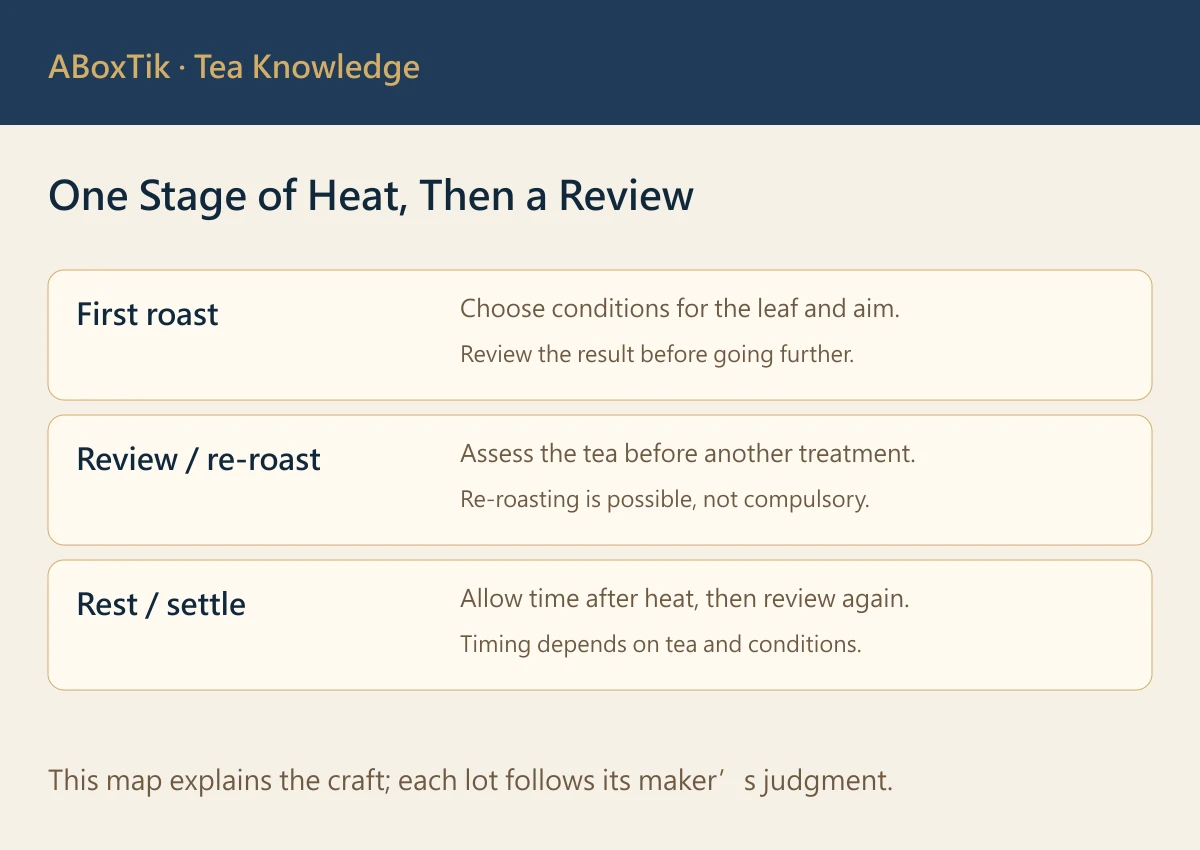
A useful way to understand the tea roasting process is first roast, review, a possible re-roast, then resting. It is not one temperature and one timer that every maker should copy. The leaves, earlier processing, present condition and intended style all matter. “Re-roast” can sound dramatic, but it is closer to a careful follow-up than a second attempt at passing an exam.
For language to describe the cup, visit our roasted tea aroma guide. For choosing a style, see light versus roasted Taiwanese tea. Here, the focus stays on sequence: where heat enters, when a maker pauses to assess, and why some tea is allowed time to settle.
Where roasting sits in tea making
Fresh leaves become tea through a route that changes with the tea type: withering, bruising and oxidation, fixation, rolling, drying, shaping and other steps may appear in different combinations. Roasting is generally a later heat-treatment decision. It is separate from the oxidation that develops before fixation in many oolong processes. Our oolong oxidation guide follows that earlier part of the journey.
It also helps to keep drying and roasting as separate ideas. Depending on the tea and producer, drying, re-drying and roasting may put different weight on moisture control, stability, aroma development or mouthfeel. Those jobs can overlap, but the words are not a promise that every tea has followed the same equipment settings. Read tea drying and moisture and tea fixation for the surrounding steps.
A deeper liquor therefore does not prove a heavier roast, and a roasted note cannot reveal an entire factory workflow. Cultivar, leaf maturity, weather, oxidation, rolling, storage and brewing all take part. Separating these influences makes the work of heat easier to appreciate.
First roast: establish a direction
A first roast is an opening stage of later heat treatment. A maker chooses conditions in relation to the tea’s state and the direction they hope to preserve or develop. Heat does not simply add a “roasted flavor” to a blank leaf. It continues changes in a material that already carries a cultivar, a season and the memory of every earlier decision.
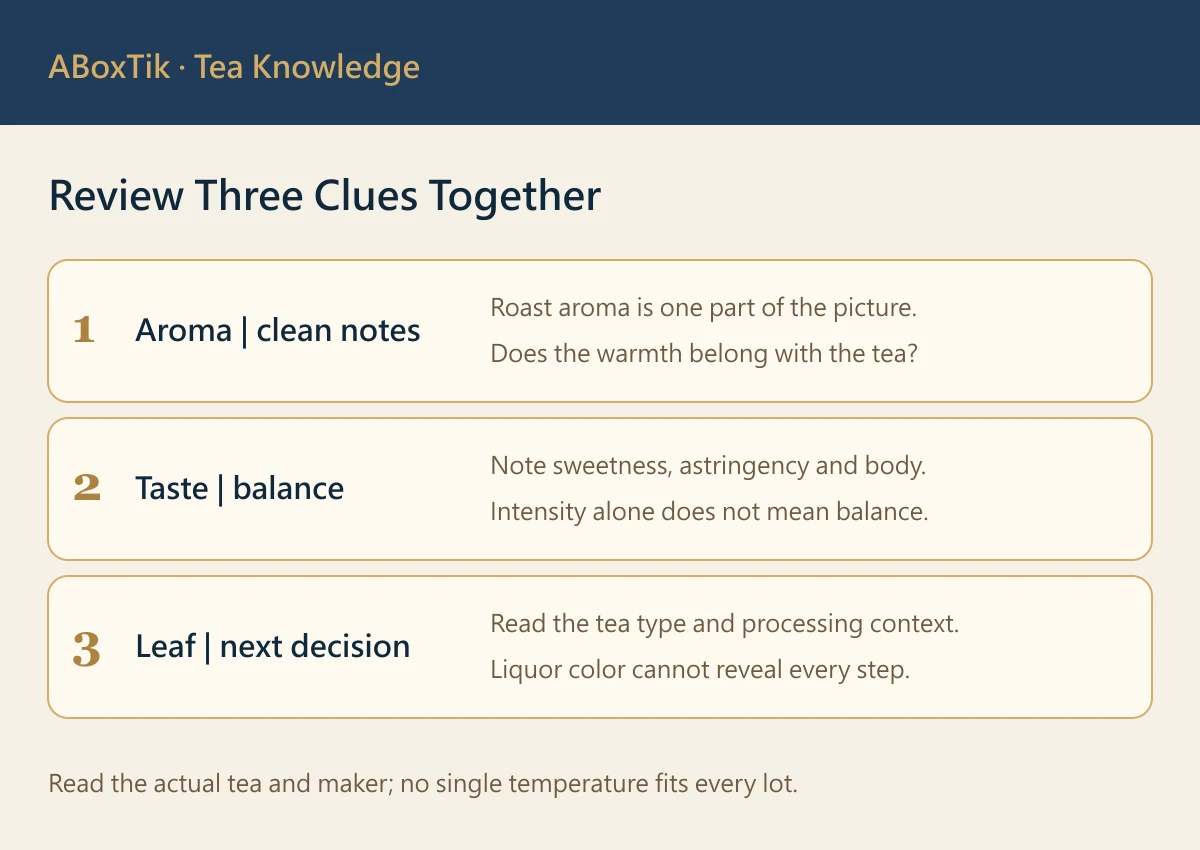
After a first roast, three broad questions can guide a review: is the aroma clean, is the taste balanced, and does the leaf condition suit a next step? Notes may move from fresh to more mature, or toward grain, nut or warm sweetness. Body, astringency and aftertaste matter too. These are not a universal scorecard. They are ways to compare the tea in front of the maker with the direction they have chosen.
At home, the useful parallel is not to turn the oven into a tea workshop. Brew according to the product guidance, smell dry leaf and hot tea, then taste again as the cup cools. Keep aroma, sweetness and astringency in separate notes. The tea aroma smelling guide and brewing guide offer a calm order for doing that. Stable brewing is already enough to make comparison meaningful.
Review and pause: why color is not the whole answer
Tea does not disclose every detail the instant it leaves the heat. A newly heated aroma can be vivid, yet it may not predict the balance in a later cup. Allowing the tea to return to a reviewable state gives aroma, flavor, texture and leaf condition a chance to be considered together. That is one reason two teas described as roasted can feel very different.
A practical question is: does the warmth feel connected to the tea itself? If the cup is only sharp, burnt or bitter, calling it “deep roast” does not explain much. When warmth, tea flavor and texture support each other, there is more to explore. Use our tea flavor guide for vocabulary, and the bitterness and astringency guide to record intensity without turning every strong sensation into a verdict.
For a drinker, clear product information such as tea type, origin, flavor direction and brewing guidance is a sound starting point. Exact production parameters belong to a particular producer, lot, machine and aim. A number without that context is less useful than a trustworthy source and a cup you have brewed with care.
Re-roasting: a possible adjustment, not a compulsory badge
Re-roasting means that, after an earlier treatment and review, another heat-treatment stage may be used. It is not a checkpoint every tea must pass, and it is not a ranking system. Whether it is useful depends on the tea’s current state, the flavor a maker hopes to keep or refine, weather, storage and working judgment. Names and rhythms can differ among tea types and workshops.
Think of it as an edit rather than a boast. Some writing needs a night on the desk; some needs one careful change. Leaves are more sensitive than sentences, of course, so the important point is not “again” but having a reason before and after each stage. Agricultural tea resources discuss drying and roasting within the wider process for the same reason: a setting alone cannot describe the result.
This perspective avoids a familiar shortcut at the tea table. A stronger roast note is not a quality guarantee, and a lighter roast is not the absence of craft. For a roasted-style starting point, explore the current description for Dong Ding Oolong. For a more floral, fresh direction, see Green Jade Oolong. They are entries into different styles, not a controlled experiment with only roasting changed.
Resting after heat: letting the tea find its pace
In tea-making language, resting after roasting can refer to allowing the tea to settle before later review or handling. A Ministry of Agriculture producer case describes roasting followed by this kind of rest, while also showing why the wait cannot be turned into a universal countdown. The length depends on the tea and the maker’s conditions. What has just met heat may not show its settled character immediately.
Waiting still has a purpose. It places judgment at a better moment. The same patience is useful in a cup: dry aroma, hot aroma, first taste and cooler tea each offer a different clue. Follow the aroma sequence to notice that shift. Once a package is opened, good storage continues the work; our tea storage guide covers the everyday handoff.
Bring process knowledge back to the next cup
The best result of learning this sequence is not hunting for a secret number. It is learning to ask better questions. Does this tea suggest grain, nuts or warm sweetness? Does that character fit the liquor? When brewed a little stronger, does it become more complete or simply dry and bitter? Change one variable at a time—leaf amount, time or water temperature—and the answer begins to have shape. Our tea-making steps and rolling guide help connect more of the process.
To compare styles one quiet afternoon, choose two teas from the Classic Taiwan Tea Set, use the same cups and water volume, and keep the first infusion gentle. Write which cup feels closer to the warmth you enjoy. That small record says more than rushing to assign a roast level. Heat becomes meaningful when it leaves a tea balanced enough to invite another sip.
Related reading
- Tea drying and moisture guide: separate moisture control from roasting.
- Roasted tea aroma guide: put useful words to warm notes in the cup.
- Dong Ding Oolong: begin with a current flavor description.
Sources
- Tea and Beverage Research Station: tea-processing topic (accessed 2026-10-14)
- Ministry of Agriculture Knowledgebase: drying, re-drying and roasting (accessed 2026-10-14)
- MOA Farmers Academy: producer case on roasting and resting (accessed 2026-10-14)