
Tea Knowledge
Meishan Tea Regions: A Guide to Ruili, Taihe and Taiping
A little preparation leaves more room to enjoy the tea.
To understand the Meishan tea region, start with the place names in Meishan Township, Chiayi County: Ruili, Taihe and Taiping each offer a different starting point for learning about the area. Then return to the particular tea for its garden, cultivar, harvest, maker and processing information. A place name can orient a reader; it cannot guarantee a fixed aroma, quality or elevation for every package.
It is easy to see “Alishan” and a village name on the same label and wonder which is the real origin. The two names can describe different levels of geography. You do not need to memorise a map before making tea. This guide offers a three-place reference and a practical comparison card; for Shizhuo, Xiding and Zhangshuhu, visit the separate Alishan tea regions comparison.
Meishan, Alishan and village names: read the levels
Meishan is a township in Chiayi County. Ruili, Taihe and Taiping are place names within it. The broader Alishan tea-region concept covers several townships, so a regional name and a more specific local name can appear together without describing exactly the same geographic level. Neither one alone identifies the precise garden where a particular batch grew.
Our Taiwan tea regions guide provides a wider view, while the Alishan tea introduction offers regional background. This article brings the view closer to three Meishan locations. Zhangshuhu is in the Taihe area: seeing both names on a description does not necessarily mean two different origins or two different teas.
| Place | A useful starting point in public information | What to ask next |
|---|---|---|
| Ruili | The National Cultural Memory Bank describes the tea area and its neighbouring places, including Taihe | What garden or producer information corresponds to this batch? |
| Taihe | The official Taiwan Rural Travel site describes local tea houses and lists businesses in the area | What location, harvest and process does this product identify? |
| Taiping | A place name in Meishan Township; identify what the seller means by it | Can the seller provide more specific garden and batch information? |
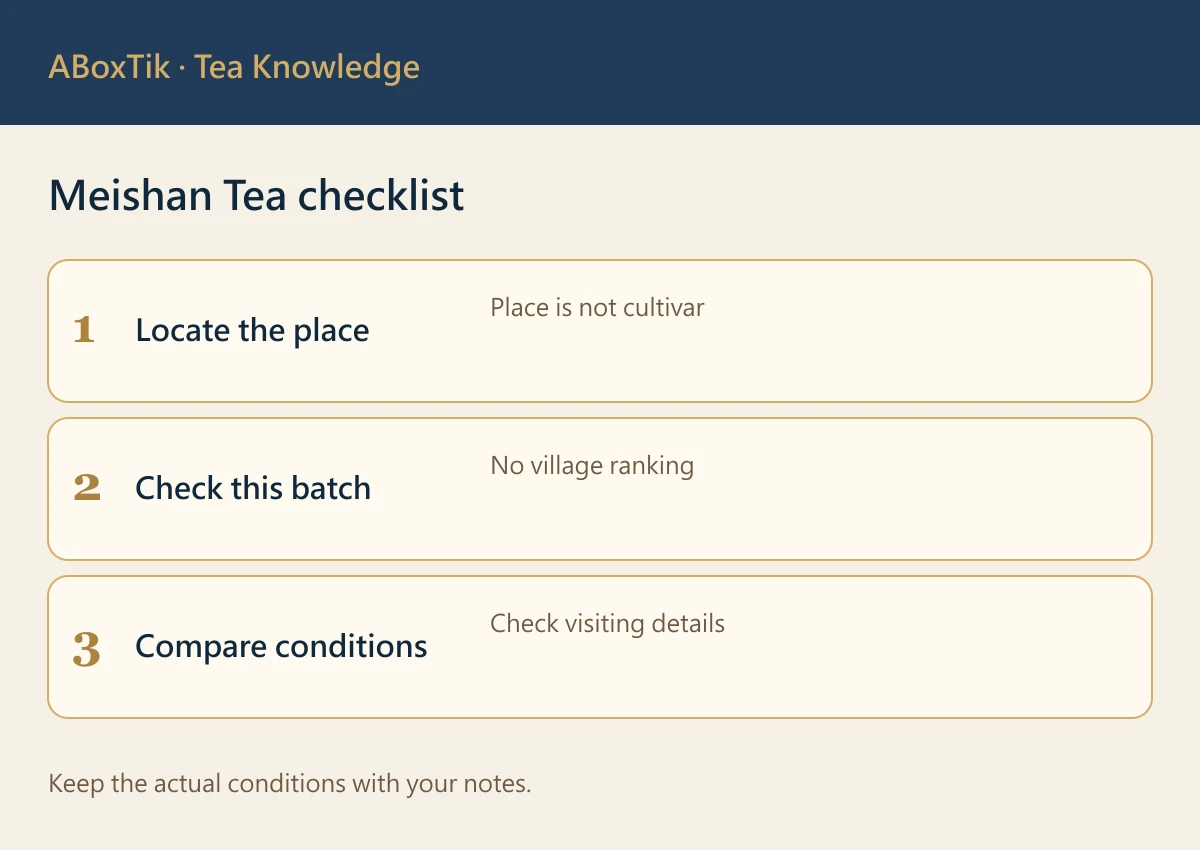
This table is a way to organise questions, not a ranking. A tea-house experience is not evidence of the origin or quality of every product sold in the region. The Alishan National Scenic Area’s tea-region overview provides wider context; a purchase still calls for the specific item’s information.
Ruili: move from an area description to a garden
The National Cultural Memory Bank places the Ruili tea area in southeastern Meishan Township and describes its relationship with neighbouring areas, including Taihe and Ruifeng. That information helps locate Ruili. It does not tell us the slope, cultivar or production conditions of every garden. Two teas carrying the same local name may come from different producers and batches.
Begin with what the packaging actually says: tea name, more specific origin, cultivar, harvest information and the responsible producer or supplier. Ask about missing details rather than silently completing the label yourself. If only “Ruili” appears, treat it as an invitation to ask the next question, not as a flavour profile that must apply to the whole area.
A simple tasting note can keep location and experience separate. Record the tea and brewing conditions first, then describe the aroma and texture you actually notice. Compare those notes with the product description afterward. Our tea aroma guide can help establish a useful sequence without turning a single impression into a claim about an entire village.
Taihe: keep the tea-house story and product evidence distinct
Taiwan Rural Travel, maintained by the Ministry of Agriculture’s agency for rural development and soil and water conservation, describes the development of tea houses in Taihe and the experience of sitting down to drink local tea. Its page also lists businesses in Taihe Village, including addresses in Zhangshuhu. This is a useful glimpse of how a place welcomes visitors, beyond the name on a package.
The same source discusses bamboo-grove tea seating in Ruifeng, a different place from Ruili. Similar English and Chinese names make this distinction easy to miss. Experiences, opening hours and reservation arrangements can change, so contact the individual provider if planning a visit. The setting may enrich a conversation about place, but it does not replace the origin, harvest or processing information for the tea in the cup.
When a product mentions Taihe or Zhangshuhu, ask which garden or producer is involved, what cultivar was used, when the leaf was harvested and how the tea was made. These fields provide a more useful basis for comparison than asking whether every tea from one location is alike. Our high-mountain tea quality guide explores the factors beyond elevation that can matter to a particular tea.
Taiping: let the name begin the conversation
The Alishan National Scenic Area lists Taiping, Ruili and Taihe among Meishan’s tea-producing places. Its Taiping Old Street experience includes tea seating and asks visitors to book by phone in advance. Before planning a visit, confirm the current activity, transport and hosting arrangements. Keep the place name, venue and actual tea garden as separate details.
Taiping is another place name in Meishan Township. When it appears in a tea description, clarify whether it identifies a garden, a producer, a packing location or a place discussed in the product story. A name can serve different functions in different descriptions; knowing which one is intended makes the next question clearer.
Then record the cultivar and batch information available for the actual tea. Leave an empty field when the information is not supplied. A scenic location’s elevation should not be silently assigned to a garden, and neighbouring place names do not establish identical processing or flavour. A useful question is: “Could you tell me the cultivar, harvest and processing direction for this batch?”
Labels and quality terms can also be read alongside, rather than substituted for, origin. The tea quality labels guide explains other questions a buyer may encounter. Neither an attractive label nor a famous place name removes the need to understand what a particular statement covers.
A comparison card for two Meishan teas
Use the same fields for both teas and leave unknown items blank. A blank does not automatically make a tea good or bad; it identifies what you might ask next. The point is to make the comparison understandable when you return to it a week later.
| Record | Tea A | Tea B |
|---|---|---|
| Place on the label and more specific origin | ___ | ___ |
| Cultivar, harvest and batch | ___ | ___ |
| Processing, roasting and storage information | ___ | ___ |
| Leaf, water and steeping used today | ___ | ___ |
| Aroma, texture and personal preference | ___ | ___ |
If your question concerns location, look for teas with reasonably similar cultivars, harvests and processing directions when available. Follow each product’s brewing guidance and make the conditions comparable where practical. If conditions differ, write that down instead of crediting every difference to geography. Our steeping time guide and oolong water temperature guide can help you keep a useful record.
Try the card with two teas you already have. Taste each on its own before reading your previous note, then compare what you wrote. If one aroma is hard to name, a broad word such as “roasted” or “floral” is enough. There is no need to elect a village mayor for your tea cup; the aim is to understand what you enjoy and what remains uncertain.
From a label to the next cup
Before buying, look for the product’s ingredient, origin, producer, net amount, storage and brewing information. If a traceability mark or other label is present, check the scope and the relevant scheme. A statement about one component does not automatically apply to every part of a gift box. The tea traceability guide and Taiwan tea overview provide further context.
You do not have to buy all three places at once. Choose one tea with clear information and a style that suits your routine, record the conditions and your preference, then try another when it makes sense. The Taiwanese tea set and two-box tea bag set can be starting points for exploring different teas; check their current contents and origins and match the item to the origin information supplied for it.
Ruili, Taihe and Taiping are three geographic invitations. Cultivar, season, making and brewing also have a place at the table. Learn more about ABoxTik or compare light and roasted tea when choosing a familiar direction for the next cup.

Related reading for your tea routine
- Notice flavour between infusions
- Brewing tea in a mug
- An office brewing routine
- Choosing tea bags for the office
- Choosing a mixed tea bag gift
- Adjusting steeping time
- Water for brewing tea
- Tea in a thermos
- Whole-leaf tea bags
Sources
- National Cultural Memory Bank: Ruili tea area, Meishan Township — geography and neighbouring areas.
- Taiwan Rural Travel: High-mountain tea in the Ruifeng–Taihe area — Taihe tea houses, Ruifeng experience and local listings; updated 13 February 2026.
- Alishan National Scenic Area: Local flavours — broader Alishan context.