
Tea Knowledge
Tea in Taiwanese Literature: Reading Two Works with Care

When tea appears in a story, begin by returning it to the day its characters are living.
Tea in Taiwanese literature is best approached through works that readers can return to and check. In Chung Chao-cheng’s “Tea-Picking Season,” fresh leaves, picking work and a tea factory become part of the path along which characters meet. In the first volume of Lupin, tea gardens belong to the livelihood of Quanshui Village and to the landscape children notice as they move through it. Tea is not a decorative cup of nostalgia here. It is part of work, waiting and the slow business of understanding a place.
These two works by Chung Chao-cheng offer a reading route through tea labour, a factory visit and village life. Make a cup if you like, then begin with what the characters are doing. There is no need to assign an aroma note to every hillside. A small detail about work or waiting can be enough to keep a reader company.
Begin with two texts that can be checked
A dependable way to discuss tea in literature is not to assemble a long list of famous writers. It is to ask a simpler question: which work actually lets tea take part in its characters’ lives? The official Hakka Cloud digital texts make it possible to return to “Tea-Picking Season” and the first volume of Lupin. The former brings spring picking, tea leaf handling and a factory into the movement of the story; the latter places tea gardens within village livelihood and childhood observation. Those two routes already offer plenty to notice without inventing extra scenes for either book.
It also helps to keep literature, tea history and brand storytelling on separate shelves. For a basic map of tea categories, see the six tea categories and their processes. For a starting point on aroma and taste, begin with where tea aroma and flavour come from. Useful knowledge is a bookmark: it helps us return to the page, but it should not rush ahead and speak for the novel.
In “Tea-Picking Season,” tea first travels as work
At the opening of “Tea-Picking Season,” the narrator gathers fresh leaves during the first spring harvest and takes them by bicycle to a tea factory in town to sell. The act is modest, yet it keeps tea from remaining only in the garden. It connects picking, transport, trade and the hour of going home. At this point, it is worth noticing how a day is arranged for the people in the story, rather than quickly turning a bicycle load of tea leaves into an abstract symbol of mountain life.
Later, Gui takes part in the world of picking and approaches the tea garden with curiosity. Her attention brings the work of harvest, its physical demands and the rhythm of the garden into view. Tea becomes part of care, work and the process by which people come to understand one another. It has fragrance, certainly, but it also has sore fingers and tasks that do not wait. That reading carries more of the text’s weight than a tidy “tea country” label ever could.
If a reader would like to make tea alongside the book, starting with the package guidance and a simple steeping-time adjustment method is enough. The cup does not need to reproduce a character’s life. If it helps you stay with the page, it is doing its job beautifully.
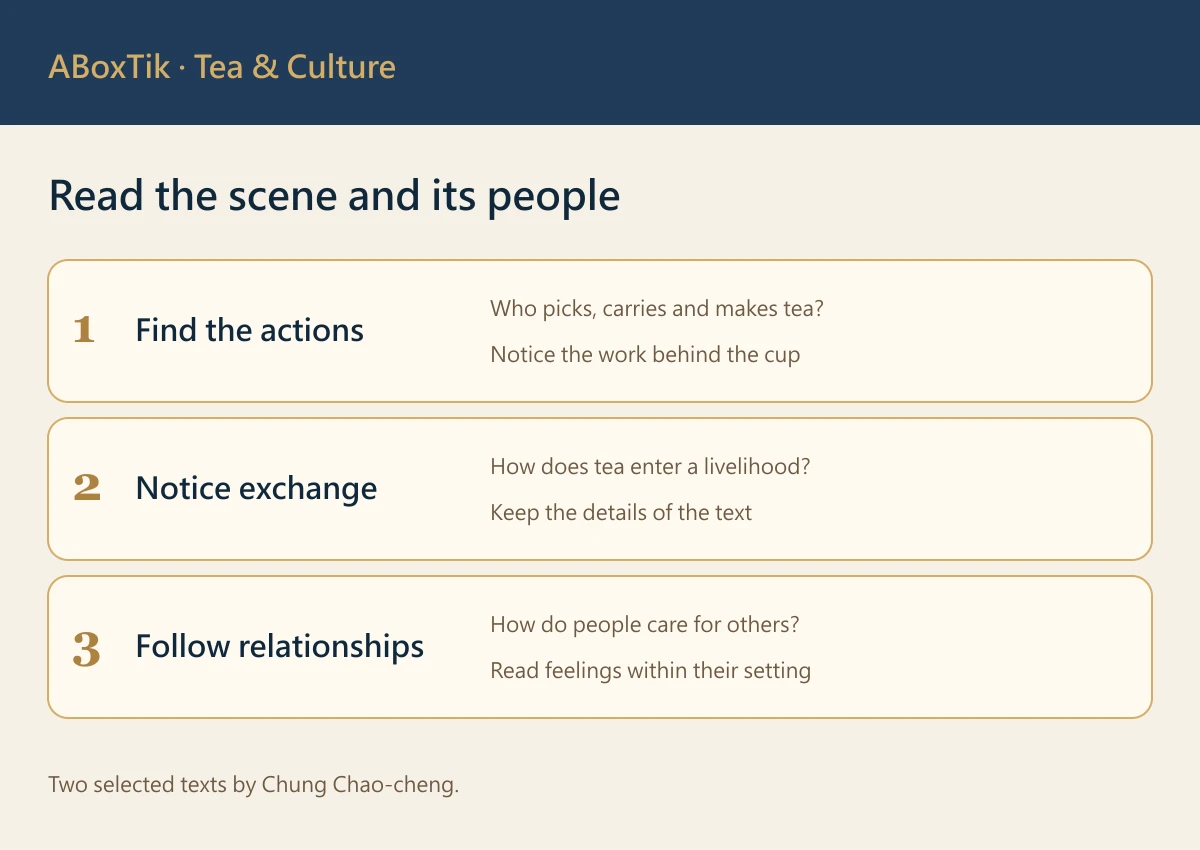
The factory scene makes process visible as labour
In “Tea-Picking Season,” Gui visits a tea factory with the narrator and sees leaves being spread, handled, heated, rolled, dried, sorted and stored. The scene is not a complete modern manual of tea manufacture. Instead, it lets readers follow a newcomer’s attention and recognize how many movements take place before tea reaches a cup. The leaves have already passed through hands, heat and waiting long before anyone begins to discuss their finish.
That is why the scene need not be converted line by line into technical specifications. Its literary work is to give surprise, understanding and human connection somewhere tangible to stand. Readers who would like additional process context can explore how rolling shapes tea leaves and their brewing behaviour, then return to the story with a clearer sense of the difference between supporting knowledge and the scene itself.
For a reading group, one gentle question is enough: “Which action makes tea feel like more than a finished product?” Each person can choose one process and one response. This is not a tea-factory entrance exam. Nobody needs to re-steep their answer.
In Lupin, the tea garden holds livelihood and a child’s view
The first volume of Lupin places the terrain of Quanshui Village, cultivation and tea-growing livelihood beside one another. Tea gardens are not merely distant scenery. They recur around the characters’ ordinary movements. These passages let us see that local livelihood is not a painted backdrop: it affects how people work, how they speak about the ground in front of them, and how a child learns to recognize a village.
That does not make Lupin a novel solely about tea. A closer reading is that the tea garden offers a continuing scene of life, bringing childhood observation near to the work of adults. When children pass through, pause near or notice the garden, readers are invited to see that local life is made not only of large events, but also of a landscape that keeps being there each day.
To extend this reading into present-day tea appreciation, Taiwanese tea’s terroir and craft offers a wider orientation. It should not, however, be used to dictate how the novel must be read. Literature preserves a world as its characters encounter it; tea knowledge supplies another map.
What becomes visible when the two works are read together
Both works bring tea close to local life, yet they do so differently. “Tea-Picking Season” uses the handling of fresh leaves, picking and a factory visit to carry the movement of relationships. Lupin makes the tea garden a place where village livelihood and a child’s observation share the same ground. Read together, they show how tea can be the content of labour and also part of the landscape in which everyday life unfolds.
Try placing one passage from each work side by side: who is looking at the garden, who is working, and what happens next? Record the work and the passage beside the observation. The paired notes let a reading group compare scenes without losing the people and actions that made each one memorable.
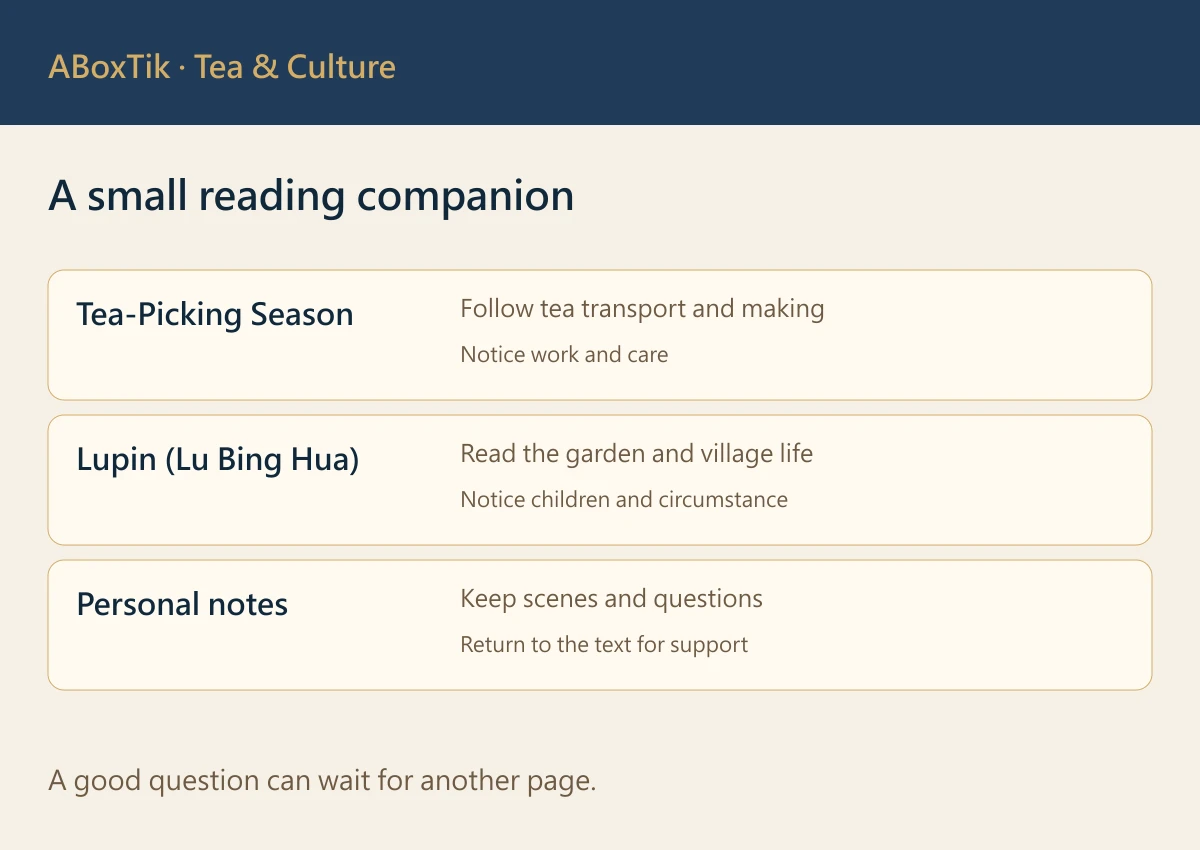
A practical reading-and-tea table: give each response its place
A page and a cup do not have to be finished in one sitting. On a quiet afternoon, try keeping a small reading note beside a small tea note. One column can record what the text shows; the other can record what you notice in the cup. This does not pretend that a personal aroma impression is evidence about a novel. It simply gives two kinds of attention room to illuminate one another.
| Reading moment | A text question to notice | A gentle cup practice |
|---|---|---|
| When a tea garden appears | Who is looking, and how is the garden tied to life? | Smell the dry leaves and write one immediate word. |
| When picking or processing appears | Which actions reveal time and labour? | Brew the first cup by the package guidance; do not adjust everything at once. |
| After a section ends | What remains: a person, a place or a relationship? | Note strength and texture; change only one condition next time. |
For aroma, follow a sequence from dry aroma to warm and cool aroma. If the tea feels too strong, return to adjusting one brewing condition at a time. Reading notes work much the same way: one reliable observation is more useful than a page crowded with beautiful but uncertain words.
Preparing tea for a reading is not the same as staging an examination
For two or three people reading together, one tea with clear information and an easy way to share is enough. Let everyone read a short section first, then share one detail of life they noticed. Only afterwards turn to aroma or texture in the cup. This sequence allows tea to stay nearby without volunteering to narrate the book. If the tea goes cool, it usually means the conversation was good; no tea deity is keeping score.
For a relaxed tasting, the Classic Taiwan Tea Four-Tea Set provides a clear entrance to several styles, while the Two-Box Tea Bag Gift Set can make sharing straightforward. If someone wants to continue with a cultivar after the reading, the Jinxuan Oolong product information is a useful next stop; current specifications and availability are always shown on the product page.
For a reader who would appreciate a gift, the questions to ask before choosing a tea gift box can bring the choice back to their usual teaware and flavour preferences, rather than guessing what a bookish person ought to enjoy. The most thoughtful detail is often a small brewing card, leaving them the time to open the tea when they are ready.

Follow a Box of Tea
Let one cup accompany a slower page
At ABoxTik, we believe tea deserves to be understood and to have a place in the rhythm of ordinary life. From the busy route in “Tea-Picking Season” to a child’s view beside the tea gardens in Lupin, these two works remind us that a tea story often begins before the cup: it begins where someone is living.
Next time, choose one passage, brew one cup and leave two lines of notes. To continue with the social setting of tea, read how tea welcomes guests in Taiwan. To care for the tea already at hand, begin with guidance for storing tea after opening.
Related reading
- Use an aroma sequence to let a cup unfold slowly
- See how tea moves from rolling to brewing
- Return to a wider map of Taiwanese tea terroir and craft
Sources
- Hakka Cloud: Full text of Chung Chao-cheng’s “Tea-Picking Season”
- Hakka Cloud: Full text of the first volume of Chung Chao-cheng’s Lupin
Sources checked 19 October 2026.