
Tea Knowledge
TTES No. 19 Biyu: A Gentle Guide to This Taiwanese Tea Cultivar
A tea name is a small invitation. Read it with care, leave a little time for the cup, and a familiar-looking word can open a new conversation with Taiwanese tea.
TTES No. 19 Biyu is a Taiwanese tea cultivar suited to partially oxidised tea, including pouchong and oolong styles. It is distinct from TTES No. 13 Cuiyu, often sold as Green Jade oolong. If the names feel similar, begin with the cultivar number, then read the origin, harvest and processing details. That simple order makes choosing considerably easier.
What is TTES No. 19 Biyu?
Taiwan’s Tea and Beverage Research Station identifies Biyu as TTES No. 19. Its mother parent is TTES No. 12 Jinxuan and its father parent is Qingxin oolong. Named in 2004, it is a small-leaf cultivar. These details tell us about the tea plant behind the leaf; they do not identify a growing region or guarantee the taste of a finished tea.
Jinxuan is part of Biyu’s parentage, but Biyu remains a cultivar in its own right. A family connection does not mean that every Biyu lot will have the milky aroma associated with some Jinxuan teas. Our Jinxuan cultivar and aroma guide offers a useful next step if that relationship interests you. Keep ancestry as background, then let the actual lot supply the tasting details.
At ABoxTik, we find it helpful to give each label a different job: the cultivar identifies the plant, while the product description explains the tea in the packet. For a wider view, what makes Taiwanese tea distinctive connects plant breeding with place and craft. Returning to the small print is easier once those pieces have somewhere to fit.
What tea can Biyu make?
The Research Station lists Biyu as suitable for partially oxidised tea. The National Taiwan Science Education Center presents lightly fragrant, strip-shaped pouchong and ball-shaped oolong as common directions. Those are sensible styles to ask about when looking for an introductory Biyu tea. Suitability is a starting point for understanding the cultivar, rather than a requirement that every tea maker produce the same result.
A cultivar answers “which tea plant?” Processing answers “how was the leaf made into tea?” Leaf shape is another piece of information: rolled balls or longer strips do not establish that the raw material is Biyu. If these terms are new, our guide to tea types provides context. The articles on oolong oxidation and roasting and aroma then help separate two processing decisions that are easily confused.
There is no need to begin by searching for the single most authentic flavour. If bright floral teas are already comfortable territory, ask the seller about a floral, lightly roasted Biyu lot. If you prefer a quieter, deeper cup, ask whether another processing style is available. A description of the actual tea is more useful than the cultivar name alone.
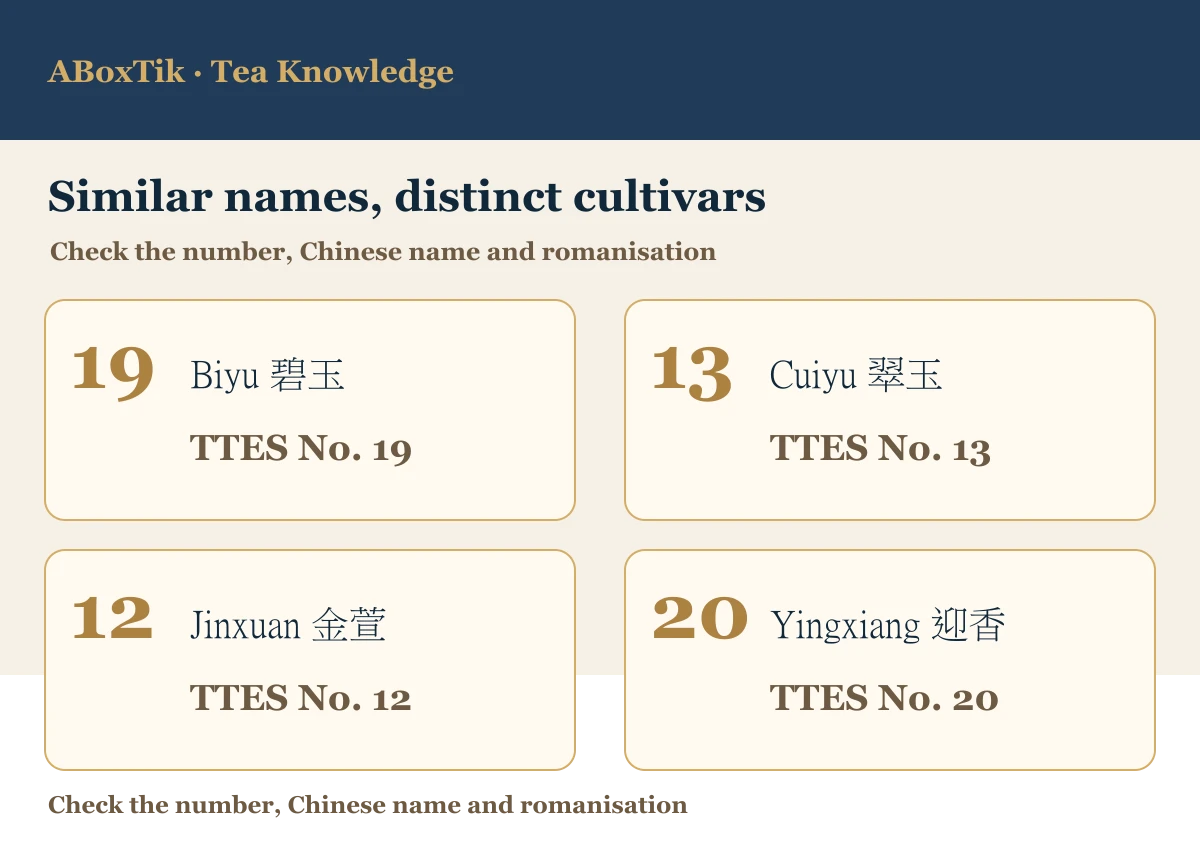
Biyu, Cuiyu, Jinxuan and Yingxiang: reading the names
| Name | Number | What to remember |
|---|---|---|
| Biyu 碧玉 | TTES No. 19 | A cross of Jinxuan and Qingxin oolong; suited to partially oxidised tea. |
| Cuiyu 翠玉 | TTES No. 13 | A separate cultivar, often called Green Jade. |
| Jinxuan 金萱 | TTES No. 12 | Biyu’s mother parent, with its own cultivar identity. |
| Yingxiang 迎香 | TTES No. 20 | Another cultivar suited to partially oxidised tea; the number is not a quality ranking. |
Both Biyu and Cuiyu contain the Chinese character 玉, associated with jade. An English label using only “Jade Oolong” can therefore leave an important question unanswered. Check the Chinese name, romanisation and number together: Biyu with 19, Cuiyu with 13. If the packet gives only an English marketing name, a short question to the seller can clear things up.
This table is a name reference, rather than a tasting competition. Our Green Jade oolong article covers Cuiyu, TTES No. 13. Keeping that distinction makes both stories easier to follow and prevents a well-known product name from quietly replacing a different cultivar.
How should you approach Biyu’s floral aroma?
The Science Education Center mentions floral aroma in its Biyu introduction. Treat this as a direction to notice, with room for differences between finished teas. There is no need to identify a particular flower before deciding whether a cup is enjoyable. Processing, storage and brewing still belong beside the cultivar when considering what a lot tastes like.
For a first cup, smell the warm lid, taste a little tea, then return when it has cooled slightly. Simple notes such as “clear aroma,” “light body” or “stronger than I prefer” are useful. They describe a real experience without forcing it into a flower name. Our tea aroma observation guide offers a sequence if a little structure would help.
Origin and harvest are also worth asking about. Use our Taiwan tea regions guide as geographical background, then read the specific lot description. Altitude or season alone is not enough to decide how much you will enjoy a tea.
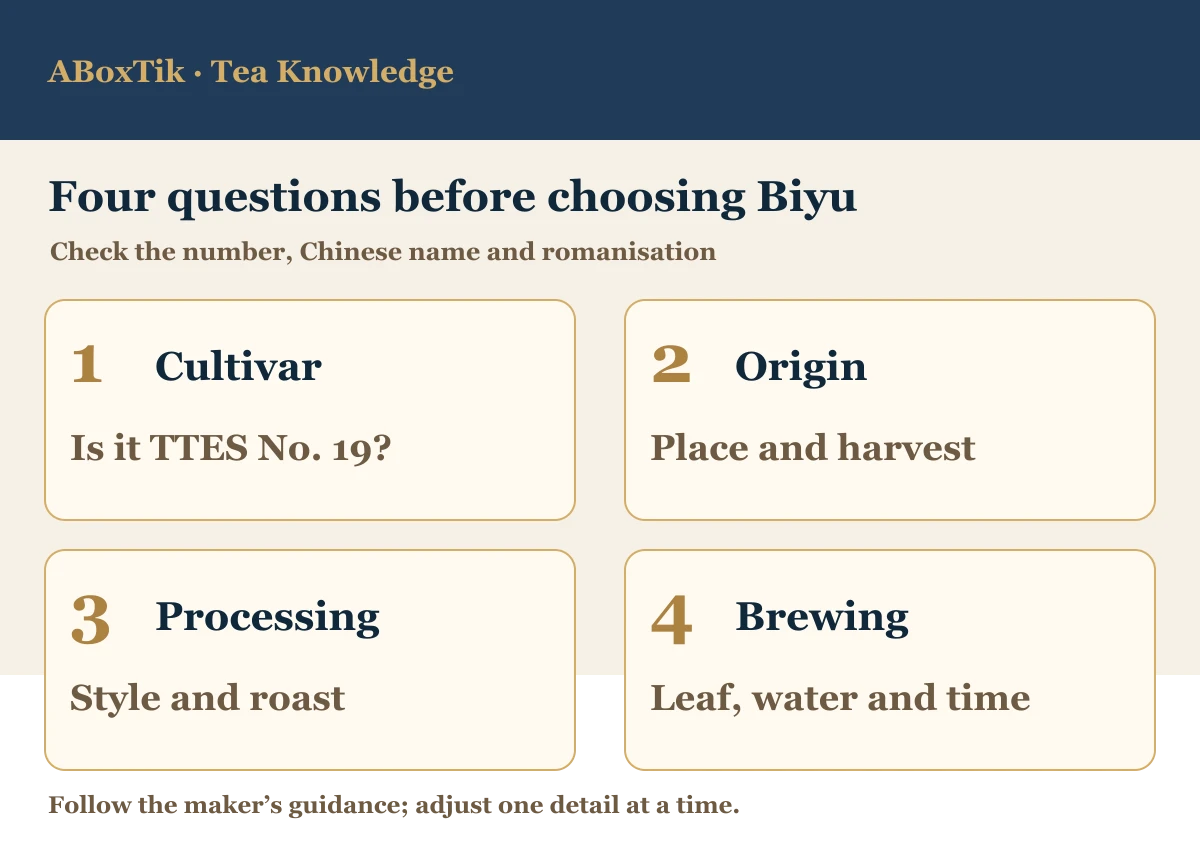
Four questions to ask before buying Biyu
- Is the cultivar identified as TTES No. 19? If the label says only Biyu tea, ask for clarification. For a blend, ask how its ingredients are described.
- Where was it grown, and which harvest is it? Recording origin and season helps when looking for a similar lot later.
- Is it pouchong, lightly fragrant oolong or another style? Ask about roasting too, so expectations match the finished tea.
- Which brewing vessel does the advice assume? Leaf quantity, water volume and time should make sense together.
These questions need no specialist vocabulary. Put the answers on one small card before comparing two packets. If one seller provides origin, cultivar and processing while another gives only an attractive name, fill the information gap first. A higher price cannot supply the missing answers. Our tea price and value guide explores that decision in more detail.
For a gift, consider the recipient’s everyday cup or teapot. Clear brewing instructions may be more welcoming than a long list of aroma terms. The Taiwanese tea starter set guide helps connect the choice to how the tea will actually be used.
Brewing the first cup: keep a repeatable starting point
Begin with the packet or maker’s instructions and note the vessel capacity, leaf quantity, water temperature and steeping time. If advice is incomplete, ask the seller rather than borrowing numbers from a different Jinxuan or Cuiyu tea. The same steeping time can produce a different result in another vessel or with a different leaf shape.
Next, change one detail. If the tea feels too strong or astringent, shorten the infusion first; if it feels weak, extend it slightly. When exploring temperature or leaf quantity, hold the other details steady so the difference is easier to understand. Our guides to oolong water temperature and steeping time offer more context.
A useful record can be short: date, four brewing details and one sentence about the cup. Once a comfortable strength emerges, the next brew has a familiar starting point. Reseal opened tea and keep it dry, away from light and strong smells, to look after the next cup as well.
Common questions about Biyu
Is Biyu the same as Green Jade oolong?
Biyu is TTES No. 19; Cuiyu, commonly called Green Jade, is TTES No. 13. Confirm the cultivar number when an English tea name is ambiguous.
Does Biyu necessarily taste milky?
No. Jinxuan is its mother parent, but Biyu is a separate cultivar. Parentage does not replace the flavour description of the actual lot.
Can leaf appearance or liquor colour identify Biyu?
Appearance alone is not a reliable buying method. Use cultivar and source information for identity, and the cup for understanding style and preference.
Follow ABoxTik
Let one tea name become a comfortable next step
Learning about Biyu does not require buying every cultivar. Begin by distinguishing it from Cuiyu, then try a clearly described tea that suits your preferences. Familiar ABoxTik teas can also help practise reading cultivar and processing information side by side:
- Green Jade oolong: explore TTES No. 13 and the current product description.
- Jinxuan oolong: meet Biyu’s mother parent and the roasted, sugar-sweet direction described for this product.
Each has its own identity. Keep the name and number with the packet, add a simple brewing note when sharing, and the introduction can feel as welcoming as the cup itself.
Sources
Editorial sources checked: 7 October 2026.