
Tea, Tea Bag, Tea Knowledge
Pyramid Tea Bags vs Regular Tea Bags: Space, Leaf Size, and Flavor
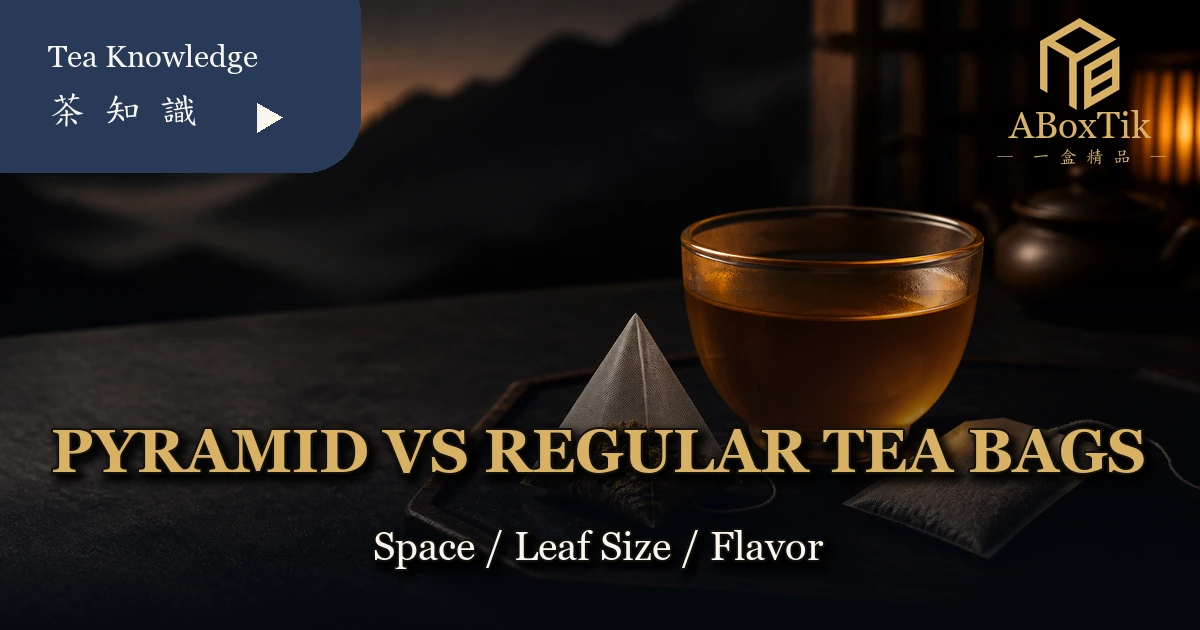
Even a small tea bag needs to leave room for the leaf. When water enters and the leaves begin to open, a landscape of aroma finally has space to wake.
Pyramid tea bags usually offer more usable internal space than traditional flat tea bags, giving larger or rolled leaves room to absorb water and allowing water to circulate around them. But the triangular shape alone does not make a better cup. Tea quality, leaf size, the amount packed into the bag, filter permeability, water temperature, time, and water volume all matter.
A pyramid bag filled too tightly can still restrict expansion. A well-sized flat bag paired with smaller leaf particles can brew quickly and consistently. This guide therefore compares how the formats actually work rather than treating one silhouette as a quality guarantee. If you are still mapping the broader category, begin with our guide to types of tea bags or browse ABoxTik’s Taiwanese tea bag collection.
Pyramid tea bags vs regular tea bags: five differences that matter
| Factor | Pyramid tea bag | Traditional flat tea bag | What to examine |
|---|---|---|---|
| Usable space | Usually offers more three-dimensional room | Usually has a flatter chamber | Whether wet leaves still have room to expand—not shape alone |
| Typical leaf form | Often used for rolled, wiry, or visibly larger leaves | Often used for broken or finely cut tea | Leaf form is not a grade; provenance and processing still count |
| Extraction speed | Depends on leaf size and water movement | Fine particles often infuse faster | Particle size, loading, temperature, and time matter more than the label |
| Use case | Useful when drinkers want visible whole-leaf expansion | Useful for fast, repeatable everyday brewing | Office, travel, hot brew, and cold brew have different priorities |
| Buying decision | Both should clearly identify the tea, net weight, filter material, heat guidance, storage, and brewing method | No bag shape replaces transparent information | |
A study published in Food Chemistry compared tea bag sizes and shapes. Extraction increased as bag size increased until the ratio of leaf size to bag size reached an effective range; under the study conditions, bag shape itself had no influence on infusion rate. In other words, the practical value of a pyramid is not triangular geometry. It is the usable headroom the format can provide when the tea is loaded appropriately.
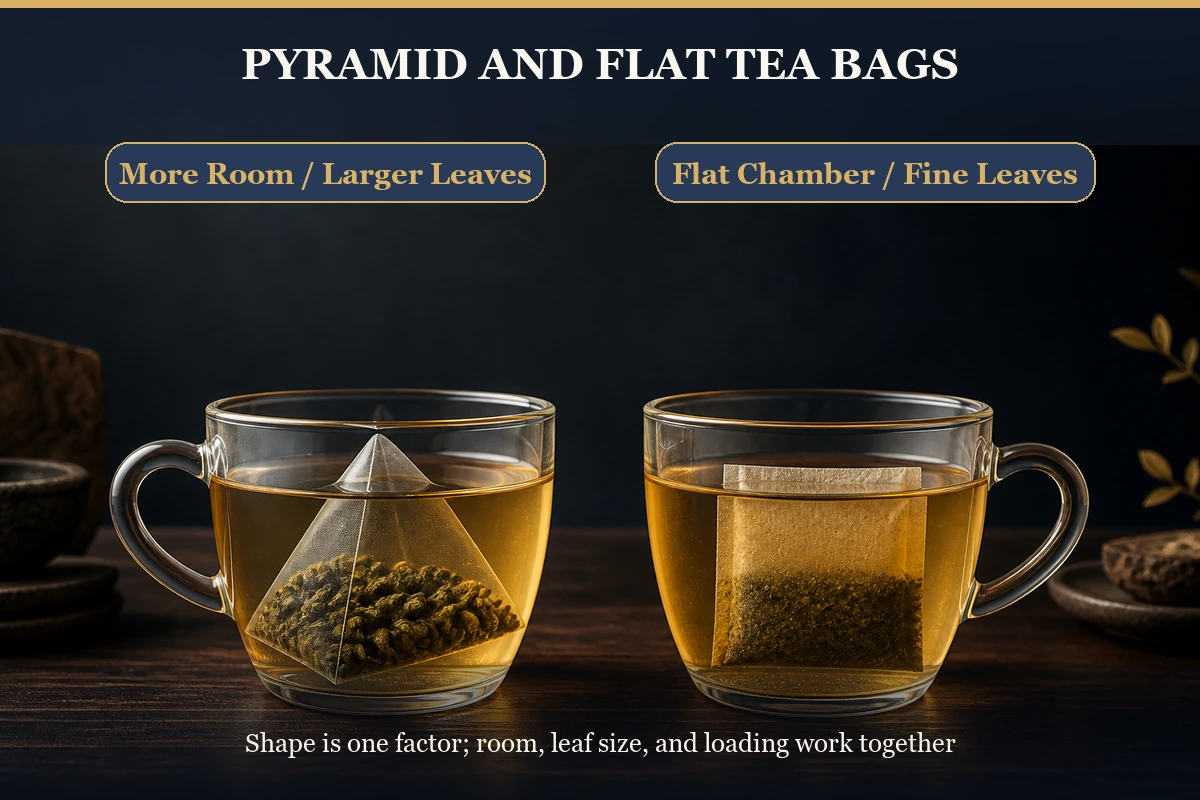
Look first at usable room after the leaves become wet, then at leaf size, loading, and filter material. Shape is only one part of the system.
The bag sets a boundary, water creates the path, and the leaves open at their own pace. Flavor has never been the work of one shape alone.
Do pyramid tea bags really taste better?
Brewing inside a tea bag is a sequence. Water enters the filter, dry leaves absorb it and swell, soluble compounds move out of the leaf, and the infusion passes through the bed of tea and the filter into the cup. Research on swelling and infusion in tea bags identifies factors including particle size, loading, temperature, agitation, and the bag itself. If tightly rolled oolong is crowded into a small chamber, expansion and fluid movement may be constrained. Smaller particles, meanwhile, expose more surface area and often extract faster, so they may become strong or astringent sooner.
That also means “whole leaf is always superior” is too simple. Finely cut tea can deliver fast and consistent extraction, which is useful when brewing time is short. Larger leaves preserve more visible structure and may reveal changes across repeated infusions. To understand why rolled Taiwanese oolong needs room, see our overview of Taiwan’s major tea styles. For the relationship between craft and flavor, continue with our guide to oolong oxidation and leaf-tossing.
Which teas benefit most from a pyramid bag?
Rolled oolong, wiry whole-leaf tea, and visible herbal pieces can make practical use of a larger three-dimensional chamber. Taiwanese high-mountain oolong and Sijichun are compact when dry, then expand considerably in water. A useful pyramid bag should therefore show some empty room before brewing rather than looking impressively full. For regional context, compare the mountain environments in our Taiwan tea regions guide and Alishan tea area comparison.
Finely cut black tea, breakfast blends, and formulas designed for fast strength do not become inferior because they use a flat bag. Small particles are intentionally efficient. When the raw material, storage, and instructions are transparent, a flat format may fit a commute or a busy office very well. Readers interested in Taiwanese black tea can explore TTES No. 8 Assam black tea to see why cultivar and processing tell us more than packaging shape.
ABoxTik’s four-flavor Taiwanese tea bag gift set presents tea in 2.5-gram pyramid bags. The goal is not to let the format stand in for the leaf, but to balance convenience with room for Taiwanese tea to open. If you would like to compare loose leaf with easy-to-serve formats, the Classic Taiwan Tea four-box gift set can help you choose according to equipment, time, and gifting context.
How to brew pyramid tea bags hot or cold
The product’s own directions should come first because leaf style and loading vary. When no detailed guidance is available, start with one bag in approximately 250 ml of water and adjust one variable at a time:
- Hot-brewed oolong: Begin near 90°C for about two minutes. If it tastes light, add roughly 30 seconds before changing temperature and time together. For black tea, water just off the boil often works, but finely cut leaves may strengthen quickly.
- Cold brew: A practical starting ratio is around 1 gram of tea to 100 ml of water, refrigerated for four to eight hours. A 2.5-gram bag can begin with roughly 250–350 ml of cold water. Keep the finished tea refrigerated and drink it promptly. Our cold-brew tea guide explains the method in more detail.
- Help water move: Lift the bag gently once after pouring. There is no need to keep squeezing it. If it floats, make sure the bag is intact and give it time to become fully submerged.
- Taste before adjusting: Shorten the time first if the cup is too strong or astringent. If aroma is thin, reduce the water volume or extend the infusion in the next trial. See our tea temperature and timing guide for the underlying principles.
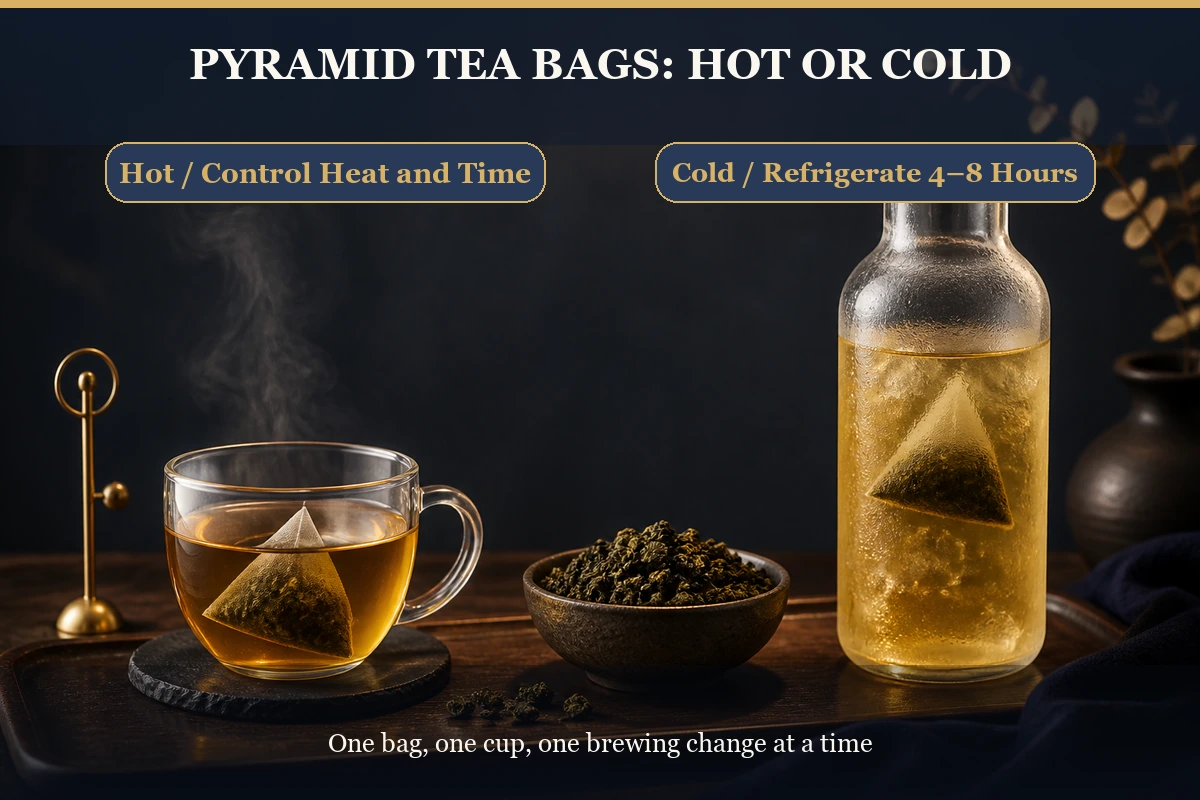
One bag, one cup, one change at a time: controlled adjustments are more useful than chasing a single universal recipe.
A 30-second checklist for buying pyramid tea bags
- Is the tea identified clearly? Look for the tea name, origin or ingredient source, net weight, and manufacturer information—not only words such as “premium” or “high mountain.”
- Is there real room inside? Dry leaves should not pack the chamber completely. Rolled oolong in particular needs headroom once it absorbs water.
- Are the filter and heat limits disclosed? Pyramid bags can be made from several materials, so broad claims about all of them are unreliable. Check the manufacturer’s material and heat-use information and follow the label.
- Are the brewing instructions specific? Water volume, temperature, and time help you reproduce a cup; “add hot water” does not.
- Does the package protect aroma? Tea is sensitive to moisture, light, and surrounding odors. Individually wrapped bags still belong in a cool, dry place. Review our tea storage guide for a fuller checklist.
For a gift, consider the drinker’s equipment and routine as well. A frequent traveler may value individually wrapped bags, while someone who enjoys watching leaves open may prefer a whole-leaf pyramid bag or loose tea. Our guides to choosing a premium tea gift box and understanding a limited-edition tea set can help connect format, quantity, and occasion.
Frequently asked questions about pyramid tea bags
Do pyramid tea bags always contain whole leaves?
No. A roomy bag can hold larger or rolled leaves, but it can also contain broken tea or a flavored blend. Examine the ingredient information, the dry tea, and the infused leaf instead of assuming quality from the silhouette.
Can a pyramid tea bag be steeped more than once?
Sometimes. Rolled or larger-leaf oolong may have enough material for another infusion, depending on dose and the first steep. Finely cut tea may give most of its strength in the first cup. Use fresh hot water and judge aroma and flavor rather than forcing a fixed number of infusions.
Are pyramid tea bags suitable for cold brew?
Many pure teas are, but check the product instructions. Use drinking water and a clean container, brew in the refrigerator, keep the finished tea chilled, and consume it promptly. Drinks containing milk, sugar, or fresh fruit require different food-safety handling.
Are pyramid tea bag materials safe in hot water?
Shape does not identify material. Products may use nylon, PET, PLA, or other filter media. A shopper cannot assess every material from appearance alone, so look for clear material and heat-use information and follow the manufacturer’s directions. Ask the brand when the labeling is incomplete.

Discover Taiwan, one cup at a time
Choose a bag that suits the leaf—and a tea that suits your day
The useful question is not whether pyramid tea bags look more premium. It is whether the chamber matches the leaf form and dose. A traditional flat bag is not obsolete; it is another tool, often optimized for speed and consistency. Read the tea, filter, and brewing information, then compare the formats with the same water volume and timing. That small test will tell you more than the package shape.
ABoxTik works to bring high-quality Taiwanese goods and tea culture to a wider audience. For tea bags, that means preserving traceable information, practical brewing, and enough room for the selected leaf—even on a busy day. Explore our Taiwanese premium tea bags and find a cup you will be glad to make part of your routine.
Sources
- Food Chemistry: Kinetics of tea infusion. Part 3 — the effect of tea bag size and shape (checked 2026-08-28)
- Journal of Food Engineering: Swelling and infusion of tea in tea bags (checked 2026-08-28)
- Taiwan Food and Drug Administration: material and heat labeling for food-contact plastic packaging (checked 2026-08-28)